Mail-Order STI Tests Make You Collect First, Find Care Later
A self-collected swab can spare you a waiting room. It also turns specimen quality, timing, shipping, and the first treatment decision into jobs you manage alone.
August 27, 2026 · 8 min read

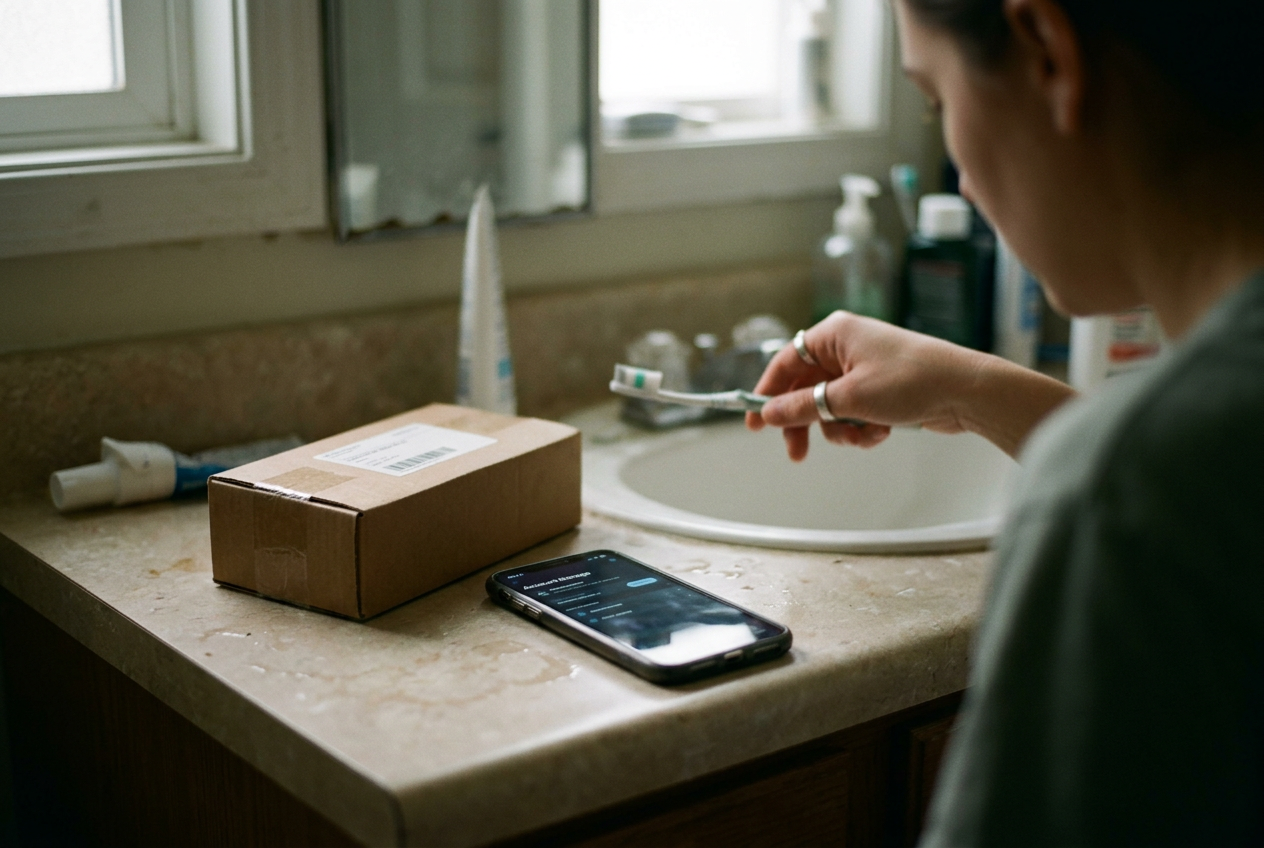
The decisive object in the kit I handled was a scored plastic swab stem. After collecting a vaginal sample, I had to lower the swab into a transport tube, snap the shaft at its marked line, seal the cap, and trust that the bit now carrying biological evidence had landed where it belonged.
The swab was not difficult to use. That is part of the pitch, and the pitch is broadly right. No receptionist. No paper gown.
No conversation conducted while somebody stands with one hand on the door. Mail-order testing can reduce the embarrassment, scheduling trouble, transportation costs, and clinical judgment that still attach themselves to routine sexual health care.
But the scored stem reveals the bargain. The company has not removed the clinic so much as disassembled it, packed some of its functions into a cardboard box, and assigned them to the customer. You become the person who identifies the correct anatomical site, collects enough material without contaminating it, labels the sample, packages regulated biological matter, gets it into the mail, waits, interprets the result language, and locates care if the screen turns unwelcome.
Convenience is labor transfer with decent packaging.
The bathroom becomes the collection room
A vaginal swab is less technically demanding than drawing blood. It still asks for a sequence of small decisions that a clinician would normally supervise or absorb. Wash your hands. Do not touch the soft tip.
Insert the swab far enough. Rotate it as directed. Keep it away from the sink, counter, toilet, towel, and every other surface in the room. Then snap that stem without spilling the transport liquid or flicking the sample onto the floor.
The instructions I handled used diagrams and compact blocks of text. They were readable, but readability is not the same as reassurance. A clinic can notice hesitation, clarify which opening an instruction means, replace a dropped swab, or explain whether menstruation, recent sex, medication, or vaginal products matter for that particular test. A leaflet must anticipate every point of confusion without becoming so long that the customer stops reading it.
This is where the home kit’s clean visual language starts doing institutional work. White space and numbered panels make collection feel settled, even though the customer cannot assess specimen adequacy, meaning whether enough usable material reached the tube. You can follow every visible step and still have no independent sign that the sample was good. The scored stem snaps.
The cap closes. Nothing confirms the biology.
Laboratories can reject a leaking, mislabeled, delayed, or otherwise unusable specimen. More ambiguous failures are harder. A negative result may reflect no detected infection, collection at the wrong site, testing too soon after exposure, or a sample problem that did not trigger formal rejection. Nucleic acid amplification testing, usually shortened to NAAT, looks for genetic material from an organism and can perform well on self-collected swabs when the test and collection method are appropriate.
The customer still has to choose the right test for the body parts and exposures involved.
A vaginal sample does not answer every question about a throat or rectum. A broad product label such as an STI panel can flatten those distinctions at the exact moment they matter. The box arrives as one object, but sexual exposure does not organize itself according to packaging.
Shipping is part of the test
Once the swab stem sat inside its tube, the medical procedure became a logistics procedure. I sealed the inner packaging, checked the identifiers, and fitted everything into the return mailer. The customer now depends on collection schedules, transit conditions, laboratory intake, and the company’s ability to match the physical tube to the digital order.
Clinics deal with couriers and specimen tracking too. The difference is that their staff know what a delay looks like and who to call. At home, the customer receives status language. Registered.
Shipped. Received. Processing. Those labels reduce uncertainty, but they can also obscure where responsibility sits when a parcel stalls or a barcode fails.
The service may have sold the order, another company may run the lab, a carrier moves the sample, and a separate clinician network may handle treatment.
That divided chain is central to the business. Mail-order testing companies can concentrate on customer acquisition, software, fulfillment, and access to partner laboratories rather than maintaining neighborhood clinics with examination rooms and staff. The customer pays for discretion and reduced friction. The company saves by standardizing the encounter, especially when most users need no live clinical time.
That arrangement works best for the uncomplicated negative. A clean result can move through the system without anybody entering the room, virtual or otherwise. The user gets a notification, signs in, reads a line of text, and leaves. Automation has done something useful.
The scored swab stem has completed its little journey.
A result is not the same as care
Result delivery is where the service shows what it believes it sold. A laboratory answer can identify detected or not detected. Care requires context: whether the tested sites matched the exposure, whether the timing made sense, whether symptoms need separate assessment, whether a result requires confirmation, how treatment is obtained, and what happens to partners.
The result materials I reviewed handled the laboratory category more cleanly than the messy next step. This is common to digital health design. A status fits inside a colored box. Clinical judgment does not.
When follow-up language sits behind another link, switches to generic educational copy, or points the customer toward an unspecified health care provider, the company returns the difficult part to the person whose reason for buying the kit may have been difficulty accessing one.
A positive result changes the emotional and practical conditions of reading. The customer may be at work, in bed beside a partner, or alone late at night. They may need treatment, a confirmatory test, prompt assessment of symptoms, or a conversation about recent partners. Even accurate language can fail if it offers no visible route from result to action.
The distinction between “clinician reviewed” and “clinician available” matters here. Review can mean that an authorized professional approved or released the laboratory result. Availability means the customer can reach somebody who can explain it. Treatment access is a further promise: somebody licensed in the customer’s location can assess the case and, where appropriate, prescribe or direct care without restarting the entire encounter elsewhere.
Those functions should not be collapsed into a badge. If treatment is included only in some states, costs extra, excludes certain results, or requires another appointment, that boundary belongs beside the purchase button and on the result screen. It should not emerge after a customer has opened a message marked abnormal.
Privacy ends where follow-up begins
The home kit offers privacy from other people. It does not offer an absence of records. Ordering creates payment and shipping data. Registration connects an identity to a kit.
The laboratory generates health information, while the testing company’s portal and its clinical partners may each retain their own part of the encounter under different rules and notices.
That does not make mail-order testing uniquely reckless. Conventional care creates records too, often across insurers, laboratories, pharmacies, and patient portals. The relevant question is whether the company explains its chain plainly enough for a customer to know who holds the result, who can contact them, and which party remains responsible after delivery.
Discretion can also conflict with continuity. A customer who wants the test hidden from a shared insurance plan may pay directly, then discover that treatment requires another provider, another bill, or a pharmacy interaction. The first transaction solved the waiting-room problem. It did not solve the health system.
This is why the handoff deserves more scrutiny than the unboxing. Collection instructions are visible product design. Follow-up is institutional design, and it costs more because humans, licenses, jurisdiction, scheduling, and clinical responsibility enter the picture. A company can make a very good box while leaving that expensive edge thin.
What a complete service would admit
A credible mail-order test should tell the customer, before payment, which infections and anatomical sites it covers, what kinds of exposure may require a different sample, how timing can affect detection, and what happens after each category of result. It should distinguish laboratory review from a conversation with a clinician. If treatment is outside the service, it should name that limit without dressing a referral link up as care.
Error recovery matters as much as ideal use. The useful instruction is not merely how to snap the swab stem, but what to do if the swab touches the counter, the tube spills, the label tears, the parcel misses collection, or the laboratory rejects the specimen. A replacement policy is part of test quality because customers cannot repair compromised samples through confidence.
Mail-order STI testing is worth using when it expands access without pretending that shipping a tube has completed the encounter. The collection can be private, competent, and less degrading than plenty of clinic visits. The weak version sells relief from human contact, then relies on the customer to reconstruct human care when the result demands it.
The strongest evidence of quality is not how little the service asks you to speak to someone. It is whether someone qualified appears quickly when the scored stem has done all it can.
Questions people ask
Are mail-order STI tests accurate?
Accuracy depends on the specific test, specimen type, collection quality, anatomical site, and timing after exposure. Self-collected vaginal swabs can be suitable for some laboratory tests, but one sample does not cover every infection or every exposed body site, and an early or poorly collected specimen can limit what a negative result means.
What happens if a mail-order STI test is positive?
The result screen should explain whether treatment, confirmation, or further assessment is needed and provide a direct route to qualified care. Some services connect customers with clinicians, while others refer them elsewhere. The practical difference is whether the handoff includes an appointment and treatment path or merely another task.
Can a home STI kit test the throat or rectum?
Only if the service offers and processes specimens validated for those sites. A vaginal or urine sample cannot rule out an infection limited to the throat or rectum, so the test menu needs to match the sites exposed rather than relying on a broad panel label.
Is mail-order STI testing private?
It can avoid a clinic visit and shared waiting room, but it still creates shipping, payment, account, laboratory, and health records. Privacy depends on how the company, lab, clinical partner, pharmacy, and any insurer handle those records, which is why the data chain matters alongside the plain packaging.
One update a day
Today's story, in your inbox
One story each morning — no hype, no filler, no algorithm deciding for you.