Ring Restricted Police Footage Requests. Axon Brought Them Back.
Ring removed police requests from Neighbors, then introduced a narrower route through Axon. The button changed; the privately funded camera network remained.
August 18, 2026 · 7 min read
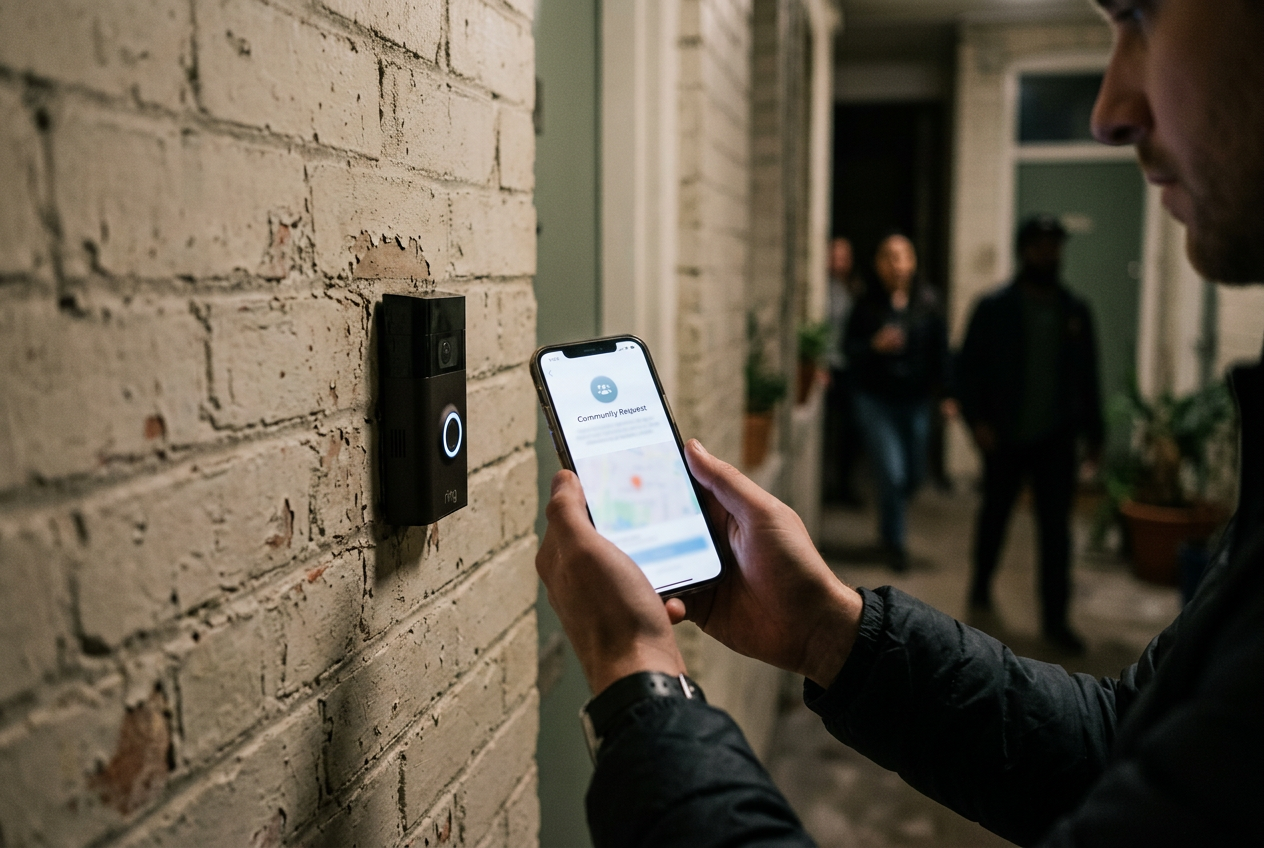
The concrete object is now a Community Request notification inside the Ring app. It arrives because a verified public-safety agency has selected an area and time connected to an investigation, then used Axon Evidence, the company’s system for storing and managing police evidence, to ask nearby Ring owners for relevant recordings.
The owner can review the request, inspect their footage and decide whether to send a clip. Ignoring it is allowed. Police do not receive a live view, a list of everyone notified or an automatic search across local cameras.
That is a real restriction. It is also a new police request channel built across software already installed on private homes.
The request tool left one portal and entered another
In January 2024, Ring ended Request for Assistance, the feature that had allowed police and fire agencies to post geographically targeted appeals for footage through Neighbors, Ring’s neighborhood social app. Agencies retained access to the Neighbors Public Safety Service, where they could publish safety information and communicate with residents, but Ring said they could no longer request or receive video through that service.
The change narrowed a relationship that had made household cameras legible as a local investigative resource. An officer did not need to identify every doorbell, knock on every door or wait for residents to notice a general appeal. The portal handled discovery and distribution.
Ring’s later Community Requests feature restored part of that convenience through a different institutional partner. According to Ring and Axon’s product documentation, an eligible agency creates the request through Axon Evidence, specifying the relevant place and period. Ring then distributes a notification to users whose devices may have captured something useful. If an owner chooses to share, the selected recording enters the agency’s Axon evidence environment.
The Community Request notification is therefore more than a digital flyer. It connects Amazon’s map of installed devices to Axon’s police evidence system while withholding certain information unless a user responds. The agency can seek footage without first knowing which homes own cameras, and Axon can receive resulting clips inside the system where investigators already organize case material.
Ring describes the exchange as voluntary and privacy-protective. Those terms matter, but they describe the interface between the officer and the account holder. The delivery driver, neighbor, child or passerby recorded at the edge of the property did not buy the camera, receive the notification or choose whether the clip entered a police file.
Consent is only one route
Community Requests do not grant police remote control of a Ring camera. Ring’s documentation says agencies cannot use the feature to watch Live View, search a customer’s complete video history or see which users received and declined a request. The owner chooses which recording to provide, if any.
An investigator can still approach the same household outside Ring’s systems. Officers may knock on the door, call an owner whose identity they already know, leave contact information or ask a building manager to preserve footage. A Ring customer can download recordings from the app and send them through ordinary communications or an evidence-upload link supplied by an agency.
Public posts create another opening. When a user voluntarily publishes a recording to the Neighbors feed, verified agencies using the public-safety service can view material made available there. That does not reveal the rest of the account or turn the camera into an agency device, but the evidentiary value of a clip does not disappear because its owner posted it as neighborhood content first.
These routes look less efficient than the old portal because they are. Friction changes outcomes. A resident can ignore a notification, refuse a doorstep request or decide that a vague appeal does not justify sharing video. Investigators must spend more time defining what they want, and the owner gets another point at which to say no.
The system still begins with a privately purchased sensor facing shared space. Police did not finance its installation, negotiate access to the wall or persuade a city council to approve another camera. They arrive later, after the household has paid for the hardware and, where required for cloud recording, an eligible Ring subscription.
A warrant reaches the company, not the doorbell
Voluntary sharing is not the end of the paper trail. Ring maintains law-enforcement guidelines for demands served on the company itself.
Legal process, meaning a subpoena, court order or search warrant issued under applicable law, can compel different categories of records. Ring’s documentation distinguishes basic subscriber and account information from stored content such as video. Investigators generally need a search warrant for stored recordings, while less intrusive legal instruments may reach specified non-content records. Ring says it reviews demands for validity and scope and may reject or seek changes to requests it considers defective or excessive.
A warrant cannot retrieve footage Ring does not possess. Availability depends on whether the camera recorded the event, whether the account had cloud recording enabled and whether the clip remained within its storage period or had been preserved. Deleted or expired material is not recreated by legal paperwork.
Ring also says it may notify an account holder about a government demand unless the law prohibits notice, a court has delayed it or an emergency makes notice inappropriate. That policy creates procedural distance from the Community Request notification: one asks the owner to provide a chosen clip, while the other asks Amazon to produce records already held in the account.
The distinction matters to the owner. It matters less to someone captured on the sidewalk. In either route, control sits with the customer, the platform and the investigating agency, while the recorded subject may learn about the transfer only if the footage surfaces later in a case.
Emergency disclosure remains a separate door
Ring’s guidelines also allow law enforcement to request information without ordinary legal process during an emergency involving imminent danger of death or serious physical injury. An emergency disclosure request is an agency’s claim that delay would create grave harm, not a general label for an urgent investigation.
Ring says it evaluates these requests individually and may disclose information when the stated facts satisfy the legal standard. The company does not describe this route as routine access, and an officer’s submission does not guarantee production. It nevertheless places the initial decision with a corporate review process rather than a judge, under conditions where the person whose account is affected may receive no advance notice.
This exception existed apart from the Neighbors request portal. Ending Request for Assistance did not remove it, just as it did not prevent warrants, direct canvassing or owner-initiated sharing. The 2024 announcement changed one workflow and was often read as a larger retreat because that workflow had become the most visible symbol of Ring’s police relationships.
The network’s ownership model did not change
The Community Request notification shows why the system survives policy revisions. A police department does not need uninterrupted access to every camera for the network to be useful. It needs a way to identify a relevant zone, reach enough owners and collect whatever those owners release.
Ring supplies the installed base, device map, customer relationship and notification channel. Axon supplies the evidence-management environment used by participating agencies. Households supply the cameras, electricity, broadband, mounting position and attention required to review clips. Public agencies bring investigative authority and whatever contracts support their software stack.
The brand documentation explains the workflow but does not disclose the commercial terms governing the Ring-Axon integration.
That distribution lowers the political cost of expansion. A city-owned camera network can require procurement hearings, placement rules, retention policies and public spending that residents can contest. A street assembled one doorbell at a time arrives through retail purchases. By the time police seek a clip, the cameras are already fixed to brick, siding and apartment entrances.
The limits remain meaningful. There is no general police dashboard for browsing every Ring camera, owners can refuse voluntary requests, and legal demands face standards that a Community Request does not. Treating those safeguards as proof that the network disappeared, however, confuses constrained access with no access.
The old police button was removed. The current Community Request notification performs a narrower version of the same connective task, while warrants, emergencies and ordinary police canvassing cover the cases where a notification fails. The network did not need to become public infrastructure. It only needed enough doors into privately held footage.
Questions people ask
Can police watch a
Ring camera live through Community Requests?
No. Ring’s documentation says Community Requests do not provide Live View or general access to an account’s recordings. An agency defines an area and time, Ring alerts potentially relevant users, and each owner decides whether to select and share footage.
Can a
Ring owner ignore a police footage request?
Yes. Community Requests and direct requests from officers are voluntary unless police obtain binding legal process. Ring says agencies cannot see which users received or declined a Community Request, although an investigator may separately contact a household identified through ordinary police work.
Can police get Ring video with a warrant?
Police can serve Ring with valid legal process for records the company holds. Stored video generally requires a search warrant, and production depends on whether the recording exists in the account and remains available. A warrant cannot recover a clip that was never recorded or is no longer stored.
Who pays for this surveillance network?
Households buy, install and operate the cameras, sometimes paying Ring for cloud-recording services. Agencies fund their own investigative and evidence systems, including Axon products where contracted. The result is a distributed network whose physical buildout is largely paid for by residents, even when its recordings later serve a police investigation.
One update a day
Today's story, in your inbox
One story each morning — no hype, no filler, no algorithm deciding for you.