
That Gas-Station Sex Pill Has Not Been Cleared for Anything
A Rhino 7 Platinum 5000 packet looks like a supplement. An FDA warning found sildenafil inside, exposing the regulatory gap built into the package.
August 11, 2026 · 7 min read
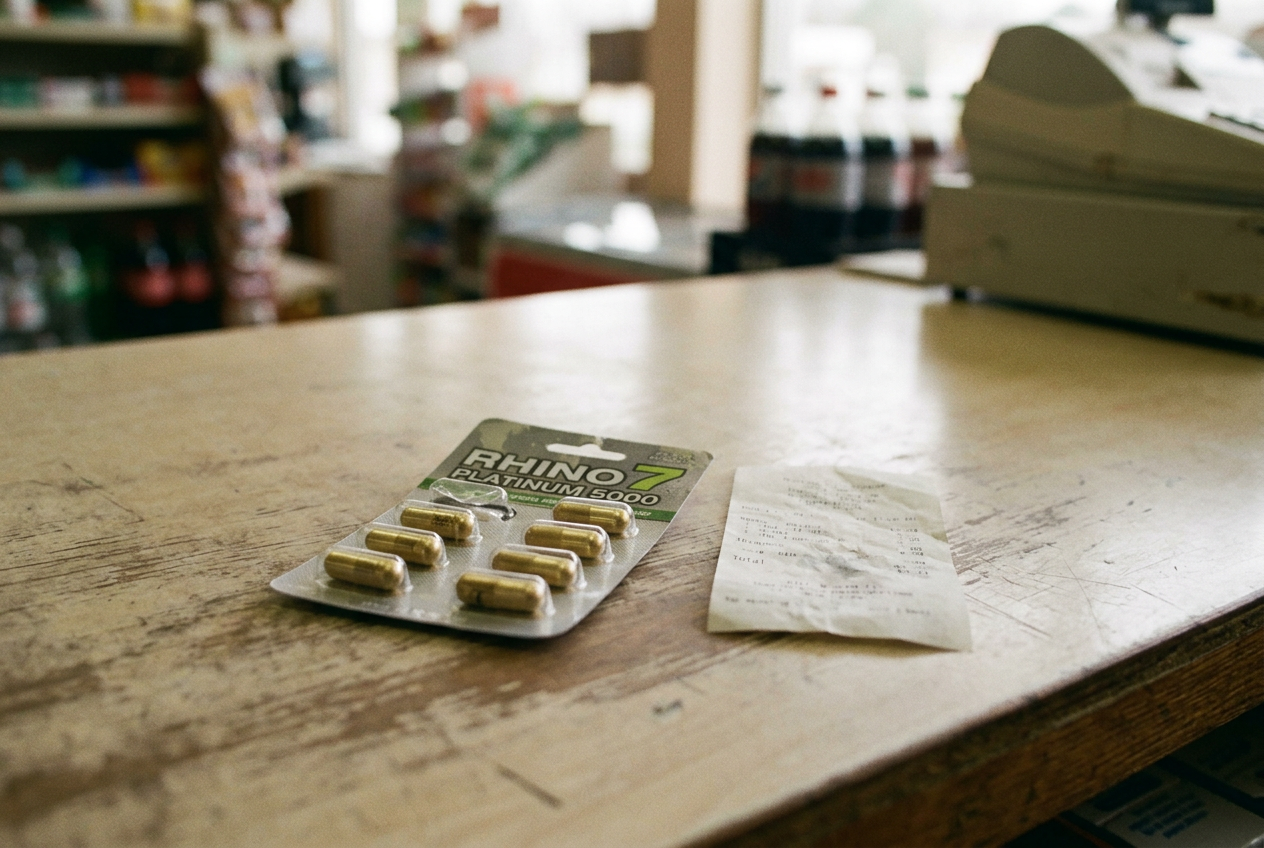
Keep one packet in mind: Rhino 7 Platinum 5000. It is a single-dose sexual-enhancement product in metallic-finish packaging, with an ingredient panel, an oversized potency claim and the visual cues of a dietary supplement. The packet looks official enough to answer questions it cannot answer.
The Food and Drug Administration tested this exact product and reported in 2018 that it contained sildenafil, the active ingredient in the prescription drug Viagra. Sildenafil was not disclosed on the label. The agency told consumers not to buy or use the product.
That result does not prove every packet with a rhino, a large number or a male-enhancement claim contains sildenafil. It establishes something narrower and still important: the wrapper is not chemical evidence. Buyers are encouraged to read the package as proof of what is inside, while regulators may discover an undeclared drug only after capsules have reached stores.
This is reporting, not medical advice. Anyone who has taken an unknown sexual-enhancement product and develops chest pain, faintness, a severe headache, vision changes or an erection lasting several hours needs prompt professional help. In the United States, Poison Control is available at 1-800-222-1222. Severe symptoms warrant emergency services.
The package gets the first move
Dietary supplements do not face the same premarket approval process as prescription drugs. Manufacturers generally carry the legal responsibility for selling supplements that are safe and properly labeled. The FDA monitors products already in commerce, inspects facilities, reviews reports and tests selected samples.
That sequence gives the Rhino 7 Platinum 5000 packet a head start. A manufacturer or distributor can market a capsule as a dietary supplement without first putting it through the clinical review required for a new drug, while a convenience store can place the packet near condoms, energy shots or the register without testing its contents. The store sells it. A distributor supplies another.
The customer buys the promise.
Nothing in that transaction requires the cashier to know whether the capsule contains a prescription ingredient, and nothing about metallic packaging turns the contents into a lawful dietary supplement. If testing uncovers an undeclared active pharmaceutical ingredient, meaning a chemical that produces a drug’s effect, the FDA may treat the item as an unapproved and misbranded drug. By then, people may already have swallowed it.
Rhino 7 Platinum 5000 makes the gap unusually easy to see. Its packet communicates sexual enhancement and extreme potency. The FDA’s laboratory record identifies sildenafil. A purchase that appears to be an herbal or supplement-style product may therefore act like a prescription medicine, except the buyer does not receive a reliable dose, a complete interaction warning or any assurance that a second packet contains the same formulation.
This is how the shelf display works. The supplement framework allows the product to enter the market without drug approval, convenience retail offers privacy, and enforcement tends to arrive one named product at a time after regulators have obtained a reason and a sample to test. The packet can move through stores before the warning catches up.
A database match is evidence, not clearance
The FDA publishes notifications about sexual-enhancement products found to contain hidden drug ingredients. A search can produce an exact match between a product name and a laboratory result, as it does for Rhino 7 Platinum 5000. The agency has also warned about multiple Rhino-branded products after tests found undeclared prescription-drug ingredients in items marketed for sexual enhancement.
The database has a firm limit. It records products the agency has identified; it is not a census of every capsule hanging beside a New Jersey convenience-store register. The FDA states that absence from its tainted-products records does not show that a product is safe, which matters because regulators cannot test every pill, sellers can change names, packaging can be copied and a warned item can be replaced with a similar-looking variant.
The exact packet matters for the same reason. A warning for Rhino 7 Platinum 5000 should not become a laboratory claim about every item carrying Rhino branding. It should not be waved away as irrelevant history, either. The public record confirms that at least some products presented in supplement-style packaging have contained undeclared prescription ingredients.
That is enough to make trust based on the wrapper a poor trade.
Names require close reading. Number strings, spelling and package wording can separate one product from another, even when two packets look related, while a counterfeit or reformulated product may borrow familiar branding. An FDA notification reports what the laboratory found in the tested sample. It does not certify every packet sold before that test or every one that appeared later.
Read the warning for what it is: a confirmed labeling failure with defined boundaries. It proves that one tested product contained something its label omitted. It cannot reveal the contents of an untested capsule.
The risk sits in the missing information
Sildenafil is a real medicine with established uses, known effects and recognized contraindications, which are conditions or circumstances that make a treatment unsafe for a particular person. The problem here is not the pharmaceutical name. It is the possibility that someone may take sildenafil without knowing it is present, without knowing the dose, and without knowing whether the maker added another active ingredient or produced each capsule consistently.
The FDA’s Rhino 7 Platinum 5000 warning highlighted the interaction with nitrates, medicines commonly used for chest pain. Sildenafil combined with nitrates can lower blood pressure to dangerous levels. Some people with diabetes, high blood pressure, high cholesterol or heart disease use nitrates, leaving an undisclosed ingredient especially risky for customers who may already be managing cardiovascular illness.
The single-capsule format hides other variables. Someone may take it after alcohol or another drug, use it alongside prescribed erectile-dysfunction medication, or swallow another packet after deciding the first did not work. If the label is false, the buyer cannot describe the exposure with confidence, and a clinician trying to assess a reaction starts with the same missing information.
The convenience is real.
So is what has been withheld.
The Rhino 7 Platinum 5000 packet comes back into view here. Its compact format turns a decision involving dose, interactions and health history into a purchase that can take less time than buying a drink, while the tested sample’s sildenafil was absent from the label. There is no consultation. More importantly, there is no dependable disclosure on which a person could base a decision to decline it.
The useful harm-reduction point is limited. FDA warnings can identify products already linked to laboratory findings, but they cannot clear a product that does not appear in the records. Keeping the wrapper and any remaining capsule may help a clinician or poison specialist identify what was taken. Consumers can also report adverse events through the FDA’s MedWatch system, giving regulators information they may use to investigate products.
Medication obtained through a licensed pharmacy comes with a regulated label and a route for checking interactions. Access, cost and embarrassment still help explain why some buyers choose the convenience-store packet instead.
The business runs on discretion and distance
Sexual performance lends itself to opaque retail. A buyer may value speed and anonymity more than a conversation, while one small packet occupies little counter space and can make a large promise without requiring the retailer to explain the chemistry. Distribution puts distance between the manufacturer and the shelf. The store completes a compact sale.
The customer takes on the uncertainty.
Enforcement must work backward through the chain because regulators first need to identify a product, obtain a sample and test it, after which they may publish a notification, seek a recall and try to reach stores or customers. During that time, sellers may switch to another name or a nearly identical packet. A warning page does not sit beside the cash register. The business model does not depend on one brand surviving forever, only on replacement products remaining easy to stock.
This is where the words “dietary supplement” carry more authority than the evidence beneath them. They describe a regulatory category and a marketing posture, not an FDA endorsement. The agency does not approve supplements for safety and effectiveness before sale. A familiar Supplement Facts panel may resemble the label on a bottle of vitamins, but it cannot inform the buyer about an ingredient the seller left out.
The point from the New Jersey shelf is narrower than saying every gas-station pill is secretly Viagra. Buyers are being asked to settle a laboratory question by reading a wrapper. The Rhino 7 Platinum 5000 wrapper already gave the wrong answer.
Questions people ask
Are gas-station sexual-enhancement pills FDA approved?
Products sold as dietary supplements are not FDA-approved for safety and effectiveness before they reach stores. If testing finds an undeclared prescription ingredient, the FDA may warn consumers and treat the item as an unapproved or misbranded drug. That action generally comes after the product has entered the market.
Does an
FDA database search prove an unlisted pill is safe?
No. The FDA says its public tainted-products records include products the agency has identified, not every product for sale. An exact warning match is meaningful evidence about the named item and tested sample. No match means the search did not return a published finding.
What did the FDA find in Rhino 7 Platinum 5000?
The FDA reported that laboratory analysis found sildenafil, the active ingredient in Viagra, though the Rhino 7 Platinum 5000 label did not declare it. The agency warned that sildenafil can interact with nitrate medicines and lower blood pressure to dangerous levels.
What information should someone keep after taking one?
Keep the packet, any remaining capsule and the available purchase details rather than throwing them away. Exact branding and lot information may help a clinician, poison specialist or regulator assess the exposure. This is general harm-reduction reporting, not individualized medical advice; urgent symptoms require prompt professional help.
One update a day
Today's story, in your inbox
One story each morning — no hype, no filler, no algorithm deciding for you.