A Negative Fentanyl Test Strip Cannot Clear That Pill
Drug-checking strips can reveal a reason not to trust a drug. They cannot certify its identity, potency or safety, and poor sampling can make their reassurance dangerously persuasive.
August 11, 2026 · 8 min read
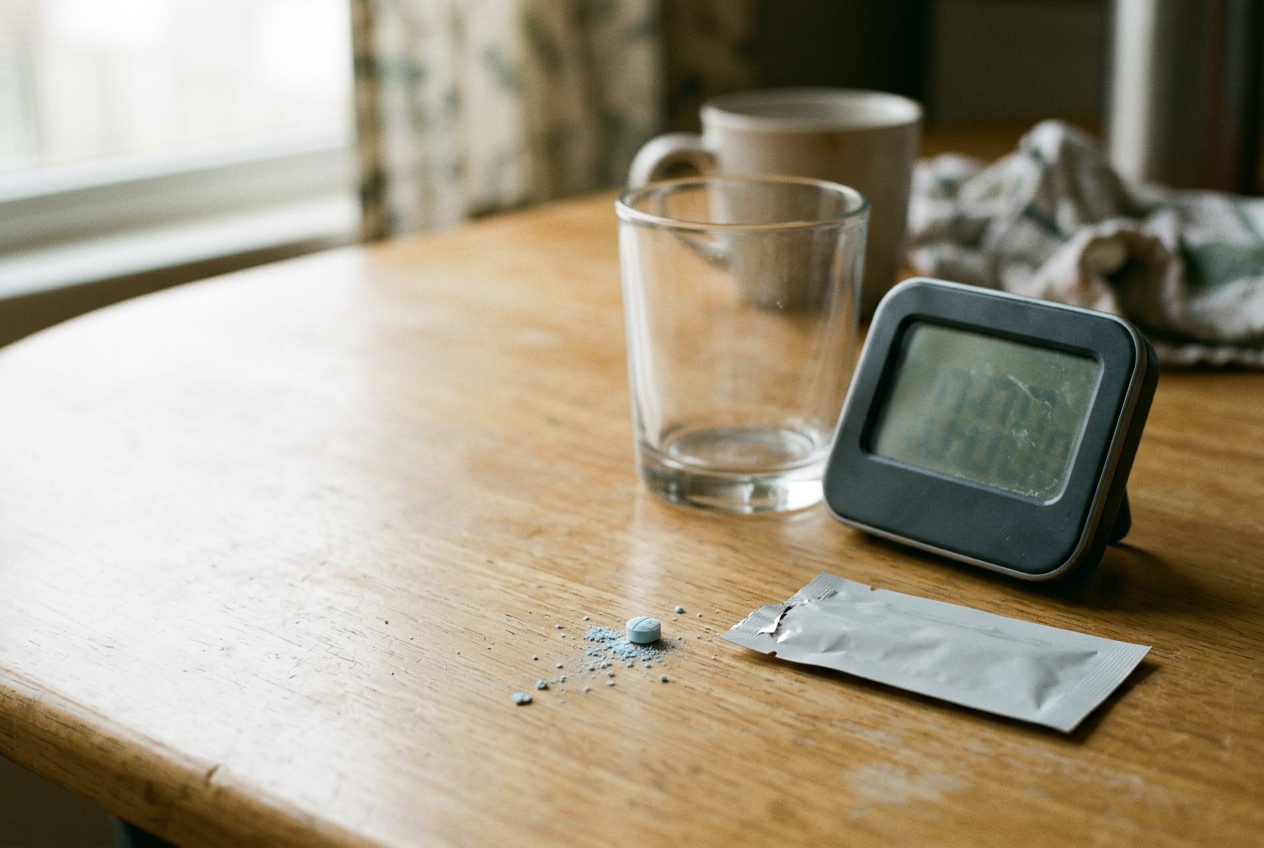
On the table is one blue pressed tablet stamped M30, sold as oxycodone, beside a clean glass cup and a narrow fentanyl test strip. The stamp looks official because that is its job. It does not establish what the tablet contains.
The strip will not establish that either.
A drug-checking strip answers a tightly framed question: did this particular liquid sample trigger the strip’s chemical target above its detection threshold? It does not identify everything in the cup, measure potency or predict what the drug will do to one body after alcohol, medication, heat, exhaustion or another dose enters the picture.
That distinction has become more important as fentanyl and xylazine strips have moved from specialist harm-reduction programs into community organizations, vending machines and online shops. Access is good. The sales pitch around access can be less good. A cheap strip offers a clean visual result in a market defined by inconsistent manufacture, uneven contamination and products whose instructions are not interchangeable.
The certainty belongs to the graphic design.
The strip is a screen, not a chemical certificate
Most drug-checking strips use a lateral-flow assay, a paper-based screen that pulls liquid past chemical binders designed to react with a target substance. Depending on the product, one arrangement of lines indicates that the target was detected, another indicates it was not detected, and a missing control line means the test failed.
Read the insert. On many fentanyl strips, one line means positive and two mean negative, including a faint second line, but you cannot safely assume every brand uses the same interpretation. The strip must also be dipped only to its marked limit, left in the liquid for the stated time and read within the stated window. A photograph found online is not the instruction sheet for the packet in your hand.
Many strips in circulation grew out of urine-testing technology or use the same basic architecture, while newer products are marketed specifically for checking drug samples. That history matters because an assay engineered to detect a metabolite or drug in one type of liquid may behave differently in a concentrated mixture of powder, dye, filler and active compounds. Public-health groups have developed practical protocols around these tools, but protocols cannot turn a binary field screen into a laboratory.
Return to the blue M30 tablet. A negative fentanyl result means the tested liquid did not trigger that strip under those conditions. It does not prove the tablet contains pharmaceutical oxycodone. It says nothing about nitazenes, benzodiazepines, xylazine or another undeclared compound unless a separate validated test targets one of them.
It cannot tell whether the amount present is low or high.
A positive is useful because it gives you a reason to stop and reconsider. A negative is useful only if you keep its limits attached.
Sample preparation decides what gets tested
The most consequential mistake happens before the strip touches water. Breaking a crumb from one edge of the M30 tablet feels like testing the pill, but it tests that crumb. Illicitly manufactured tablets and mixed powders may not be uniform, so the fragment in the cup can differ from material elsewhere in the same pill or bag.
For a tablet, current harm-reduction guidance generally favors crushing the entire pill into a fine, evenly mixed powder before taking a sample, or dissolving the entire intended amount when the product instructions support that method. For powder, mix the material thoroughly and sample from more than one area if the whole amount cannot be tested. Residue from an emptied bag can offer information, but it cannot represent material that never touched the tested surface.
Use a clean container and clean equipment. Cross-contamination is mundane: a scoop, card, countertop or cup that previously held fentanyl can create a positive even when the new sample did not contain it. The reverse problem is poor mixing, which can leave the target outside the small portion that reaches the strip.
Add the amount of water specified by the manufacturer or the harm-reduction program that supplied that exact product. There is no responsible universal ratio for every strip and every drug, because concentration changes how assays behave, and guidance may differ for methamphetamine, MDMA and other substances known to interfere with some fentanyl tests when the solution is too concentrated. More powder does not make a test more thorough. It may make the chemistry less reliable.
Dissolve and mix the sample as fully as the instructions require. Dip the strip to the marked line, not past it, then place it on a clean surface and use a timer. Read it during the stated interval. A line that appears much later may be an evaporation artifact rather than a valid result.
If the control line fails, the test has not produced a result. Repeating the same claim with the same damaged strip does not rescue it. Use a new strip, remake the sample with clean equipment and check the packet instructions before proceeding.
Cross-reactivity can turn concentration into confusion
Cross-reactivity occurs when a substance other than the intended target also binds strongly enough to trigger the assay. Some fentanyl strips can return false positives when highly concentrated solutions contain drugs such as methamphetamine or MDMA, and certain medications or cutting agents can interfere with particular products. Xylazine strips have their own cross-reactivity profiles. Brand, formulation and sample concentration matter.
This is where generic online advice becomes dangerous. If a supplier’s current instructions recommend a second test at a specified dilution for a known interference, follow that protocol rather than adding water until the result changes. Repeated dilution can eventually push any target below the strip’s detection threshold, producing the negative result a person hoped to see without resolving what was in the original sample.
A positive result can also reflect contamination from hands or equipment, an expired strip or a manufacturing problem. None of those possibilities makes a positive safe to dismiss. They mean the result needs confirmation through a local drug-checking service when one is available, especially if the finding conflicts with what the drug was represented to be.
Laboratory or spectroscopic drug checking can identify a broader range of compounds, although each method still has limits and not every service can quantify potency. Programs using techniques such as Fourier-transform infrared spectroscopy, which identifies substances through their infrared absorption pattern, may combine instrument testing with strips because trace fentanyl can fall below the instrument’s practical detection range. Better checking uses methods together. It does not crown one gadget infallible.
Storage is part of the test
The strip beside the M30 tablet is a chemical device, not an immortal piece of paper. Heat, moisture and damaged packaging can degrade its reagents, while an expired product may no longer perform as labeled. A strip left loose in a humid bathroom cabinet or cooked through repeated afternoons in a car has already acquired an uncertainty the result window will not display.
Keep strips sealed in their original foil until use and store them within the temperature range printed on the package, away from humidity and direct sunlight. Check the expiration date, lot information and packaging for damage. Do not reuse a strip. If a distributor or health department posts a recall or revised instruction for that lot, the old leaflet in a drawer does not overrule it.
Buying also requires judgment. A product page can promise sensitivity without showing independent validation, current instructions or a clear route for reporting faulty lots. Community harm-reduction organizations and public-health departments are generally better starting points than an anonymous marketplace listing because they can provide the correct protocol, explain local drug trends and connect a confusing result to confirmatory checking.
A negative result changes precautions less than people want
False confidence is the most dangerous failure mode because it looks like successful harm reduction. The strip develops two lines, the M30 tablet appears cleared, and ordinary precautions begin to feel excessive. Yet the negative may reflect an unrepresentative crumb, excess dilution, degraded reagents, a fentanyl analog the assay does not reliably recognize or a different potent substance outside the strip’s target.
The practical response is layered. Do not use alone. Keep naloxone available and make sure someone present knows how to recognize an opioid overdose and administer it. Avoid mixing opioids with alcohol, benzodiazepines or other depressants, which can further suppress breathing.
Use less than usual and wait before taking more, particularly when the source or batch has changed. Call emergency services if someone is unresponsive or breathing abnormally; naloxone should be given when opioid overdose is suspected, even if xylazine or another substance may also be present.
These measures cost time, privacy and money, while confirmatory services remain patchy and criminalization still pushes drug checking into improvised spaces. That is the institutional bargain hiding inside the little strip: individuals are handed a low-cost screen and expected to manage a volatile supply that regulators do not control. The tool remains worth using. The burden placed on it is absurd.
For current instructions, use the manufacturer’s insert alongside guidance from the CDC, SAMHSA, a state or local health department, or an established harm-reduction service such as a syringe services program. Guidance changes as products, evidence and the drug supply change. A screenshot detached from its strip brand and lot is not current guidance.
Questions people ask
Can a fentanyl test strip tell me how much fentanyl is present?
No. A strip gives a qualitative screen, meaning detected or not detected under the test conditions. It cannot distinguish a trace from a potentially lethal concentration, and line darkness should not be used as a dose meter. Quantification requires different testing and may not be available through every community program.
Does a negative fentanyl test mean a pill is safe?
No. It means that one prepared sample did not trigger that strip. The pill may contain fentanyl elsewhere, an analog the assay misses, another undeclared drug or a dangerous dose of the substance you expected. Keep overdose precautions in place and treat any new batch as unverified.
Should I test a crumb or crush the whole pill?
Testing the whole pill gives a more representative sample because pressed tablets may be unevenly mixed. If that is not possible, crush and mix the material thoroughly, then follow the exact strip instructions; a crumb from one edge can only describe that crumb.
What should
I do with a confusing or unexpected result?
Do not resolve uncertainty by staring longer at the strip or diluting repeatedly until it turns negative. Photograph the result within the valid reading window, retain the packaging and lot number, and contact the distributor, a local harm-reduction program or a drug-checking service for product-specific guidance.
One update a day
Today's story, in your inbox
One story each morning — no hype, no filler, no algorithm deciding for you.