
That Gas-Station Sex Pill Label Is Covering an Evidence Gap
A Rhino 7 packet promises potency while the fine print shifts the risk to the buyer. The label looks informative, but it cannot prove what is inside.
August 11, 2026 · 8 min read
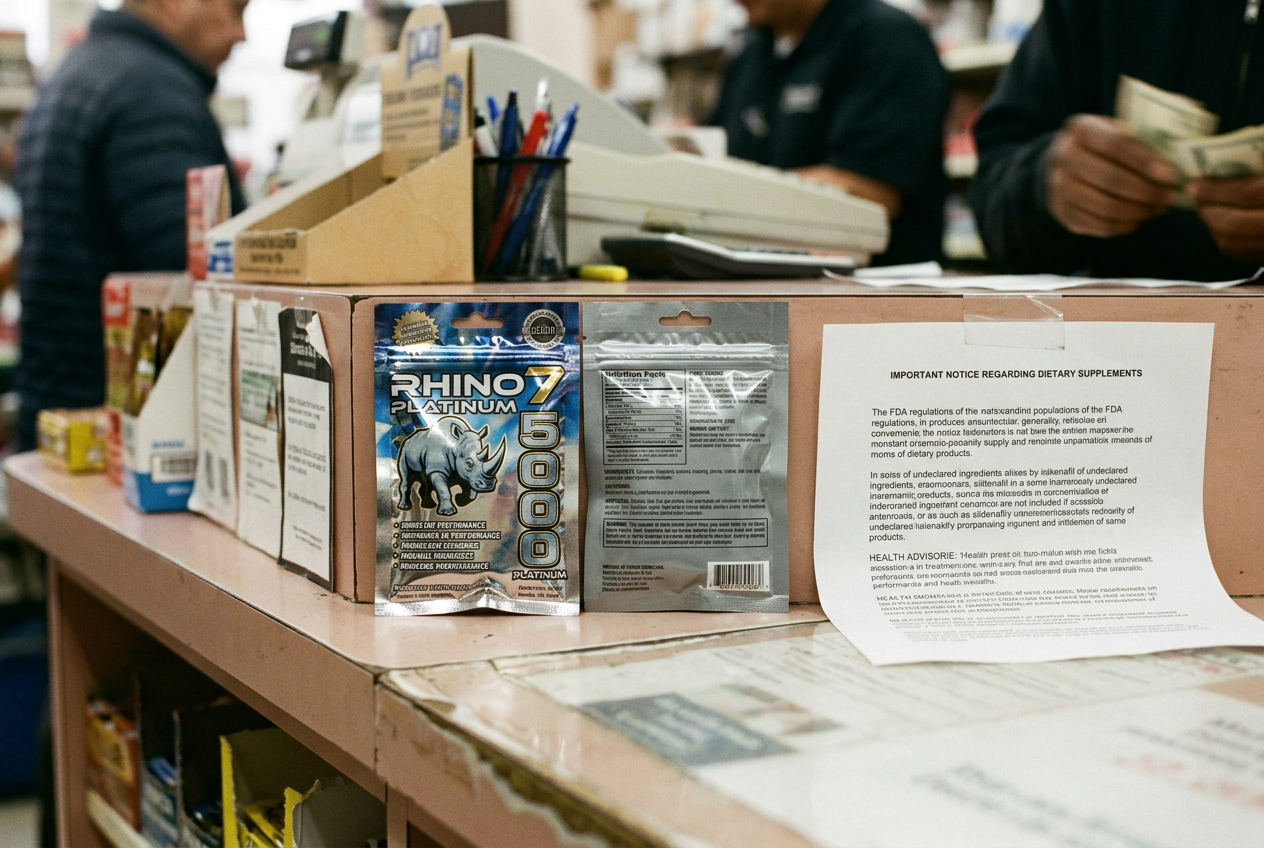
The Rhino 7 Platinum 5000 packet does most of its work before anyone opens it. A metallic rhinoceros fills the front. The number is huge. The words “male enhancement” tell the buyer what kind of night the packet is meant to rescue, while “dietary supplement” assigns it a regulatory category that sounds more settled than it is.
That packet is the concrete object at the center of this analysis. I reviewed publicly available photographs of its front and back, retailer listings, regulator notices and evidence on ingredients commonly used in stimulant and sexual-wellness supplements. I did not consume it, and the packet was not sent for laboratory testing. NoAlgo does not take products for spectacle, and this reporting is not medical advice.
The limit matters. A label review can show what a seller wants a buyer to believe. It cannot establish what a capsule contains.
The category does the legal work
In the United States, dietary supplements do not pass through the same premarket approval process as prescription drugs. Under the federal framework created by the Dietary Supplement Health and Education Act, manufacturers generally carry responsibility for safety and labeling before sale, while the Food and Drug Administration often acts after a product reaches consumers or evidence of a problem emerges.
This produces an unusually useful commercial arrangement. The package can borrow the visual authority of medicine without submitting the finished product to medicine’s standard proof requirements. It can use capsules, dosage-style directions, anatomical implications and serious-looking numbers, then retreat into the supplement category when the buyer looks for evidence that the formula was tested as sold.
The Rhino 7 packet compresses that arrangement into a few square inches. “Male enhancement” names a desired outcome without offering the kind of precise, testable claim that would make the front panel read like an approved drug label. The large “5000” creates scale, although a number has little evidentiary value unless the label clearly explains what it measures and why that quantity matters. The rhino supplies the rest.
Strength is communicated as design.
This is not empty decoration. It replaces information that would be expensive to produce: a verified formulation, controlled clinical evidence on the finished product, dependable manufacturing records and a risk profile that reflects what is in each unit. Printing metallic ink is cheaper.
The warning sits somewhere else
FDA notifications and recalls have repeatedly identified products sold under Rhino branding or closely related names that contained undeclared sildenafil, tadalafil or chemically similar substances. Sildenafil and tadalafil are active pharmaceutical ingredients used in approved erectile-dysfunction drugs; they can interact dangerously with nitrate medications and may lower blood pressure.
That history does not prove the contents of every Rhino-branded packet. Product names, distributors, packaging and formulas can change, and a regulator finding about one sampled item cannot be cleanly transferred to every item sharing an animal logo. It does establish a category-level problem that the label cannot resolve: the buyer has no practical way to tell whether a packet contains only its declared supplement ingredients, an undeclared drug ingredient, a variable amount of either, or something else.
FDA’s health-fraud database is valuable, but it is not a preclearance list. A product absent from the database has not received a clean bill of health. It may never have been tested. Enforcement also has a timing problem, because a short-lived brand can move through wholesalers and convenience-store counters faster than sampling, laboratory analysis, notification and removal.
The packet moves first. The warning follows.
That lag favors everyone between the contract manufacturer and the register. A manufacturer can sell into a market where dramatic claims command attention, a distributor can rotate stock among similar names, and a retailer can treat the packet as another high-margin impulse item. The buyer pays for certainty that the supply chain has not earned.
“Natural” does not settle the stimulant side
The same label machinery appears in gas-station energy and sexual-wellness products that declare caffeine, yohimbe or proprietary blends. A proprietary blend lists a mixture under a combined weight while withholding the amount of each component, which makes the label less useful for assessing exposure.
Caffeine at least has a familiar name, but familiarity does not disclose the total amount across capsules, shots, coffee and energy drinks taken during the same stretch of time. Yohimbe is more difficult. It comes from the bark of an African tree, while yohimbine is a pharmacologically active compound associated with it; analyses summarized by the National Institutes of Health have found substantial variation among yohimbe supplements, and the evidence for sexual performance or weight-loss claims remains limited.
“Plant-based” cannot answer a dose question. “Herbal” cannot verify manufacturing. Neither term rules out interactions, contamination or undeclared ingredients.
This is where stimulant and sex-pill marketing meet. Both sell an immediate change in the body, often at a moment when the customer is tired, embarrassed, intoxicated, under time pressure or trying to avoid a clinical conversation. The package has seconds to close the sale. A sober explanation of uncertain evidence would take longer than the transaction.
The Rhino 7 packet therefore does not need to make a detailed argument. Its number implies intensity, the animal implies performance, and the supplement designation reassures without guaranteeing. Fine print can disclose that claims were not evaluated by FDA, yet that familiar disclaimer does not tell the buyer whether regulators have previously found hidden drug ingredients in similarly branded products.
The label is a liability map
Supplement labels are often read as miniature evidence files. They are closer to maps of what a seller believes it can say.
Structure-function claims describe support for normal bodily functions, using language such as supporting energy, stamina or circulation, rather than claiming to diagnose or treat a disease. That distinction helps explain the soft verbs. “Supports” can carry a hard implication while leaving the exact outcome undefined. A person buying a packet for erectile function is unlikely to interpret “stamina” as an abstract contribution to normal physiology.
The market depends on that gap.
The disclaimer performs another task. It tells the attentive buyer that FDA has not evaluated the claim, but it arrives after the branding has already presented the product as purposeful and potent. Legally significant language gets the least persuasive part of the package. The rhinoceros gets the front.
Available evidence cannot rescue this setup. Research on an isolated ingredient does not validate a finished multi-ingredient product, particularly when the amount, sourcing and batch consistency are unclear. Evidence from an approved prescription drug is even less transferable to a supplement that may contain an undeclared version of that drug, because clinical use includes a known dose, manufacturing controls and screening for contraindications, meaning conditions that make a treatment unsafe for a particular person.
The evidence gap is not an unfortunate omission around the business. It helps make the business possible. Proper trials cost money, stable formulas constrain suppliers, and transparent quantities make comparison easier. Ambiguity lets a packet suggest pharmaceutical force while competing as a convenience-store supplement.
What documentation can and cannot do
A useful label check starts with photographs of every panel, the listed distributor, ingredient quantities, serving directions, lot information and any web address or QR code. Those details can then be compared with FDA warning letters, public notifications, recall notices and the agency’s health-fraud database. The Office of Dietary Supplements at the National Institutes of Health provides evidence summaries for many common ingredients.
This work can identify a warning already attached to a product name or distributor. It can expose a proprietary blend that hides individual amounts, a missing quantity or language that outruns the research. It cannot authenticate a capsule. Only chemical analysis of the specific unit can do that, and even one laboratory result describes one sampled product rather than every packet carrying the same artwork.
For someone who already used a product and feels unwell, the relevant move is not amateur label interpretation. Chest pain, fainting, severe headache, major changes in heart rate or blood pressure, or an erection lasting several hours can require urgent medical attention. A clinician or poison-control service needs the package and a candid account of other substances or medications involved. This is reporting, not professional advice.
The unopened Rhino 7 packet remains persuasive because it offers privacy and speed. Those are real needs. A better system would not punish the person trying to meet them; it would require finished-product verification before sale, faster retailer notices when warnings appear, and labeling that cannot use a giant number as a substitute for a measurable claim.
Until then, the most accurate part of the package may be the regulatory disclaimer printed smaller than the rhino.
Questions people ask
Are all gas-station sex pills unsafe?
No. A sales location alone cannot establish what a product contains, and a warning about one item does not prove that every similar packet is adulterated. The problem is that labels and shelf placement cannot verify purity, dose or batch consistency, while FDA findings show that undeclared prescription-drug ingredients have appeared in this category.
Does “dietary supplement” mean FDA approved?
No. FDA does not generally approve dietary supplements for safety and effectiveness before they reach stores. Manufacturers are responsible for lawful products and labels, while regulators can inspect, issue warnings or pursue recalls after problems are identified. The supplement designation describes a regulatory category, not a government endorsement.
Can the ingredient list prove what is in the capsule?
The list shows what the seller declares. It cannot rule out contamination, substitution, inaccurate quantities or undeclared pharmaceutical ingredients, and proprietary blends may omit the amount of each component. Laboratory testing of the specific packet would provide stronger evidence, although one result would still apply only to the sampled unit or batch.
Where can someone check a product before buying it?
FDA publishes health-fraud notifications, warning letters and recalls, while the National Institutes of Health summarizes evidence on common supplement ingredients. Absence from a warning database does not prove safety because regulators do not test every product before sale, and names or packaging may change faster than public records.
One update a day
Today's story, in your inbox
One story each morning — no hype, no filler, no algorithm deciding for you.