TikTok Pays for the Sixty-First Second, So Creators Fill It
Creator Rewards makes the minute mark a pay gate. The pauses, recaps, and delayed reveals that follow are not just bad editing. They are payroll strategy.
August 25, 2026 · 7 min read
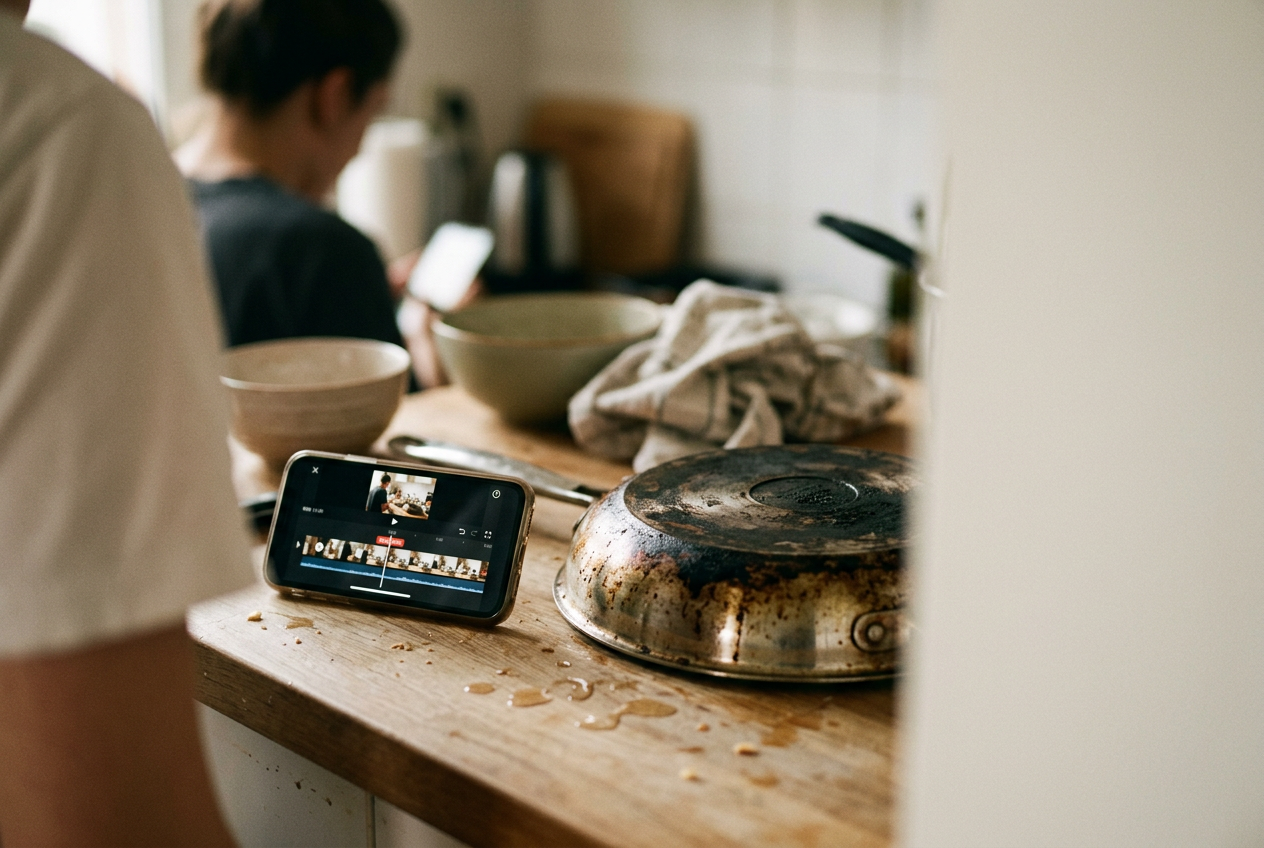
Consider a 61-second video about cleaning a scorched stainless-steel pan. The first frame shows the blackened base. A hand points at the damage, supplies appear one by one, paste is mixed, the pan gets scrubbed, and the clean result arrives after the minute mark. The useful information could fit comfortably inside 25 seconds.
The other 36 seconds are doing another job.
TikTok’s Creator Rewards Program documentation says eligible videos must be original, high-quality, and longer than one minute. Payment is based on qualified views and RPM, meaning the rewards earned per thousand qualified views. TikTok also says its formula considers factors including watch performance, search value, audience engagement, and the viewer’s region.
The sixty-first second does not carry a fixed price. It opens the door to a room where payment may happen, provided the creator has already met the program’s account requirements and the video attracts enough views that TikTok agrees to count. That distinction matters. TikTok has not introduced a wage for making longer videos.
It has created a conditional reward for producing videos that cross a duration threshold without losing the audience along the way.
That is why a complete thought on TikTok has begun to change shape.
The minute is a gate, not a format
The pan video has two clocks. One belongs to the demonstration: show the burn, apply the cleaner, reveal the result. The other belongs to Creator Rewards. That clock needs the video to remain alive past one minute, even if the demonstration reaches its natural end sooner.
Creators have to reconcile them. The easiest method is rarely to add more information, because more information requires research, shooting, captions, sourcing, or expertise. It is cheaper to slow the information already available. The damaged pan gets a longer inspection.
The cleaning mixture receives a close-up. A sentence repeats what the opening image established. The reveal waits.
Under another payment model, those choices could be dismissed as weak editing. Under this one, they protect eligibility. A creator who delivers the answer in 25 seconds may have made the cleaner video and the worse product, at least from the standpoint of the program that might pay them.
TikTok does not say that every second beyond the first minute generates money. Its documentation places duration at the eligibility stage, then makes qualified attention the basis of rewards. The creator therefore has to clear the minute without making viewers feel that the minute is being cleared. This produces a peculiar rhythm: enough movement to prevent a swipe, enough delay to preserve the endpoint.
The result is not television pacing squeezed into a phone. Television episodes are commissioned or licensed at known lengths, with payment arrangements established elsewhere. Creator Rewards asks independent workers to finance production first, publish without guaranteed compensation, and discover afterward whether the platform considers the resulting attention qualified.
The creator carries the risk. TikTok keeps the ruler.
A view has to survive inspection
A qualified view is not every play visible beneath a post. TikTok’s program documentation says qualified views come from the For You feed and excludes views it identifies as fraudulent, artificial, paid, promoted, or watched for less than five seconds. Repeat watching from the same account does not keep multiplying the count in the way a raw play total might suggest. A video begins generating rewards only after reaching the program’s stated threshold of qualified For You views.
That makes the opening five seconds part of the payroll mechanism. The black pan must be instantly legible, the promised transformation must feel plausible, and the viewer must remain long enough for the view to have a chance of counting. After that comes a longer retention problem: the creator needs enough continued viewing to support the performance signals TikTok says affect RPM.
This explains the increasingly familiar first sentence that contains both evidence and a withheld conclusion. The creator shows the stain but delays the cleaned pan. A caption promises a test while keeping the result offscreen. The opening is compressed because abandonment is expensive; the middle expands because the video still needs to reach its eligible length.
Padding, in other words, is not distributed evenly. It gathers between proof and payoff.
Return to the pan. The first five seconds cannot be leisurely. They have to establish the problem before a thumb leaves. Seconds six through 50 can accommodate measuring, rubbing, a second angle, or context that would have been cut from a shorter version.
Near the minute mark, the edit regains urgency. The water runs. The surface clears. The hand tilts the steel toward the light.
This pacing can be irritating because the audience recognizes the delay, even without seeing the payment rules behind it. Viewers experience the repeated premise as a demand on their time. The creator experiences the same repetition as a way to keep uncompensated production eligible for uncertain compensation. TikTok gets both: a longer session and a worker blamed for making it longer.
Searchable usefulness gets stretched
Creator Rewards documentation does more than reward duration. TikTok says search value can affect RPM, which pushes creators toward subjects that answer explicit needs: recipes, repairs, product explanations, beauty techniques, software walkthroughs, and cleaning demonstrations such as the scorched pan.
Searchable material usually has a natural endpoint. The screw comes loose. The setting gets changed. The stain lifts.
Once the answer arrives, the viewer has little reason to stay, so a creator trying to satisfy both search intent and the program’s length requirement has an incentive to move the answer toward the back.
This is how monetization edits the sentence before it edits the timeline. Instead of “use this paste and scrub for this long,” the creator begins with the history of the pan, rules out another cleaner, or announces that the first attempt failed before showing the method that worked. Some of that context can be useful. The system does not distinguish useful context from delay at the level of eligibility.
Both occupy time.
TikTok’s documentation praises original, engaging, specialized content, but the platform is not paying a creator merely for possessing expertise. It rewards expertise after that knowledge has been packaged into a video of sufficient length, distributed through the right feed, watched past the exclusion point, and assessed through a formula the worker cannot independently audit.
The complete thought therefore becomes less grammatical than economic. It ends where the explanation is finished, but it also has to cross the line where labor becomes eligible for consideration. Those endings may coincide. The program gives creators a reason to make sure they do.
The platform does not buy the video
Creator Rewards can sound like compensation for production. Structurally, it is closer to a performance bonus whose qualifying rules, distribution channel, and measurement system belong to the same company.
TikTok does not commission the pan video, cover the ingredients, pay for the failed take, or reimburse the time spent captioning. The creator supplies the phone, location, materials, editing labor, and audience relationship. If the video stalls before enough qualified views, those costs remain with the creator. If it succeeds, the platform calculates rewards through RPM, which can vary rather than functioning as a posted hourly rate.
This arrangement changes who can afford to experiment. A creator with time to reshoot, produce frequent videos, and wait for uneven returns has more chances to discover which openings hold attention. Someone fitting production around another job may spend an evening turning a short answer into a minute-long asset and receive nothing from the program. Eligibility is not payment, just as being available for a shift is not the same as clocking in.
The audience pays differently. Each delayed reveal extracts a small quantity of attention, too minor to invoice and easy to mock. Across a feed, those quantities become the inventory TikTok can organize, measure, and sell around. The creator receives a contingent reward for helping retain it, while absorbing the reputational cost of saying the same thing twice.
A better system would not require every useful idea to impersonate a longer one. TikTok could reward completed, original videos across durations, publish clearer explanations of how performance changes RPM, and separate compensation for useful work from an arbitrary minute gate. None of those changes would eliminate retention tactics. They would remove the clearest reason to keep scrubbing the already-clean pan.
Questions people ask
Why are TikTok videos getting longer?
TikTok’s Creator Rewards Program limits eligible videos to those longer than one minute, while its reward formula considers qualified views and viewing performance. Creators who want access to that income have a financial reason to extend concise ideas without losing attention before the payoff.
Does TikTok pay creators for every view?
No. Creator Rewards uses qualified views, a narrower category than the public play count. TikTok says it excludes certain short, repeated, promoted, paid, artificial, and fraudulent views, and rewards begin only after an eligible video reaches the program’s required number of qualified For You views.
Does a longer TikTok automatically earn more money?
No. Passing one minute makes a video eligible under the duration rule, but it does not guarantee distribution, qualified views, or a particular RPM. The sixty-first second opens the pay gate; the creator still has to persuade viewers and TikTok’s measurement system to keep the pan video alive.
One update a day
Today's story, in your inbox
One story each morning — no hype, no filler, no algorithm deciding for you.