TikTok Search Is Making Creators Say the Product Name Again
TikTok can treat speech as search material. A hands-on test with one cleanser shows why creators now repeat exact queries instead of talking like people already know the subject.
August 21, 2026 · 8 min read
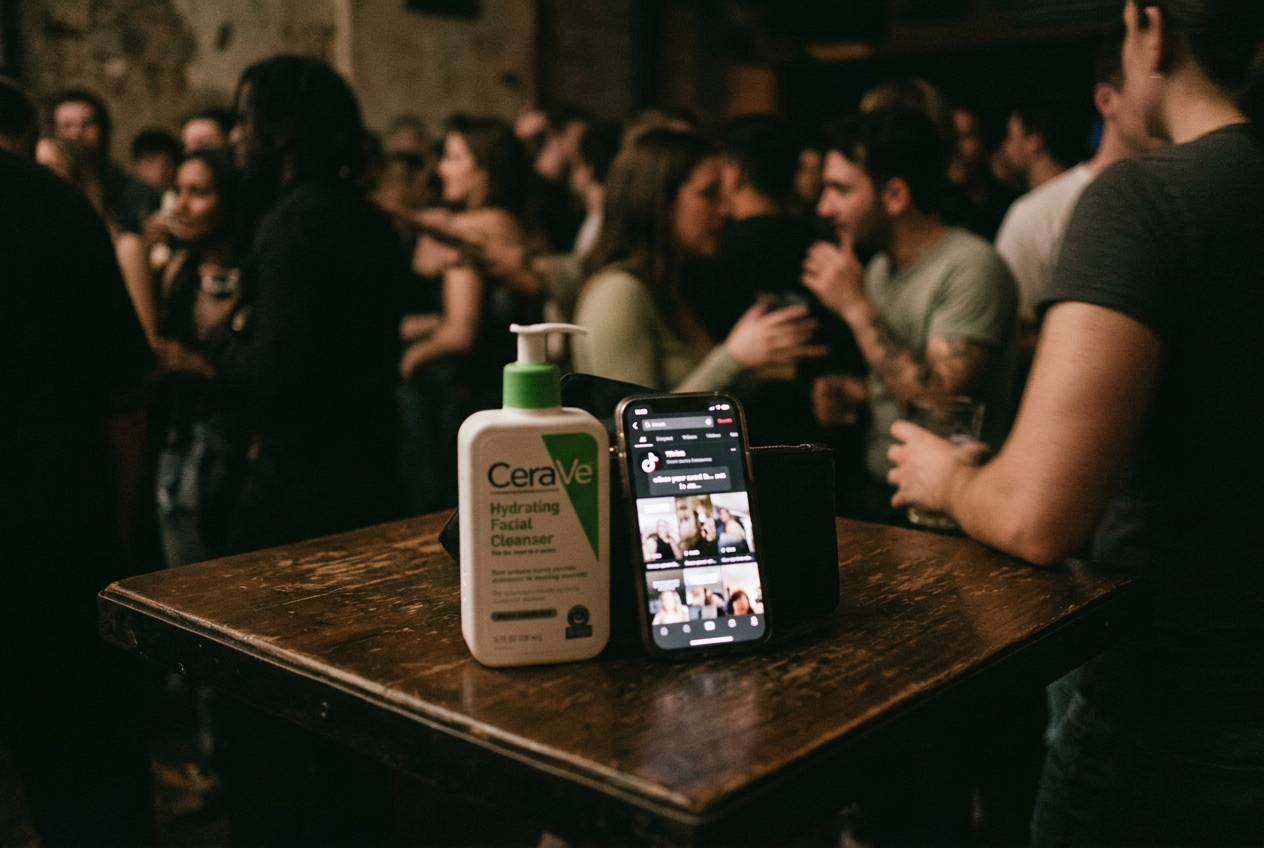
The green-and-white pump bottle is already in frame. Its label faces the camera. Still, the creator says CeraVe Hydrating Facial Cleanser in the opening seconds, repeats CeraVe Hydrating Facial Cleanser while demonstrating it, then names the cleanser again before the recommendation ends.
This is not pointless repetition. The bottle may be obvious to a viewer, but TikTok search cannot rely on obvious. It needs language it can process, compare and retrieve. The creator is speaking to two audiences at once: the person watching and the system deciding whether this video belongs under a product query.
I used that full product name as the anchor for a hands-on pass through TikTok search. I searched CeraVe Hydrating Facial Cleanser, the shorter CeraVe cleanser and the use-case phrase cleanser for dry skin, then compared the spoken audio with creator-written captions, automatic subtitles, on-screen text and the search language attached to results. This was a qualitative evaluation, not a ranking audit. Results shift by account, location and time, while TikTok does not expose the weighting behind them.
The pattern was clearer than the ranking. Videos built for retrieval kept returning to complete nouns. The product was rarely allowed to become it, this or the cleanser for long. Pronouns work in conversation because people hold context.
Search systems prefer another serving of the label.
The bottle has a query attached
CeraVe Hydrating Facial Cleanser is an awkward phrase to say repeatedly. It belongs on packaging. In ordinary speech, someone would name it once, hold up the pump bottle and move on. In search-shaped video, the full name behaves like a handrail: the opening claim grips it, the demonstration grips it again, and the closing recommendation often returns to a shortened but still recognizable version.
That repetition gives TikTok several chances to identify the subject. Automatic speech recognition, software that converts recorded audio into text, can turn the spoken name into machine-readable language. Creator captions and words placed over the video add separate textual signals. TikTok can then place those signals in an index, a database that connects content with terms people may search.
Indexing is not the same as ranking. A video can be understood as relevant without receiving a prominent position, and TikTok can weigh watch behavior, account history, recency and other signals it does not fully disclose. No outsider can inspect the recipe. The practical lesson available to creators is blunter: if the query appears in several readable places, the system has less ambiguity to resolve.
The bottle therefore becomes secondary evidence for the machine, even though it remains primary evidence for the viewer. Object recognition may help platforms identify what appears in an image, but a clean spoken product name is easier for a creator to control. Saying CeraVe Hydrating Facial Cleanser costs a few extra seconds. Leaving the subject implicit risks making the clip legible only to humans.
Speech becomes metadata
Search engine optimization, the practice of shaping material so a search system can retrieve it, used to leave its most visible marks on web pages. A recipe site repeated the dish name. A retailer expanded a product title until it carried every useful modifier. TikTok has moved that pressure into the mouth.
The new delivery style has recognizable habits. A creator states the exact topic before offering context. The next sentence restates it as a problem. Midway through, the creator names it again rather than trusting the viewer’s memory or the object sitting six inches from the phone.
The ending often compresses the whole clip into a searchable conclusion.
These habits are easy to mistake for bad scripting. Some of them are bad scripting. They also solve a platform problem. A clip arrives without the stable architecture of a conventional page, where a title, headings and body copy can tell a search engine what the page contains without forcing the presenter to speak like a product listing.
In vertical video, the face and voice carry much of that architecture.
The same construction appeared when I moved away from the cleanser. Searches around ADHD in women surfaced clips that repeated the diagnostic phrase while discussing a narrower trait or personal experience. Searches for a Severance ending explained favored a style in which the title and the words ending explained were spoken near the start, even when the viewer could already see the show named on screen.
Those checks matter because the pressure does not stop at commerce. A product name is clumsy but bounded. A diagnosis is not. Repeating a broad diagnostic query can pull a personal account toward a category claim, stripping away the qualifications that make health information responsible.
Plot summaries lose less when compressed, although they still start sounding as if the creator expects every sentence to be separated from its neighbors and filed alone.
Search intent enters the script
TikTok has made search demand visible to creators through tools such as Creator Search Insights, which presents topics people are looking for and may identify areas with relatively little existing content. Search intent means the task a person hopes to complete with a query. Once that intent becomes a production prompt, the query can shape a video before recording starts.
This reverses the familiar order of speech. A person does not begin with an observation and later decide how to title it. The likely search phrase arrives first. The script must then keep proving that it answers that phrase, because relevance is easier to signal through exact language than through implication, tone or accumulated context.
For the CeraVe bottle, that means the searchable noun survives every edit. A creator can remove a pause, a caveat or the sentence explaining how their skin reacted over time, yet the full product name remains useful to discovery and therefore difficult to cut. Search optimization does not ban nuance. It assigns nuance a weaker job.
The result sounds intimate because TikTok still favors the visual grammar of direct address: one person, one phone, little distance. The language underneath is less conversational. It resembles a database entry delivered with eye contact.
The system gets a cleaner answer
TikTok benefits when users treat it as a place to find an answer rather than merely encounter a clip. Search gives the platform another route to attention, especially for queries with commercial intent, where product discovery can lead toward ads, affiliate links or purchases. A video that announces its subject cleanly is easier to organize around that route.
Creators may benefit too. Search traffic can keep a useful video circulating after its first recommendation burst, while affiliate creators have a direct reason to align product language with the terms a potential buyer types. Brands gain from having their exact names reproduced in speech, captions and text overlays by people whose videos do not look like conventional advertisements.
The labor stays with the creator. They must research phrases, front-load the answer, subtitle the clip and tolerate a delivery that can feel unnatural. Even creators with nothing to sell absorb the style because platform conventions spread beyond their original incentive. Once enough high-visibility videos speak in query-ready sentences, ordinary speech begins to look underprepared.
There is a human cost in the listening. Repetition can aid comprehension, and accurate captions improve access for many viewers. Search repetition is not a substitute for either. Auto-generated subtitles still mishear accents, unfamiliar names and specialized language, while a creator who repeats a keyword has not necessarily corrected the transcript or made the rest of the video readable.
The platform’s preferred clarity is categorical. It wants a stable object, condition or plot question. Human clarity often needs the opposite: a pronoun whose meaning comes from context, a qualification delivered later, or room to change the description once the story becomes more complicated.
A voice built for retrieval
The CeraVe Hydrating Facial Cleanser bottle makes the trade visible because there is no mystery about what the viewer sees. The label is facing forward. The pump is in hand. The product still has to be spoken into existence for the system.
That is the shift. Search no longer waits outside the performance as a title added after recording. It enters the breath pattern, deciding which nouns return and which contextual sentences can be spared. Creators are adapting with skill, not gullibility.
They have learned that a searchable video must survive being heard by software before it can be found by a person.
By the final mention, the complete product name no longer sounds like emphasis. It sounds like a field being filled in.
Questions people ask
Does
TikTok search use spoken words from videos?
TikTok can use automatic transcripts and captions to understand a video’s subject, alongside written captions, on-screen text and behavioral signals. The company does not publish a complete ranking formula, so speaking a phrase offers no guaranteed position. It gives the system clearer language to associate with a query.
Why do
TikTok creators repeat exact product names?
Repeating an exact name creates several machine-readable matches while keeping the product identifiable if one transcript or text element fails. It can also align the clip with commercial searches. For viewers, the repetition may feel redundant because the bottle is visible and the context is already clear.
Are searchable captions the same as accessible captions?
No. Accessible captions aim to represent the full spoken content accurately, including relevant sound information where needed. Search-shaped captions emphasize terms likely to aid retrieval. The goals can overlap, but repeating a keyword does not fix transcription errors or preserve the qualifications that viewers need.
Who benefits when creators speak in search queries?
TikTok gains more organized content and another path to sustained attention. Brands receive repeated naming, while creators may gain discovery or affiliate income. Viewers can find direct answers faster, but they also receive speech shaped around categorical matches, with context competing for the seconds left over.
One update a day
Today's story, in your inbox
One story each morning — no hype, no filler, no algorithm deciding for you.