A Campus Protest Map Cuts the Cost of Watching Students
University incident pages and protest trackers turn scattered public facts into monitoring infrastructure. The danger is not one map pin. It is how cheaply the pins can be joined.
August 15, 2026 · 7 min read
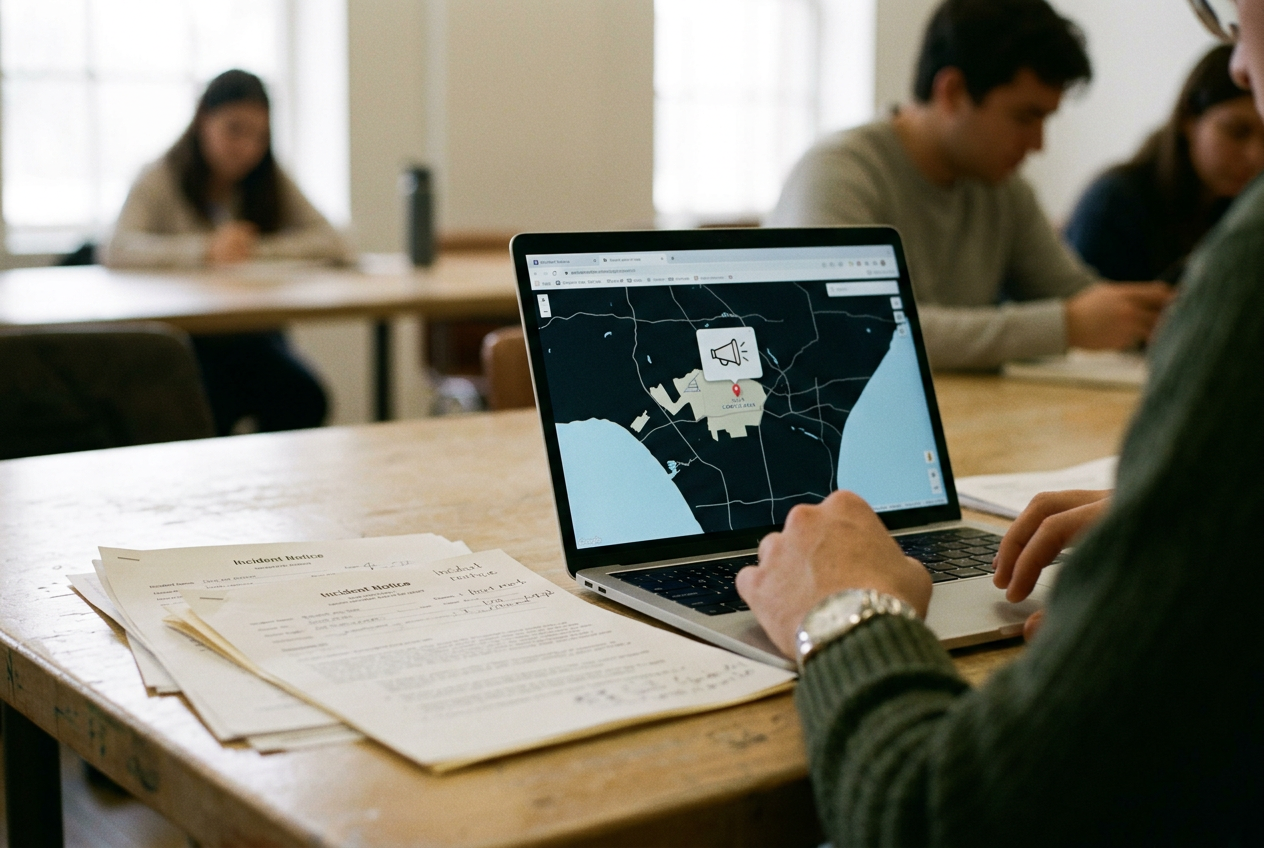
A pin sits over UCLA on ACLED’s US University Protest Tracker, part of a public map built during the campus demonstrations of 2024. Click around and the protest stops being a temporary gathering. It becomes an event object: a place, a date, a category, associated actors and a short account assembled from public sources.
The pin does not contain a secret. That is the point.
UCLA’s encampment was extensively reported. The university published updates about closures and police activity. News organizations documented confrontations and arrests. Participants posted their own material.
Anyone determined to reconstruct what happened could work through those records.
The tracker removes much of that work. It takes information produced for different purposes, applies a common structure and places the result beside other campus events. The UCLA pin can now be filtered, compared, exported or joined to another dataset. A demonstration that once required attention becomes available to a query.
That change is regularly described as transparency. It is also surveillance infrastructure.
The record beneath the pin
ACLED, the Armed Conflict Location & Event Data project, records political violence and protest as event data, meaning each reported occurrence is converted into standardized fields that computers can sort. Its university protest tracker brought that method to campus demonstrations. The Crowd Counting Consortium, an academic project that documents political crowds in the United States, has likewise published campus protest data drawn from news coverage, social media and submitted reports.
These projects have legitimate research uses. They help establish where protests occurred, how institutions responded and whether public claims about widespread disorder match the record. A durable dataset can protect against official forgetting, particularly when a university would prefer to describe police deployment as an isolated necessity rather than one decision in a national pattern.
But a dataset does not retain the purpose of the person who assembled it. Once published, its fields answer other questions with equal efficiency. Locations can show where students gather. Organizational labels can reveal which coalitions remain active.
event dates can establish cadence. Narrative notes can supply terms for further searches, while arrest counts and police presence identify campuses where participation carried a higher immediate cost.
Return to the UCLA pin. On its own, it says little that a newspaper archive could not say. In a structured collection, however, it can be placed beside later events at UCLA, filtered with protests at other University of California campuses and matched against public statements from student organizations. The analytical value and the surveillance value come from the same feature: reduced search cost.
Surveillance does not require a hidden camera or a classified database. It can begin with systematic observation, especially when the observer can retrieve a person’s political activity faster than the person can discover who is looking.
Universities supply the raw material
Third-party trackers do not build this visibility alone. Public universities maintain several overlapping publication systems, each defended by a different administrative need.
Emergency pages identify buildings, gates, roads and closure periods. Police departments publish daily crime logs under the Clery Act, the federal campus-safety law that requires certain institutions to disclose reported crimes and issue warnings about continuing threats. Newsrooms post incident timelines. Conduct offices explain rules applied to encampments.
Governing boards publish meeting material. Campus maps provide stable names and coordinates for spaces that student posts may describe informally.
None of these pages needs to call itself a protest dashboard. Together they can function as one.
A university update that identifies a plaza helps people avoid a disruption. A police log that records an arrest supports public accountability. An incident page that remains online after the danger has passed gives reporters a source. Once those records are indexed by search engines and copied into trackers, their audience expands from people dealing with an event to anyone compiling the political history of a campus.
The institutional defense is familiar: the information was already public. That claim treats accessibility as a switch. In practice, information has friction. A paper log inside a police station differs from a downloadable file.
A temporary notice differs from a permanent incident archive. A paragraph buried in an update differs from a row whose columns separate location, affiliation and police response.
Friction costs time. Removing it transfers power to whoever wants to monitor at scale.
The UCLA pin is useful because someone else completed the first pass: locating reports, reconciling descriptions and assigning the event a common format. An administrator reviewing activism across campuses no longer has to search each university site. A private intelligence firm can ingest the map’s underlying categories. A hostile campaign can use organizational labels as leads, then move to public social accounts, photographs and meeting announcements.
No evidence is required that every possible observer has already done this. Publishing decisions should be assessed by what they make cheap and repeatable, not only by the uses an institution happens to admit.
Public does not mean harmless
American privacy rules leave a large gap around protest activity. FERPA, the federal law governing education records, restricts disclosure of certain records maintained by schools. It does not turn every fact about a student into protected information, particularly when the fact comes from a public event, news report or police record.
That distinction matters legally. It does not settle the design question.
A student may appear in a public plaza without consenting to a permanent, searchable record of affiliations inferred from the event. A group may announce a rally without expecting its schedule to become one row in a longitudinal dataset, meaning a record that follows activity across time. The exposure grows when photographs, arrest reports, club pages and map entries share a date and location. Each source supplies a join key, a field that lets separate records be matched.
This is how identification can emerge without a dashboard publishing names. A tracker marks a small event. An incident page narrows the time and place. A student organization posts a photograph.
A public directory supplies a role. The resulting profile may be wrong, but the error does not make it harmless; it can send attention toward a person who was present as a reporter, legal observer, medic or passerby.
Universities understand contextual risk when the subject is security. They withhold operational details, limit access to camera systems and avoid publishing information that would make a building easier to breach. Protest data often receives the opposite treatment. The default becomes maximal detail because each fact can be justified separately.
The file is assembled downstream.
Transparency needs an expiration date
A better publication standard would preserve accountability while refusing to build a convenient political index. Universities could publish the minimum location needed for immediate safety, then remove granular event details when the warning expires. Archived summaries could use broader areas and wider time windows. Police logs should satisfy legal requirements without adding unsupported affiliations or copying protest slogans that make records easier to search by cause.
Third-party researchers have different obligations because comparison is their purpose. They can still limit harm. Public-facing maps do not need downloadable narrative notes. Rare events can be aggregated to the campus level rather than pinned to a small building.
Affiliation fields can describe broad participant types instead of reproducing every named coalition. Researchers who require detailed data can use controlled-access systems with terms, review and audit logs, rather than treating unrestricted publication as the only credible form of openness.
These measures carry costs. Aggregation reduces precision. Deletion makes later verification harder. Controlled access requires staff and favors institutions that can navigate an application process.
Those are real losses, especially for journalists and organizers documenting police conduct.
The answer is not to erase the official response while retaining only official language. Universities should preserve records showing who authorized police action, what rules were invoked, what force was reported and how disciplinary processes unfolded. Institutional conduct deserves durable detail. Student political activity deserves a higher threshold.
That distinction is absent from the UCLA pin. The map’s unit is the event, so the demonstration and the response occupy one container, even though the parties do not hold equal power or face equal exposure. A public university can retain lawyers, communications staff and records officers. A student can be reduced to a searchable association before applying for a job, crossing a border or attending another protest.
The map does not create that imbalance. It operationalizes it.
Questions people ask
Are campus protest maps public records?
Some underlying material may be public under state records laws, while third-party maps are generally publications assembled from open sources. Public status does not require every detail to be indexed forever, and universities still make choices about format, retention, searchability and how precisely they describe a location.
Do these trackers publish students’ names?
Many protest trackers focus on events rather than individual names. Identification can still occur when a precise time and place are combined with organization pages, photographs, arrest records or public directories. The monitoring risk comes from joining records, not only from a name appearing in one database.
Why are researchers collecting campus protest data?
Structured data can test claims about protest size, police response, arrests and geographic spread. It can also preserve evidence that institutions might minimize. The same standardized fields make monitoring easier, which is why publication design matters as much as research purpose.
What should universities publish instead?
They should provide enough detail for immediate safety and durable accountability for official decisions, while limiting granular student affiliations, exact protest locations after an event and permanent searchable narratives. The public needs a record of what the institution did. It does not need a ready-made index of who gathered where.
One update a day
Today's story, in your inbox
One story each morning — no hype, no filler, no algorithm deciding for you.