A Club’s Earplug Machine Is Where Its Safety Policy Gets Real
A yellow foam earplug in a visible dispenser says more than a venue’s safety page. Placement, price and staff knowledge decide whether hearing protection exists in practice.
September 4, 2026 · 7 min read
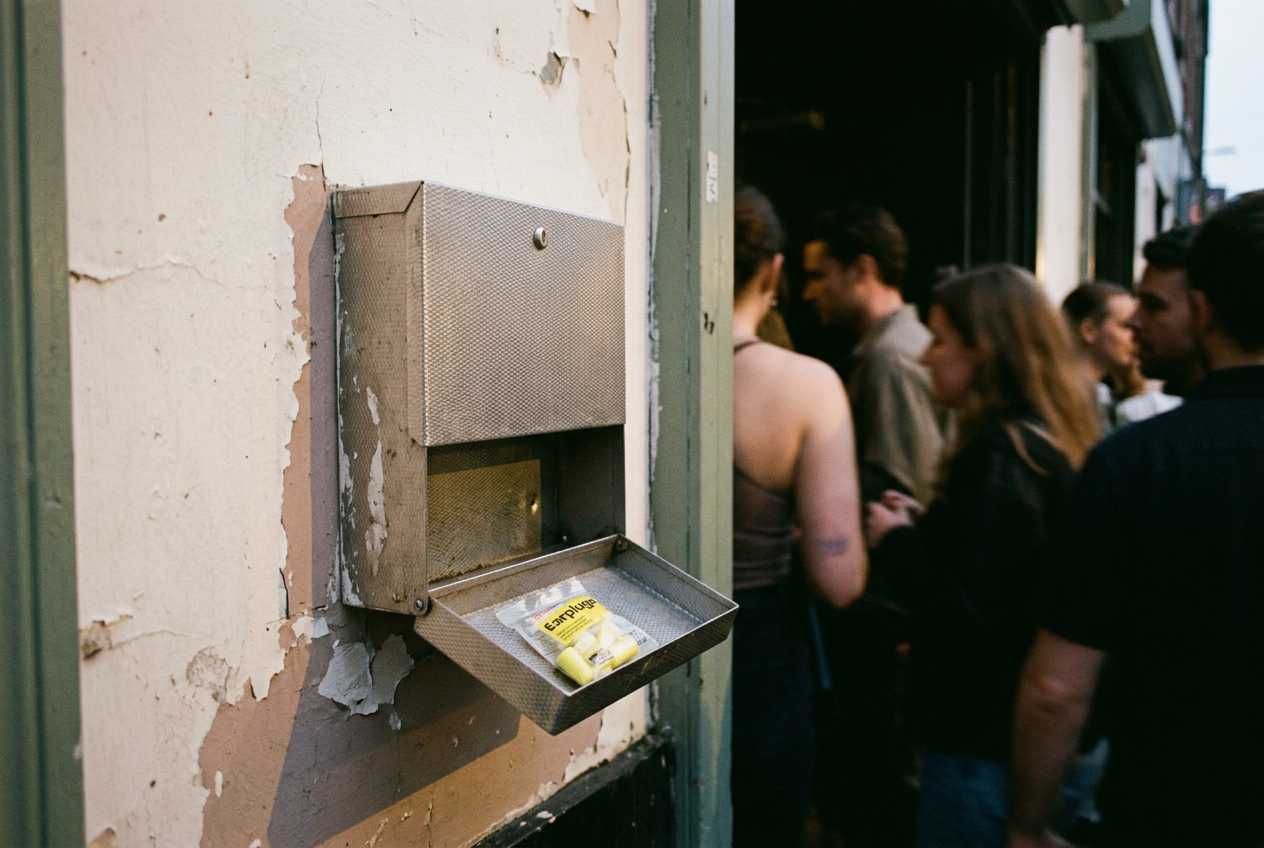
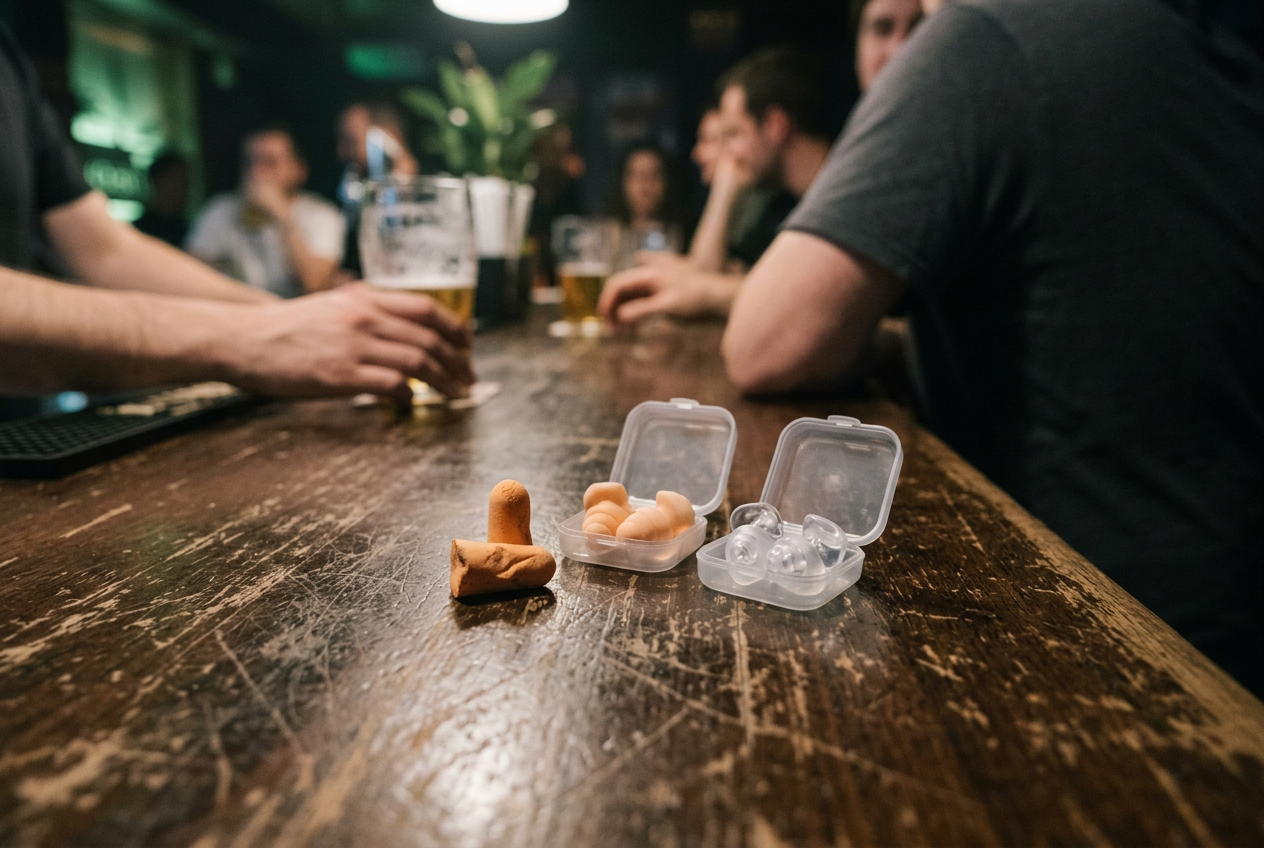
The useful object here is a pair of 3M E-A-R Classic earplugs: yellow PVC foam cylinders with flat ends, no string and the visual charm of industrial insulation. You roll each one into a narrow tube, insert it into the ear canal and hold it while the foam expands. Done correctly, the plug seals. Done halfway, it sits outside the canal like a tiny warning buoy and blocks much less sound.
That unlovely pair makes a good test of a club’s safety language because the product itself is ordinary. It is disposable, individually packaged and designed for environments where noise is expected rather than treated as a surprise. The difficult part is everything around it: whether the venue stocks enough, where it puts them, whether payment requires a functioning phone, and whether anybody on staff can explain insertion without miming an assault on the inner ear.
A club can place a jar behind the bar and call earplugs available. Technically, they are. The guest still has to identify that the room is too loud, abandon a place in the crowd, reach a bartender handling drinks and payments, then ask for a health item while shouting over the sound that caused the problem. Every step reduces uptake.
Provision without access is paperwork performed as interior design.
The machine changes who has to ask
A visible dispenser near the entrance moves the decision forward. You encounter hearing protection while your ears are still fresh, your hands are free and the person beside you can speak at a normal volume. That timing matters because sound exposure accumulates through intensity and duration: louder sound allows less exposure time before the risk of damage rises.
The vending machine also removes a social negotiation. Nobody needs to persuade a bartender that the bass feels harsh or disclose tinnitus, sensory sensitivity, an ear condition or a basic wish to leave with the same hearing they arrived with. The machine makes protection routine, closer to a coat check than a medical request.
Visibility does more work than the metal box. A dispenser should sit on the route people already travel, ideally before the ticket scan or immediately after it, with plain instructions at eye level. A machine beside an unmarked staff door may satisfy an operations checklist while failing the person entering the room. A machine inside the main dance floor has solved the problem after exposure has begun.
Payment adds another trap. A cash-only machine assumes coins. An app-only machine assumes a charged phone, signal, a payment account and enough patience to complete checkout in a queue. Free foam plugs remove those points of failure, although even a modest price can support stock control when the alternative is an empty bowl treated as communal confetti.
The relevant question is whether the transaction stays easier than giving up.
Someone pays either way. Disposable plugs cost the venue money, vending hardware needs stocking and card processing takes a cut. Charging the guest transfers a small operating expense to the person absorbing the room’s acoustic risk, while free provision treats hearing protection as part of running amplified sound. Clubs already budget for barriers, security and cleaning because the night cannot operate without them.
Earplugs belong in that category.
The yellow cylinder is good enough, with conditions
The 3M E-A-R Classic is not a music product. Its closed-cell foam is made to reduce noise, and a correct seal can make a loud room feel less punishing, but attenuation is not the same as fidelity. Attenuation means reducing sound pressure before it reaches the ear. Basic foam tends to alter frequencies unevenly, which can leave speech dull and music less open.
That tradeoff is easy to sneer at from the premium end of the market. It is also irrelevant when the immediate alternative is an unprotected ear. The yellow cylinder costs little relative to reusable filtered plugs, stores compactly and works across many ear shapes because the user compresses it before insertion. Its weakness is fit literacy.
A club that dispenses foam without showing the roll, pull and hold method is distributing potential rather than protection.
The instructions can fit on one card. Roll the plug into a narrow crease-free cylinder. Reach over the head and pull the outer ear upward to straighten the canal. Insert the plug, then hold it while it expands.
The finished plug should sit mostly inside the ear rather than hanging from the entrance. Staff do not need clinical training to point to that card, but they do need to know where it is.
The same pair returns as an operational audit. If the wrappers are damp, the dispenser is empty or the machine accepts a payment without releasing the packet, the club has assigned safety to an object and stopped supervising it. A member of staff should own the refill check during opening duties and again during the night. Otherwise the machine becomes another dead bathroom fixture with a reassuring label.
Reusable music plugs solve a different problem
Filtered earplugs such as the Etymotic ER20XS, Loop Experience and Alpine MusicSafe Pro aim to lower volume while preserving more of the frequency balance than basic foam. An acoustic filter, a small channel or membrane that controls how sound passes through the plug, can make conversation and musical detail easier to follow. These plugs are reusable, washable according to their care instructions and less disposable-looking in the ear.
They also demand more from the wearer. The tip must match the ear canal, insertion depth changes the seal, and a plug that presses against the canal can become irritating across a long set. Small parts get dropped on dark floors. Carry cases stay in other jackets.
Reusable plugs cost enough that losing one can sour the walk home.
Among common options, Loop Experience uses a ring-shaped body with replaceable silicone tips, Etymotic’s ER20XS uses a stemmed high-fidelity design with interchangeable eartips, and Alpine MusicSafe Pro pairs reusable plugs with selectable filters. Those differences matter to regular clubgoers who can test sizes in a quiet room and learn the fit. They matter less to the person standing at admissions who did not expect the venue to run this loud.
This is why a vending machine should not become a boutique earplug shop. The baseline product needs to be cheap, sealed and fast to understand. A venue may offer a reusable filtered option beside it, but premium stock cannot substitute for accessible foam any more than a branded water bottle substitutes for tap water. The first job is reducing the number of bare ears in the room.
A useful comparison happens during comparable sets, not one quiet opener and one punishing headline slot. The listener should note seal, comfort, speech intelligibility, bass definition and whether either plug works loose while moving, while keeping in mind that a subjective wear test cannot verify the protection achieved in an individual ear. Formal fit testing measures attenuation for the specific wearer. A pleasant-sounding plug with a poor seal may protect less than an inelegant foam cylinder inserted correctly.
Staff knowledge is part of the stock
Venue workers do not need to recommend a medical product. They should know that plugs exist, where to get them, what they cost and how the supplied model is fitted. They should also know what to do when the machine jams. This is basic product knowledge for an item the venue chose to install.
The distinction matters because harm reduction fails through small uncertainties. A security worker points toward the bar. The bartender points toward the coat check. Coat check has run out.
Nobody lied, and nobody provided an earplug. Distributed responsibility produces a clean incident report and a guest still standing in the room without protection.
Promoters and venue operators have an incentive to present high sound levels as part of the product while treating their consequences as personal preparation. Bring your own plugs. Stand farther back. Take breaks.
Those actions can help, but they cannot replace control by the party operating the sound system and designing the room. Hearing protection is the last layer, used after choices about level, speaker placement and exposure have already shaped the risk.
A machine is therefore evidence, not absolution. Its placement shows whether the club understands behavior. Its price shows who the club thinks should absorb the cost. Its condition shows whether anybody checks the safety feature after opening night.
The yellow foam pair is still the anchor because it leaves so little room for aesthetic distraction. Either a person can get it before the set and fit it, or the policy has failed.
The better roundup is a route through the room
Judging club earplug access should begin outside the room. Look for information on the ticket page, confirmation email and entrance signage. Follow the route from security to admissions to the dance floor. Record the first point at which protection becomes visible, whether obtaining it requires speech, what forms of payment work and whether instructions match the supplied plug.
Then return later. Availability at doors means little if stock disappears before the headline set, while a machine that staff can refill during service remains useful when demand peaks. Check whether packaging stays clean and dry. Ask a straightforward operational question about fit or a jammed machine and record whether the answer sends the guest to an identifiable place rather than into the organizational fog.
The wear test belongs after the access test. A filtered reusable plug may sound better, and custom-molded protection made from impressions of the wearer’s ears may fit better still, but neither rescues a venue that offers protection only to prepared regulars with spare money. The club’s duty is not to sell the perfect listening accessory. It is to make the adequate object obvious before somebody needs it.
Questions people ask
Where should a club put an earplug vending machine?
Place it on the normal entrance route, before or immediately after ticket scanning, where guests can see it under ordinary lighting and use it before exposure starts. A second access point near the main room helps with replacements, but it should not be the first time the venue mentions hearing protection.
Are foam earplugs good enough for club music?
Correctly fitted foam plugs can reduce sound exposure, although they may dull speech and change the balance of the music more than filtered reusable models. Their low cost and broad fit make them useful for venue distribution. The main failure is shallow insertion, so visible instructions matter nearly as much as the packet.
Should clubs charge for earplugs?
Free access removes payment friction and treats hearing protection as an operating cost of amplified sound. If a venue charges, the machine should accept a common payment method, display the price before purchase and remain cheaper and easier than seeking help from staff. A failed transaction is not meaningful provision.
Do premium music earplugs protect hearing better?
They can preserve musical detail and may feel better across a long set, but protection still depends on fit and seal. Reusable products suit regular clubgoers who can choose the right tip and practice insertion. For walk-up access, a sealed foam pair with clear fitting instructions remains the more practical baseline.
One update a day
Today's story, in your inbox
One story each morning — no hype, no filler, no algorithm deciding for you.