Filtered Earplugs Keep the Bass Without Wrecking the Morning
Foam blocks more, but filtered musician plugs preserve speech and the shape of a kick drum. The best protection is still the pair that seals properly and stays in all night.
August 27, 2026 · 7 min read
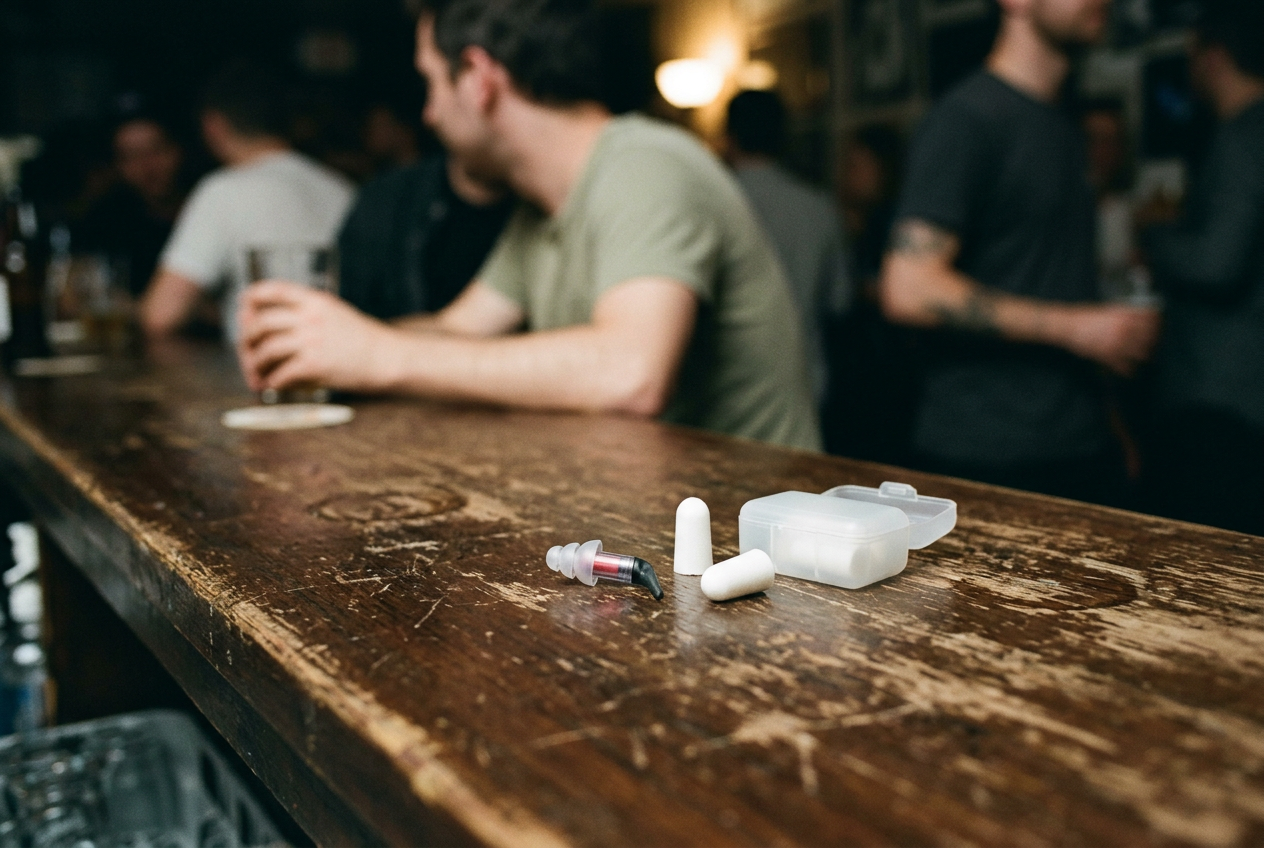
The narrow plastic stem of an Etymotic ER20XS looks like the least important object in a New Jersey club. The room has stacks, strobes, a bar trying to process six orders at once and a DJ leaning into a system built to make low frequencies physical. Then the stem loosens by a fraction and the whole room changes.
The hi-hat returns first. Conversation sharpens. The kick acquires a hard edge, then the full level arrives behind it. That tiny shift explains most of the earplug market better than the packaging does: protection depends on fit, while sound quality depends on which frequencies the plug reduces and how evenly it reduces them.
For this comparison, I rotated the ER20XS against disposable polyurethane foam plugs and a second reusable filtered pair through club sound in Jersey City and DIY rooms around New Brunswick. This was not a laboratory test. There was no calibrated measurement rig, and different rooms carry bass differently. I compared four things a person can judge without pretending to be an acoustics lab: speech, kick drum, seal stability and how my ears felt the next morning.
The ER20XS won. Not because it made a loud room safe by declaration, or because “high fidelity” is a magic phrase, but because it interfered least with the reason for being there. It stayed in.
The seal is the product
Earplug copy tends to sell attenuation, the reduction of sound reaching the ear, as though a printed rating follows the plug into every head. It does not. An Noise Reduction Rating, or NRR, is a standardized laboratory figure rather than a promise of real-world protection, where insertion depth, ear-canal shape and repeated adjustments all change the result.
Foam makes this obvious. Roll a polyurethane plug into a narrow cylinder, pull the ear slightly upward, insert it and hold it while it expands. Done properly, foam can produce a deep, stable seal and strong reduction across much of the audible range. Done halfway, it becomes a bright-colored cork balanced near the entrance of the ear canal.
Plenty of people wear foam that way because nobody at the door explains the hold-and-expand part.
A filtered reusable plug asks less of the user. The flanged silicone tip creates its seal mechanically, while a small acoustic channel or filter controls how sound passes through. It still has to fit. The ER20XS stem became the test’s recurring diagnostic tool: if the room suddenly seemed exciting when I touched it, the plug had shifted or I had been craving unprotected treble.
Neither was a reason to leave it loose.
Fit also changes through the night. Sweat collects. A jaw moves while talking. Someone catches the protruding stem while hugging you.
Disposable foam expands against the canal and tends to resist those small disruptions once seated, although deep insertion can become tiring. Reusable flanges are easier to remove and reinsert, which is convenient until convenience turns into constant fiddling.
That is the first real ranking. Foam had the strongest-feeling isolation when inserted correctly. The Etymotic had the most usable seal. The other filtered pair was easier to put in but worked loose more often, an apparently minor failure that erased whatever advantage its filter might have offered.
Bass survives for reasons the box does not explain
Club bass is not one thing. The fundamental is the lowest main frequency of a musical note, but the character of a kick drum also comes from higher-frequency attack, distortion and the room’s reflections. Remove too much of that upper information and the pressure remains while the drum loses its outline.
This is where foam sounded least flattering. The sub-bass still registered through the ear and body, yet vocals receded and percussion softened, leaving a thick low-end mass that could feel larger precisely because less competing detail survived. A person might call that “more bass.” It was less music.
Filtered musician plugs aim for a flatter response, meaning they reduce frequencies more evenly instead of heavily suppressing the upper range. They cannot reproduce the room at a lower master volume with perfect accuracy. Marketing enjoys that fantasy. In practice, the ER20XS kept enough attack on the kick to distinguish a tight club mix from a swollen one, and it preserved enough vocal information to follow a hook without pulling a plug halfway out.
The physical component remains. Low frequencies travel through the floor, chest and bones as well as through the ear canal, which is why hearing protection does not make a powerful system feel like laptop speakers. At a Jersey City club volume, the bass still pressed against clothing. In a New Brunswick DIY space, where the drums and amplifiers occupied a smaller room with less acoustic control, the plugs reduced the abrasive edge without removing the impact of the kit.
That distinction matters in scenes where loudness carries social meaning. A quiet system can read as underfunded or timid. A loud one suggests commitment, even when the room’s reflective surfaces turn commitment into punishment. Earplugs let venues and promoters preserve that equation without fixing it, shifting part of the responsibility onto the person standing near the stack.
Harm reduction starts from the room that exists, but it should not become free absolution for whoever controls the level.
Speech is where people surrender
A plug that preserves the set but destroys conversation will spend half the night in a pocket.
Foam struggled most at the bar and between performers. Speech lost consonants, especially with music still playing, and my own voice became intrusive through the occlusion effect, which makes internally conducted sounds such as speech and chewing seem louder when the ear canal is blocked. The usual response is to remove one plug. That creates an unprotected ear at the moment people stop paying attention to exposure.
The filtered pairs handled speech better, though neither made conversation effortless beside a loud system. The ER20XS preserved more of the crisp upper information that separates words, while its low-profile stem avoided the bulky plugged-up sensation of larger reusable designs. I could lean in, hear a sentence and answer without turning protection into a repeated administrative task.
That is why the winner cannot be selected from an attenuation chart alone. The person wearing maximum-reduction foam correctly for an entire set may be better protected than the person wearing a filtered plug badly. The person who removes foam every six minutes because friends sound submerged may end up worse off than someone using a less isolating filter continuously.
Behavior is part of the mechanism. The market treats comfort as a lifestyle bonus because protection ratings look more serious on a package, but comfort governs compliance, and compliance determines whether the object remains in the ear after the first good record drops.
The morning after is part of the test
Next-morning comfort has two components that are easy to confuse. One is irritation from the object itself: soreness, pressure or an unhappy ear canal after hours of contact. The other is how hearing feels after the room: dullness, ringing or unusual sensitivity. The second category deserves attention, and persistent or concerning symptoms belong with a qualified health professional rather than a product roundup.
Foam produced the most physical pressure during longer wear, especially when the plug expanded deeply and stayed there. A fresh pair was clean and soft, but disposable plugs also invite false economy. They end up in pockets, collect debris and return for another night because the bag is at home.
The reusable filtered plugs demanded their own maintenance. Earwax changes the filter and the seal. Silicone tips need cleaning according to the maker’s instructions and time to dry. A tiny plug dropped onto a DIY floor has completed its shift.
Put it in the case, not back in your ear.
The ER20XS caused less awareness by the end of the night than foam, which mattered more than any dramatic first impression. Its stem returned again at load-out, still seated, while the disposable pair had made me want to press at my ears and check the pressure. There is no universal fit hidden in that result. Ear canals vary, and anyone with pain, drainage, an ear condition or difficulty inserting plugs should stop treating trial and error as a character test.
The pair that gets through the door
The practical winner was the ER20XS because it balanced a stable seal with intelligible speech and a kick drum that retained its front edge. Foam remains the cheap, useful backup. It belongs in venue bathrooms, coat-check stations, behind bars and at merch tables, with simple insertion instructions visible rather than buried on a wrapper.
Promoters benefit when the room feels overwhelming. Venues benefit when the PA can compete with conversation. Earplug manufacturers benefit from presenting personal protection as a complete answer. The person buying the ticket pays for all three arrangements, then gets told to manage the consequences with an accessory small enough to lose in the lining of a jacket.
Keep a reusable pair attached to the same keys or bag used for shows. Keep foam as a second line, not as punishment for forgetting the preferred pair. Insert protection before the room feels painful, because pain is not a measuring instrument and a temporary absence of discomfort does not establish safety. Take listening breaks somewhere genuinely quieter when the space allows it.
The Etymotic stem went back into its small case after the final set. That case, more than the filter diagram, decided the result. It was compact enough to return to the next room.
Questions people ask
Do filtered earplugs remove all the risk from loud music?
No. They reduce sound only when they fit and remain sealed, and real-world exposure also depends on level, duration and distance from the speakers. This comparison is harm-reduction guidance, not medical advice or a declaration that any loud room becomes safe once plugs are inserted.
Are foam earplugs bad for club sound?
Foam usually removes more upper-frequency detail than a filtered musician plug, so vocals, speech and the attack of a kick can sound muted while low-frequency pressure remains. Properly inserted foam is still a valuable option, especially when the alternative is no protection at all.
Why does my voice sound strange with earplugs in?
The occlusion effect makes sound conducted through the body, including your own voice, seem louder when the ear canal is sealed. Filtered plugs may reduce that sensation for some wearers, but fit and ear anatomy matter. A strange voice is annoying; pain is a reason to stop and reassess.
Which earplugs should I bring to a club?
Bring the reusable pair that fits securely, preserves enough speech to stay inserted and lives in a case you carry consistently. Add fresh foam plugs as backup. If a design loosens whenever you talk or dance, its advertised filter performance is beside the point because the seal has already failed.
One update a day
Today's story, in your inbox
One story each morning — no hype, no filler, no algorithm deciding for you.