A Copyright Claim Can Take the Money Before Fair Use Is Tested
One disputed film clip can redirect a video essay’s revenue, trigger an appeal judged by the claimant and put the channel at risk. The legal merits arrive last.
August 22, 2026 · 8 min read
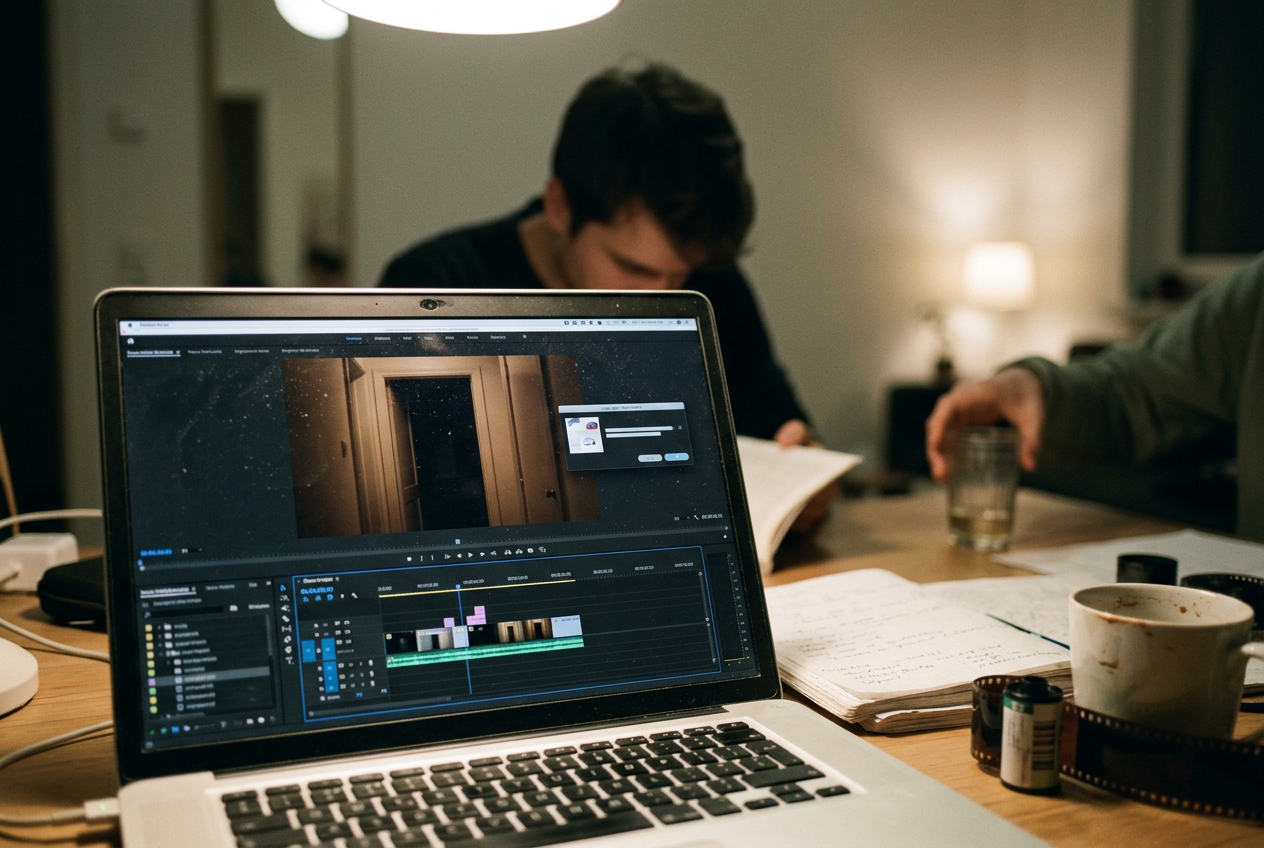
Consider one representative clip: nine seconds from a studio thriller, showing an actor framed in a doorway while the essayist explains how the blocking turns a domestic room into a threat. The film audio is muted. Narration runs over the image. The clip is cropped only to fit the essay’s layout, not disguised from detection.
A critic would recognize the purpose. The clip is evidence. A copyright filter recognizes something else: a sequence of images that resembles a reference file supplied by a rights holder.
That distinction controls the next several weeks.
The match comes before the argument
On YouTube, Content ID compares uploaded videos against reference files provided by approved copyright owners and rights-management companies. It does not ask why the doorway shot appears, whether nine seconds was necessary or whether the narration transformed its meaning. It asks whether the pattern matches.
A match can produce a Content ID claim, which is different from a copyright strike. Depending on the policy selected by the claimant, the platform may block the essay, track its viewing data or run advertising and direct the resulting revenue away from the uploader. The video can remain visible while its economic ownership changes behind the interface.
The claimant may be the studio. It may also be a distributor or a vendor administering a catalog across territories, formats and overlapping contracts. Automation makes that scale possible, but it also flattens the particulars. The doorway shot might be licensed to one company for television, another for streaming and another for music embedded in the scene.
The filter is very good at finding resemblance. It is not built to untangle a chain of title.
For the small publisher, the first practical problem is timing. Video essays earn most of their attention near publication, when subscribers receive notifications and recommendation systems decide whether the upload deserves wider circulation. A block during that window cannot be repaired by restoring the video later. An advertising claim is quieter but still effective: the essay can do its best business while somebody else collects the proceeds.
YouTube may hold disputed revenue while a claim is contested and later pay the party it determines should receive it. That protects an accounting entry. It does not reimburse the publisher for staff hours spent documenting the use, delayed sponsorship obligations or an upload whose launch was kneecapped by a territorial block.
Nine seconds have become an invoice.
The claimant gets the first appeal
The uploader can dispute the claim and explain why the clip is authorized, misidentified or protected by an exception such as fair use. Fair use is a US legal doctrine that permits some unlicensed uses after a fact-specific assessment of purpose, nature, amount and market effect. There is no universal safe number of seconds. Giving credit does not settle it.
Neither does declining to monetize the essay.
The doorway clip has a plausible argument. It is being used to analyze composition rather than substitute for the thriller, and the narration directs attention to a formal choice that a still image might not show as clearly. That does not guarantee a legal victory. This is an explanation of the machinery, not legal advice.
The important institutional fact is that the initial dispute generally goes back to the claimant. The party already benefiting from the claim gets to review the uploader’s objection and decide whether to release, reinstate or maintain it. YouTube supplies the procedure, but it does not ordinarily conduct a judicial fair-use analysis between the parties.
This is where the platform’s courtroom styling becomes misleading. There are forms, deadlines and escalating stages, yet the first adjudicator is one side of the dispute. The system treats the claimant’s catalog management as scalable infrastructure and the critic’s context as an exception requiring manual explanation.
That allocation is rational for the companies involved. Rights holders want enforcement without filing individual lawsuits. Platforms want copyrighted material handled without becoming the primary defendant or hiring enough specialists to review every contested excerpt. A rights-management vendor gets paid to find and administer matches.
Nobody in that arrangement earns more because a small video essay receives a patient reading.
The publisher pays for patience.
Escalation changes the kind of risk
If the claimant rejects the dispute, the uploader may be able to appeal. At that point, the doorway shot is no longer just a revenue problem. A claimant that maintains its position can seek removal through the platform’s copyright process, and a valid takedown can place a strike on the channel.
Repeated strikes can lead to channel termination. That threat reaches beyond the disputed essay because a channel is also an archive, a subscriber list, a reputation record and the route through which future work reaches an audience. The platform has bundled years of publishing into one account, then designed copyright escalation so that defending a single clip can expose the bundle.
A counter notification, the formal response to a copyright takedown under US law, raises the temperature again. It can require the uploader to provide identifying information and consent to a legal process, after which the claimant may pursue the matter in court to keep the material down. The exact route depends on the platform, territory and nature of the notice, but the structural choice remains: keep arguing and accept greater exposure, or abandon a use that may be defensible.
Large media companies can spread that exposure across legal departments and catalog revenue. A two-person publication cannot. It may have paid for research, editing, narration and motion graphics before the claim arrived, with no reserve for counsel and no appetite for placing the entire channel behind one disputed upload.
This is why saying that fair use remains available misses the mechanism. A right that costs more to defend than the work can earn is a right rationed by balance sheet. The publisher does not need to lose in court. It needs to believe that reaching court would be ruinous enough to avoid the route.
The doorway shot may be removed and replaced with a still. The narration may be rewritten around footage the critic no longer shows. The essay survives, technically, while the criticism becomes less exact because the platform made the evidence expensive.
The private court is a payment system
YouTube offers the clearest public map of this machinery, but the governing model extends beyond it. Meta’s Rights Manager lets approved rights holders supply reference files and apply actions to matching videos on Facebook and Instagram, including blocking content or claiming available advertising earnings. Short-form platforms also combine automated detection, licensed audio rules and repeat-infringement policies, though the controls and appeal routes differ.
These systems are usually discussed as moderation because they decide what stays up. Their sharper power is economic. They decide who receives money during uncertainty, who must spend labor to challenge that decision and whose account carries the downside if the challenge escalates.
The architecture emerged from a political bargain. US law gives online services conditional protection from liability for user uploads when they respond to qualifying copyright notices, while European rules place stronger obligations on many content-sharing services to address unauthorized works and provide complaint mechanisms. Neither framework requires every platform to operate the same automated filter. Scale and liability pressure made filtering attractive because software can process a volume of uploads that courts never could.
Software also makes a policy choice at machine speed. The reference owner begins with leverage. The uploader supplies context later. Revenue can move before the merits are settled, while the claimant risks little from making an aggressive match unless the conduct becomes unusually egregious and expensive to contest.
A more credible system would keep disputed revenue in escrow without impairing distribution, send close fair-use cases to a genuinely independent reviewer and impose meaningful costs on claimants that repeatedly assert rights they cannot support. Proportional claims would also matter: using nine seconds as evidence should not hand one rights holder the economic value of an essay built from weeks of original labor.
Those protections cost money. They slow enforcement and reduce the value of automated catalog administration, which explains why platforms prefer help pages about disputes to structural limits on claimants. The current design is cheap for the institution because it makes uncertainty expensive for the speaker.
The critic eventually replaces the doorway shot with a production still. The claim disappears. So does the movement through the frame that the paragraph was written to explain.
Questions people ask
Is a
Content ID claim the same as a copyright strike?
No. A Content ID claim may block, track or monetize a matching video without placing a strike on the channel. A strike can follow a formal removal request, and repeated strikes can threaten the account, which is why appealing a claim may carry more risk than the original match.
Can a short film clip qualify as fair use?
It can, but duration alone does not decide the issue. US courts weigh the purpose of the use, the nature of the original work, the amount taken and the effect on the market. A brief clip used as evidence in criticism may have a strong argument without receiving automatic protection from a platform filter.
Who gets paid while a copyright claim is disputed?
On YouTube, advertising revenue associated with a properly disputed claim may be held and later assigned after the dispute is resolved. That does not recover lost launch momentum, staff time or sponsorship complications, and a publisher may receive nothing if it drops the dispute rather than accept the risk of escalation.
Why do platforms let claimants review disputes against themselves?
It keeps enforcement scalable and shifts the cost of contextual review onto uploaders. Platforms avoid staffing a court for every matched clip, while rights holders retain fast control over large catalogs. The resulting procedure looks neutral on screen, but its incentives favor the party that supplied the reference file.
One update a day
Today's story, in your inbox
One story each morning — no hype, no filler, no algorithm deciding for you.