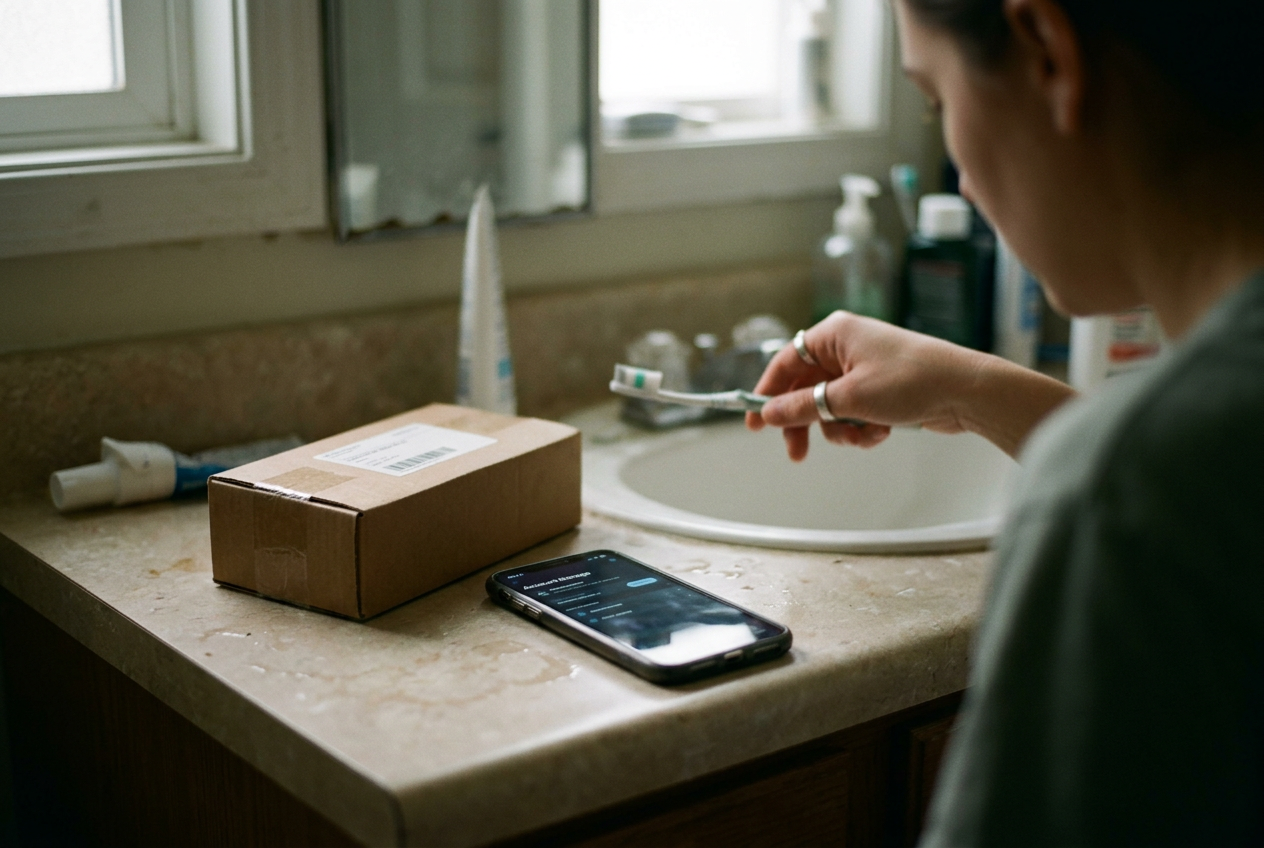
A Fentanyl Test Strip Cannot Clear the Rest of the Bag
A strip can detect fentanyl in one prepared sample. Its real value depends on clean handling, correct dilution and refusing to treat one line as a certificate of safety.
August 11, 2026 · 8 min read
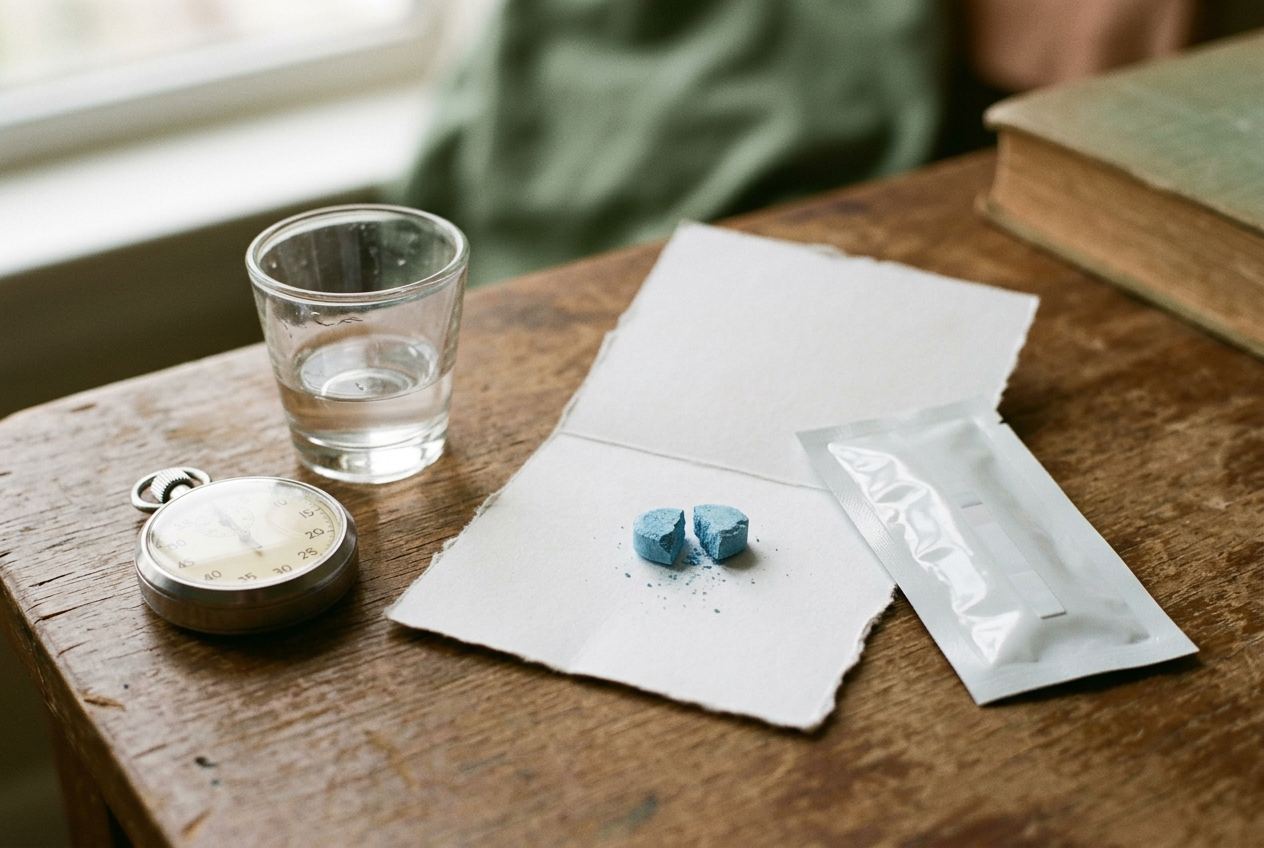
The object on the table is a chalky blue pressed pill, broken once along its score line, beside a wrapped fentanyl test strip, a clean glass cup and a timer. This is the entire promise of rapid drug checking reduced to a still life: ordinary objects, a few minutes and one narrow answer.
That answer matters. It can change whether someone uses a drug, carries naloxone, avoids using alone or discards the supply. It can also be misunderstood with lethal confidence, especially when a negative result gets repeated as “tested” and begins traveling through a group chat as though one strip cleared every pill in the bag.
It did not.
A fentanyl test strip is usually a lateral-flow immunoassay, a paper-based test in which antibodies react to a target chemical as liquid moves along the strip. The strip does not inspect a pill. It inspects the portion dissolved in the cup, under the concentration and timing conditions described by that product’s instructions.
Start with the instructions, not internet folklore
Different strips have different water ratios, dipping times, detection thresholds and coverage of fentanyl analogs, which are chemicals related to fentanyl but not necessarily recognized equally by every assay. Read the insert supplied with the exact strip. If a harm-reduction program provided it, use that program’s written instructions rather than a screenshot detached from its brand and context.
Wash and dry your hands. Use a clean container and clean stirring tool on a surface without loose powder. Cross-contamination can create a positive result that belongs to residue on the cup rather than the material being checked, while an unwashed container used for several samples makes every later answer harder to trust.
Do not dip the strip directly into loose powder. The material must be dissolved according to the manufacturer or program instructions, and the ratio matters more than it appears. Too little water can put some drugs at concentrations high enough to interfere with the assay. Too much can dilute fentanyl below the strip’s detection threshold, the lowest concentration it can reliably register.
The blue pill is where the first serious limitation arrives. If only one crumb from one edge enters the cup, the strip can report accurately on that crumb while missing fentanyl elsewhere in the pill. Illicitly manufactured tablets and powders are not pharmaceutical products with dependable mixing controls. Fentanyl can be distributed unevenly, a sampling problem often described as the chocolate-chip effect, although the tidy phrase understates how irregular the distribution can be.
Crushing and mixing the whole pill before taking a sample can improve representation. Testing material from several parts of a powder may also reduce the chance of selecting an unrepresentative speck. Some guidance recommends dissolving the full amount intended for use, which gives the strip a better shot at encountering fentanyl in that amount, but the correct handling and any recovery of the tested solution depend on the product and local program. There is no responsible universal recipe.
If the bag contains several blue pills, testing one still says nothing conclusive about its neighbors. They may share a color and stamp while coming from different mixtures or having different concentrations within the same batch. Appearance is packaging, not chemistry.
The line pattern runs against familiar intuition
After the sample is dissolved at the instructed ratio, hold the strip by the solid end and place the absorbent end into the liquid only as far as the marked limit. Leave it for the stated time, set it on a clean flat surface and read it inside the specified window. Reading too early can catch an incomplete reaction. Reading long afterward can produce drying marks that were never valid results.
Many fentanyl strips use a competitive assay. On these products, two lines usually mean negative, even when the test line is faint, while a single control line means presumptive positive. That is the reverse of the visual logic people remember from many pregnancy tests. An absent control line means invalid, not negative; the strip failed and the sample needs a new test.
Verify the diagram on the packet because line positions and interpretation can vary. A faint second line counts only when it appears in the right place, within the reading window, on a product whose instructions define that pattern as negative. Squinting at a gray mark twenty minutes later is not analysis.
A positive result means the assay detected its target at or above its working threshold in that liquid. It does not reveal how much fentanyl is present, whether the dose is consistent through the supply or which other substances are there. A strip cannot distinguish a trace contamination from a concentration carrying far greater overdose risk.
A negative result is narrower still. It means the strip did not detect the substances it recognizes, above its threshold, in the prepared sample. Fentanyl may have been outside the sampled portion, present below the cutoff or represented by an analog the strip does not detect well. The result also says nothing about xylazine, nitazenes, benzodiazepines or any other untested compound.
That long sentence people use, “It tested negative for fentanyl,” needs its missing clauses restored. This sample tested negative, on this strip, at this dilution, at this time.
Cross-reactivity is chemistry, not user failure
Antibodies are selective, not omniscient. Cross-reactivity occurs when the assay responds to a different chemical that resembles or otherwise interacts with its intended target. Published evaluations and harm-reduction guidance have found that some fentanyl strips can produce false-positive results when certain drugs, including methamphetamine or MDMA, are present at high concentrations; diphenhydramine has also interfered with some assays.
That does not mean a positive result around stimulants should be waved away. It means concentration and product-specific instructions matter. Guidance for some strips recommends further dilution and retesting when a known interferent may be present, but improvising by flooding the cup with water can create the opposite problem and move fentanyl below detection. Follow the strip’s protocol or ask the supplying program for help.
False negatives have their own routes. Poor sampling, excess dilution, an expired or damaged strip, incorrect dipping depth and a result read outside the window can all undermine the answer before the assay’s chemistry even becomes the issue. Storage matters too. Heat, moisture and a torn wrapper are not cosmetic defects for a paper test built around biological reagents.
The blue pill has now been crushed, mixed and sampled correctly. The strip can still answer only its assigned question. Correct technique reduces avoidable uncertainty; it does not turn a screening tool into a laboratory.
Cheap testing shifts the burden onto the person at risk
Strips spread because they are portable, quick and inexpensive compared with instruments requiring trained staff. That makes them useful to syringe-service programs, outreach workers, venues and individuals shut out of formal drug-checking services. It also makes them attractive to institutions that want a visible intervention without funding the slower infrastructure around it.
A community drug-checking service can combine strips with techniques that identify a broader range of chemicals, then interpret the findings with someone who understands the sample and the limits of each instrument. Laboratory methods can provide far more detail, although even sophisticated analysis depends on what was submitted. The strip places sampling, timing and interpretation in the user’s hands, then compresses the result into lines simple enough to overstate.
That overstatement has a social life. A seller can call a supply “tested.” A friend can pass on a negative result without mentioning that one corner of one pill went into the cup. Public agencies can distribute strips while access to naloxone, supervised consumption, medical care and comprehensive checking remains patchy.
The strip works for those systems when its narrow answer gets mistaken for a complete intervention.
It should be treated as one layer. If fentanyl is detected, the safest option is not to use the supply. If someone uses despite the result, harm-reduction guidance includes having naloxone available, avoiding mixing drugs, using with another person present and starting with less rather than assuming a familiar dose behaves normally. A negative result does not cancel those precautions.
Dispose of the test without creating another exposure
A used strip is single-use. Put it in the trash where children and animals cannot reach it, unless the supplying program gives different local instructions. Do not reuse it, pass it to someone else or preserve it as proof that an entire batch was checked.
The cup deserves more attention because leftover liquid can still contain active drug. Do not taste it, leave it open or pour it back into the original bag. Follow the strip maker or harm-reduction program’s instructions for disposal and, where specifically supported, recovery. Keep any residue away from food containers and shared surfaces.
Clean the cup and work area with soap and water. Accidental brief skin contact with fentanyl is unlikely to cause overdose, but visible powder should still be avoided and removed without touching the eyes, nose or mouth. Do not use bleach or alcohol-based hand sanitizer as a substitute for washing contaminated skin.
Then throw away the blue pill’s empty wrapper and record what was tested if the result will be shared: which pill, which strip, how the sample was prepared and whether the result was positive, negative or invalid. Leave out those details and the finding becomes gossip with a line on it.
Questions people ask
Can a fentanyl test strip tell me how strong a drug is?
No. It gives a presumptive positive or negative result around the strip’s detection threshold. It cannot measure the amount of fentanyl, map uneven concentration through a pill or powder, or show whether the sample contains a dose likely to cause overdose.
Does a faint second line mean a little fentanyl was found?
Usually not on common competitive fentanyl strips. If the manufacturer says two lines mean negative, a faint test line read within the proper window still counts as negative and does not measure quantity. Check the packet because products differ, and repeat any unclear or invalid test with a new strip.
Can one negative strip clear every pill in the same bag?
No. One result belongs to the material that reached the cup. Separate pills can vary, and fentanyl may be unevenly distributed within powder or a single tablet. Better sampling reduces that uncertainty but cannot certify unsampled material or compounds outside the strip’s detection range.
What should I do after a positive fentanyl result?
The safest choice is not to use the supply. Keep the strip result in context, tell anyone sharing the material, and use additional overdose precautions if use continues, including naloxone and another person present. A positive strip cannot tell you the concentration, so familiarity with the source offers no reliable protection.
One update a day
Today's story, in your inbox
One story each morning — no hype, no filler, no algorithm deciding for you.