A Locked Phone Turns School Discipline Into a Vendor Contract
New Jersey schools are buying phone-free days from private vendors. The pouch stays with the student, but control over communication moves to the district.
August 11, 2026 · 8 min read
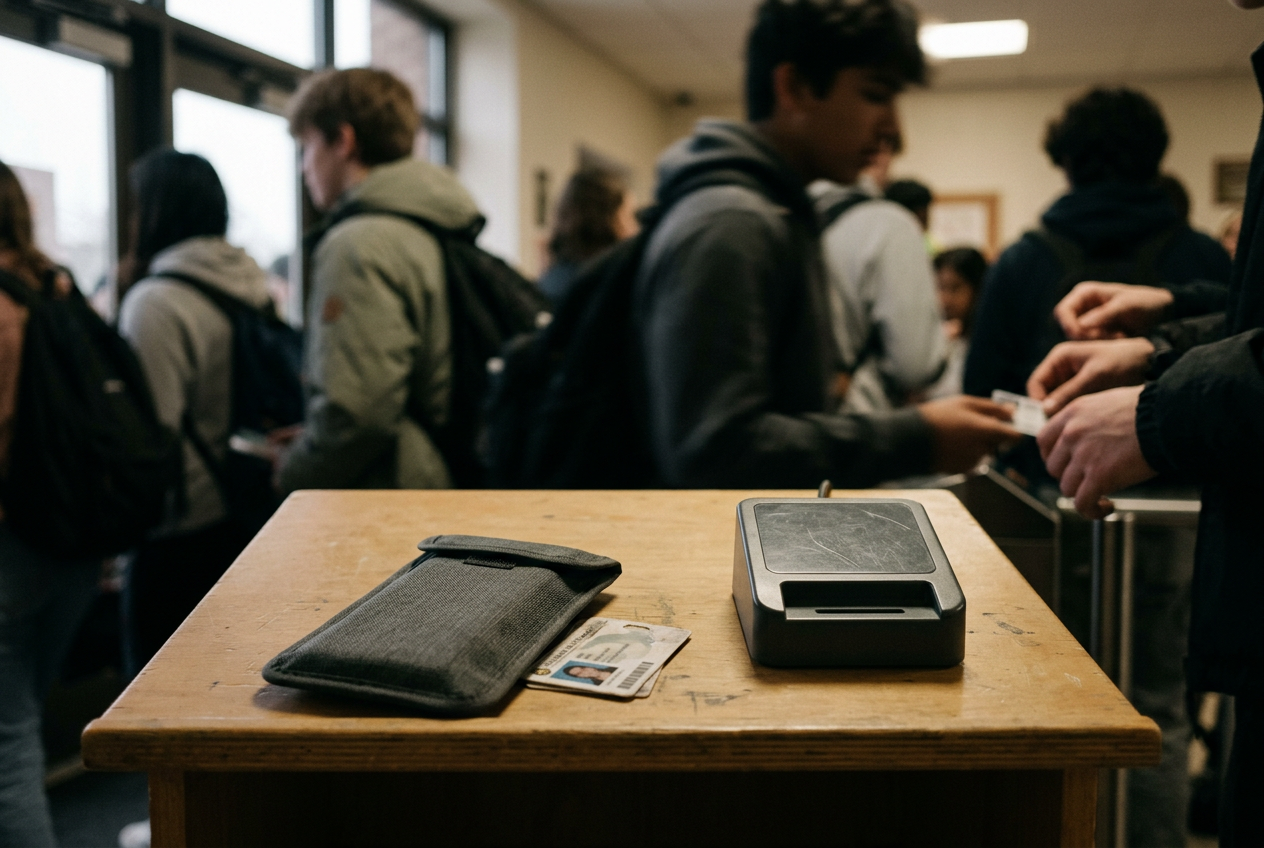
At the start of the school day, a Jersey City student places a phone inside a Yondr pouch, closes its rigid locking head and keeps the fabric sleeve until dismissal. The phone has not been confiscated. It remains inches from the student, unusable unless someone with access to a compatible unlocking device releases it.
That distinction sells the system.
Jersey City Public Schools joined a growing group of New Jersey districts using Yondr, the best-known brand in the category, as schools moved from rules restricting phone use to physical systems built to prevent it. Public board materials and district notices describe a rollout across secondary schools. The product converts a familiar disciplinary argument into a daily access-control procedure: lock in, carry, unlock, repeat.
A pouch looks modest enough. It is a fabric sleeve attached to a proprietary lock. Yet the district is purchasing more than sleeves. It needs enough pouches for a changing student population, fixed or portable unlocking stations, procedures for students who arrive late or leave early, replacements for damaged equipment, staff time at entrances and exits, and a policy for every moment when the routine fails.
The contract gets the easy part. The student handbook gets the rest.
The lock changes the rule
A conventional phone policy tells a student what conduct is prohibited. Keep the device away during class. Do not record people. Surrender it after a violation.
Enforcement happens after a teacher observes behavior, which leaves room for discretion, inconsistency and the old exhausting contest over whether the rectangle under a desk was a phone.
The pouch changes the sequence. Every student begins under restriction, before any misconduct occurs. Compliance becomes visible through the condition of an object: sealed or open, intact or damaged, present or missing. A teacher no longer has to establish that the phone disrupted class.
Staff can inspect whether the pouch has been breached.
This is surveillance in its administrative form. The system does not need to read messages or collect location data. It makes compliance legible by attaching it to a standardized container that can be checked throughout the day, while any attempt to regain access becomes evidence of a separate offense.
For administrators, that is the appeal. A rule asks hundreds of adults to make judgment calls. A locking program promises one condition for everyone. It also gives the district a physical answer to the claim that selective enforcement targets certain students more heavily, though equal distribution of hardware does not guarantee equal punishment when a pouch is missing, damaged or found open.
The Jersey City pouch returns here as more than packaging. Its locking head is the point where school authority becomes mechanical. Once it clicks shut, the student cannot comply differently, use better judgment or invoke an ordinary exception without finding an authorized adult and an unlocking station.
Procurement writes only part of the policy
School board approvals tend to present phone-locking systems as purchases with a vendor name, a contract period and an authorized spending ceiling. Those documents matter, but they rarely tell families how many minutes dismissal will take, where a student with an early medical appointment gets released, or who has an unlocker during an evacuation.
The operational obligations appear elsewhere. District announcements describe morning locking and afternoon release. Student rules assign responsibility for keeping the pouch intact. Vendor materials frame implementation as a managed program, which can include planning, staff preparation, unlocking equipment and replacement stock alongside the pouches themselves.
That structure creates a recurring relationship even when the public approval looks like a one-time order. Pouches wear out. Students enroll after the initial distribution. Locking heads fail.
Unlockers must remain available and controlled. A district that standardizes around one proprietary mechanism cannot replace one component with an ordinary pencil case or a generic magnet from the supply closet without undermining the procedure it bought.
The vendor therefore sells institutional consistency, not advanced technology. Yondr’s system is deliberately low-tech compared with software that blocks applications or monitors school Wi-Fi, and it does not require the district to install an app on a student’s personal device. That reduces one category of privacy risk. It also concentrates the program’s value in proprietary hardware and the rules wrapped around it.
This arrangement works for the vendor because discipline produces predictable demand. A pouch damaged during an argument is another unit to replace. A larger incoming class requires more inventory. A new campus needs unlocking points and training.
The district pays because abandoning the system means returning to the behavior problem officials said the purchase would solve.
Parents may hear that the school bought pouches. Procurement shows the more durable transaction: the district selected an external operating model for controlling student communication.
Failure becomes misconduct
Every physical system fails somewhere. Students forget pouches. Locks jam. Fabric tears.
A phone rings inside a sealed sleeve. Someone arrives after the entrance staff have moved on. Someone else needs to leave before the dismissal stations open.
School rules decide whether those events count as logistics or defiance.
Across publicly available New Jersey policies and rollout materials, districts commonly place responsibility for the assigned pouch on the student. Deliberate damage can trigger discipline, confiscation of the phone or a replacement charge, depending on local rules. A student who reports a broken lock and a student who forced it may present the same object at the office. Staff must infer intent from the damage, the student’s history and whatever explanation survives the morning rush.
The pouch has now produced a new disciplinary category. Before the program, a student could violate the phone rule by using a phone. Under the locking system, the student can also violate policy by mishandling the district’s access-control equipment, failing to bring it, opening it outside an approved location or refusing the entry ritual.
That expansion matters because school discipline is never distributed on hardware alone. Students with unstable housing, split households or chaotic commutes have more opportunities to lose an assigned object. Families with less disposable income feel a replacement charge differently. Disabled students may need immediate device access for health monitoring, communication or assistive functions, which means the exception process has to work before the pouch closes, not after a crisis begins.
Formal accommodations through an individualized education program or a Section 504 plan, which protects students whose disabilities require school accommodations, can preserve access. The burden still falls on families and staff to document the need, translate it into a daily procedure and make sure every adult enforcing the system knows that the exception is legitimate.
Uniformity is efficient until a person does not fit it.
Emergency access belongs to the institution
Districts promoting phone-free schools often argue that personal phones can worsen emergencies by spreading rumors, distracting students from instructions or overwhelming cellular networks. Those are plausible risks. A room full of students calling home during a lockdown can complicate an already dangerous event.
The pouch answers that problem by deciding in advance who may communicate. Students receive information through teachers, administrators, alarms and school communication systems. Families contact the main office or wait for district alerts. If individual access becomes necessary, an authorized adult must release the phone or direct the student to an unlocking point.
This is not the absence of an emergency plan. It is an emergency plan in which institutional communication takes priority over personal communication, even though the institution may be managing incomplete information, damaged infrastructure or the same panic it has removed from students’ hands.
The hard case is not a normal dismissal, when the Jersey City pouch reaches a staffed unlocking station and opens as designed. It is an evacuation that moves students away from fixed equipment, a lockdown that restricts staff movement, or a medical event measured in seconds. Portable unlockers can reduce that risk, but only if the district bought enough, placed them correctly, trained staff and kept access available without making the system easy to defeat.
Public procurement records do not usually let a parent test that chain. A board can approve the vendor without publishing an equipment map or a failure drill. Security concerns may justify withholding some details, but the result is a familiar asymmetry: students must surrender immediate access under a procedure whose emergency redundancies they cannot inspect.
The relevant question for oversight is whether a district can explain who holds unlocking authority in every setting where students are required to carry a sealed device. That includes buses, athletic travel, field trips, after-school detention, early dismissal and evacuation sites. If the answer changes by building or depends on finding one administrator, the system is less universal than the sales pitch.
The alternative is less tidy
Schools can restrict phones without buying proprietary pouches. Classroom caddies leave devices visible but transfer custody to teachers. Lockers keep them farther away but create access and liability problems. Collection bins invite disputes over damage and ownership.
Enforcement-based rules preserve student access between classes, though they return discretion to teachers and consume instructional time.
None offers the clean administrative image of a sealed pouch carried by its owner. That is Yondr’s useful compromise: the school avoids taking physical possession while retaining practical control. If the phone is scratched inside the sleeve, it remained with the student. If the student needs it, the school still controls the release point.
The purchase may reduce classroom interruptions. Public reporting from schools using phone restrictions has documented teachers and administrators describing calmer rooms and more student interaction. Those outcomes do not settle the governance issue. A program can improve instruction while assigning emergency authority badly, producing unnecessary fees or making a private supplier part of the district’s disciplinary infrastructure.
The standard should be higher than whether students talk more at lunch. Districts should publish the full operating cost, replacement terms, accommodation procedure, disciplinary consequences and emergency unlocking protocol in language families can find before rollout. Board members should distinguish consumable inventory from continuing vendor services, and ask what happens if the company raises prices or the district ends the program.
At dismissal, the pouch opens and the phone returns to being an ordinary possession. Until then, its rigid locking head carries a chain of decisions that the purchase order barely describes.
Questions people ask
Can students open a Yondr pouch during an emergency?
Students generally need an authorized unlocking device, which may be fixed at an exit or carried by designated staff. Emergency access therefore depends on the district’s equipment placement and procedures. A policy that only explains normal dismissal does not establish how phones will be released during evacuation, lockdown or a medical incident.
Do phone pouches collect student data?
The basic Yondr pouch is a physical locking product rather than an app, so it does not need to inspect messages or track a phone’s location. The surveillance mechanism is institutional: staff monitor whether the assigned pouch is present, sealed and undamaged, then treat its condition as evidence of compliance.
Who pays when a school phone pouch breaks?
The answer depends on district policy and whether staff classify the damage as ordinary failure, loss or deliberate tampering. Some school rules allow replacement charges or discipline. That makes the failure procedure important, because the same broken lock can be treated as a maintenance problem for one student and misconduct for another.
What are districts buying beyond the pouch itself?
A functioning program can require unlocking stations, portable release devices, replacement inventory, implementation support, staff training and continuing coordination with the vendor. The larger purchase is a standardized discipline system whose daily operation depends on proprietary hardware, school labor and rules for every exception.
One update a day
Today's story, in your inbox
One story each morning — no hype, no filler, no algorithm deciding for you.