
A New Jersey Bet Starts With a Scan of Your Phone
The location check that makes a New Jersey wager legal also opens a wider data channel. Betting apps document collection that reaches into devices, behavior, identity and advertising.
August 14, 2026 · 8 min read
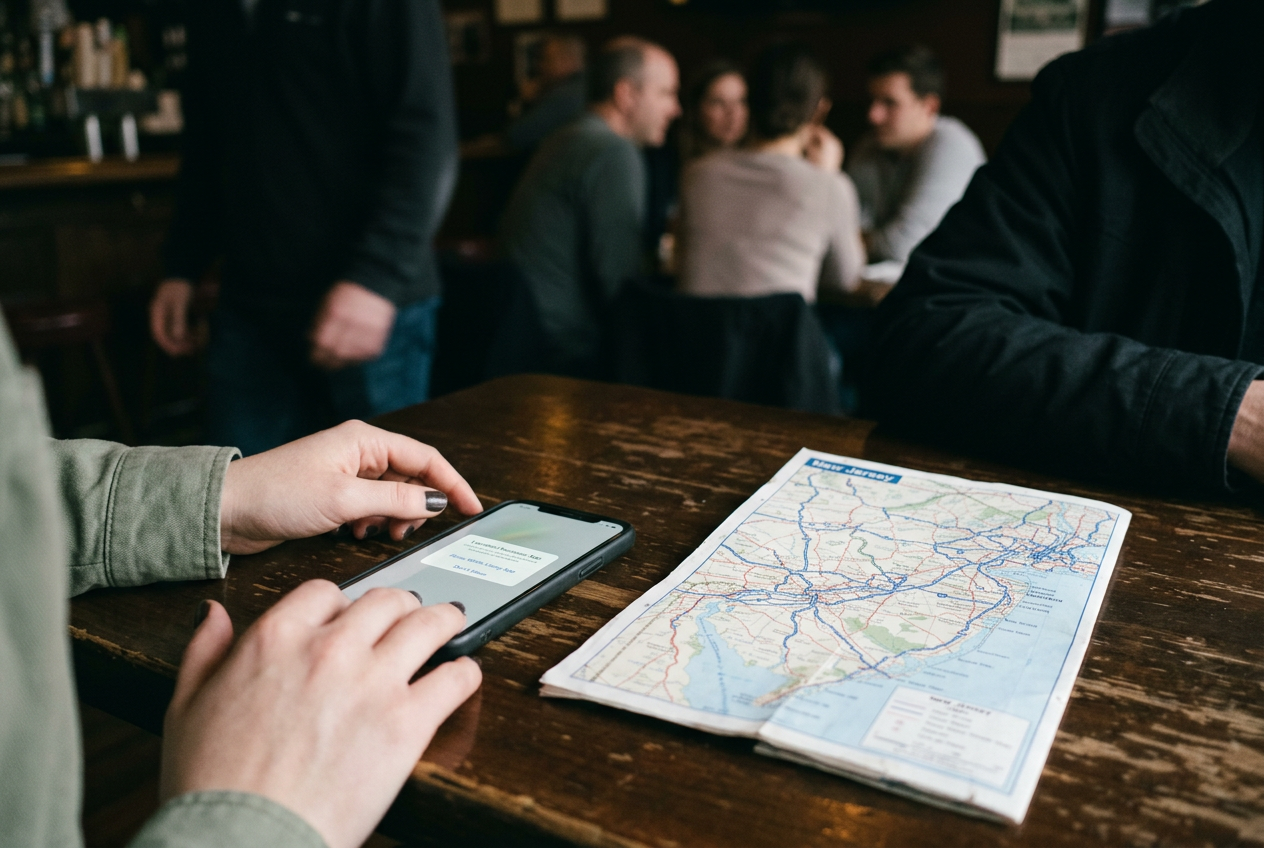
The most revealing part of a New Jersey mobile bet arrives before the odds matter. Open FanDuel, choose a line and try to wager. The app has to establish that the phone, and therefore the person holding it, is inside a jurisdiction where the transaction is permitted.
That location permission prompt looks like a tollbooth. It is closer to a lobby.
FanDuel’s public privacy materials describe the collection of geolocation information alongside account details, payment and transaction records, device information, internet activity and interactions with its services. Its app-store privacy label, a disclosure supplied by the developer rather than an independent audit, sorts data into Apple’s categories for tracking, data linked to a user and data not linked to a user. DraftKings and BetMGM publish similarly broad notices, although their wording and declared categories differ.
The point is not that every category is captured every second, or that a privacy policy proves a company performs every act it reserves the right to perform. These documents are written to preserve operational room. That room is the story. A regulated wager gives an operator a strong reason to identify you, locate you and retain evidence of what happened; once that machinery exists, the same account can support fraud controls, product analytics, promotion and advertising measurement.
The bet is the regulated transaction. The surveillance system is the infrastructure wrapped around it.
The legal border lives inside the phone
New Jersey permits online sports betting under a territorial condition: the bettor must be physically located within the state when the wager is placed. An account address does not prove that. Neither does a New Jersey driver’s license. The platform needs a fresh location judgment close to the moment money goes down.
That judgment can draw on GPS, nearby Wi-Fi networks, internet protocol addresses and device signals. Geolocation vendors also look for indications that location is being disguised, such as virtual private network use, remote-access software or device tampering. A VPN, short for virtual private network, routes internet traffic through another server and can make an ordinary IP-based location check unreliable.
The location prompt on the FanDuel app therefore covers more than a blue dot on a map. The operator needs a defensible conclusion that the wager happened where state law allows it, while its vendors need enough technical context to detect whether the phone is lying on the bettor’s behalf. If the check fails, the bet fails. Compliance becomes a product dependency.
This is the cleanest justification in the entire data stack. A sportsbook cannot lawfully accept the mobile wager without establishing location, and operators also have obligations around age, identity, payments, fraud and account security. Pretending those checks can disappear would be unserious.
But necessity has edges. Precise location at the moment of a wager does not, by itself, explain every advertising identifier, interaction record or inference described in a platform’s wider privacy notice. Regulation establishes the reason to build the gate. It does not make every business attached to the gate equally necessary.
A wager becomes a behavioral record
The sportsbook knows the amount and selection because it must settle the bet. It also knows the account that placed it, the device used, the time of the interaction and whether the location check passed. Public policies go further by describing information about browsing, app use, promotions, communications, preferences and engagement with platform features.
Put together, these records describe behavior rather than merely bookkeeping. They can show that someone opened an app repeatedly without wagering, returned after receiving a promotion, abandoned a deposit, favored a particular sport or interacted with a certain part of the interface. The operator does not need to read a bettor’s mind. It can observe a sequence.
That sequence matters because sportsbooks do not compete only to process isolated wagers. They compete for repeat activity. Product analytics can reveal where users leave, which messages bring them back and how different account groups respond to an offer. Attribution, the practice of assigning a signup or action to a particular advertisement, connects marketing spend to later behavior.
The account makes those connections durable.
FanDuel’s location prompt returns here in a different role. It begins as a compliance request, yet the successful check sits beside a logged-in identity, transaction history and device context. The company’s documentation distinguishes purposes, and some processing may be handled by separate vendors, but the user experiences one app and one permission flow. Institutional boundaries disappear behind the button marked to place the bet.
A casino once had to notice a person walking onto a floor. The app can register arrival before a wager, observe failed attempts and retain a history that can be evaluated later. That does not mean an employee is personally watching a dashboard labeled with one bettor’s name. Automated segmentation is cheaper and more useful: sort accounts by observed behavior, then change what the interface or marketing system sends back.
The policy names a supply chain
Privacy notices are often read as confessions. They function more like maps of authorized relationships.
The betting platforms’ disclosures describe sharing with service providers that support payments, identity verification, geolocation, fraud prevention, analytics, customer service and marketing. They may also describe disclosures among corporate affiliates, to advertising or measurement partners, during business transfers and when governments or regulators lawfully require information. The exact labels matter because “sharing” can cover several arrangements, from a contractor processing data on the operator’s instructions to an advertising company using identifiers across services.
“Sale” is especially slippery. State privacy laws may define selling or sharing data more broadly than an ordinary cash exchange, while a company can say it does not sell personal information under one definition and still disclose data for targeted advertising under another. A denial of sale is not a complete account of movement. The useful audit asks which party receives which category, for what stated purpose, with what opt-out and retention rules.
App-store labels offer a second view, but not an x-ray. Apple’s privacy labels and Google Play’s Data Safety section are structured summaries submitted by developers. They make comparison easier because categories sit in a standardized frame, although they remain dependent on the developer’s interpretation and may not capture every distinction found in a full policy. The long policy reserves discretion.
The store label packages it for a screen.
Across the major sportsbook disclosures, location is only one category among account identifiers, financial or transaction information, device data, usage information and communications. Some notices also discuss derived information or inferences, meaning conclusions produced from other records rather than facts directly supplied by the user. That category matters because the commercial value often sits in the classification: likely to respond, likely to leave, potentially risky, worth another message.
The incentive is plain. Compliance pays for the expensive identity and location plumbing because the wager cannot happen without it. The operator can then use adjacent data systems to reduce fraud, tune the product and measure customer acquisition. Advertising vendors and analytics providers get paid to make those systems legible.
The bettor pays through attention, exposure to targeting and the loss of practical obscurity, even before losing a dollar on the game.
Permission is not meaningful separation
A phone’s settings can narrow some access. A user can review precise-location permission, disable cross-app tracking where the operating system allows it, reset advertising identifiers and inspect the privacy controls offered by the sportsbook. State privacy rights may also permit requests involving access, correction, deletion or certain advertising uses, subject to exceptions for regulation, security and recordkeeping.
Those controls are worth using. They do not unwind the central exchange.
A sportsbook still needs enough information to identify the account, handle money, verify eligibility and prove that an accepted wager complied with state rules. Deletion rights will not necessarily erase records that an operator must retain. Turning off an advertising setting does not remove transaction history. Denying location can stop the surveillance at its most visible point, but it also stops the mobile bet.
That is why the FanDuel prompt remains the concrete fact beneath the policy language. Consent arrives under a condition: permit the check or leave. The condition is defensible for regulated location verification, then becomes politically convenient for the wider data environment because the user has already crossed the psychological threshold of identification.
A narrower model would separate compliance data from marketing systems, minimize retention outside regulatory requirements, limit precise location to wager verification and publish vendor-specific disclosures that ordinary users could compare. Those choices would cost operators flexibility. They could make attribution weaker, analysis less granular and future uses harder to authorize without another request.
Privacy policies reveal that flexibility is the asset being protected. The sportsbook sells wagers, but it operates an account-based behavioral system whose richest input is certainty: certainty about the person, the device, the place and the action. New Jersey regulates the action. The phone supplies the rest.
Questions people ask
Why does a
New Jersey betting app need my precise location?
The operator must determine that you are physically inside New Jersey when it accepts the wager. Precise location and supporting device signals help establish that fact and detect attempts to disguise it; refusing location permission will generally prevent mobile wagering rather than produce a more private version of the same transaction.
Do sportsbooks sell personal data?
A yes-or-no answer can mislead because privacy laws and company policies define “sale” and advertising-related “sharing” in technical ways. The platforms’ notices describe disclosures to service providers, affiliates, analytics companies and advertising partners, so the stronger test is who receives each data category and whether that recipient can use it beyond providing the sportsbook’s requested service.
Does turning off app tracking stop a sportsbook from profiling me?
It can restrict some cross-app advertising activity, but it does not erase what the sportsbook observes inside its own logged-in service. Wagers, deposits, app interactions, device records and promotion responses can still support security, analytics and account-level decisions under the purposes described in the platform’s policy.
Can
I use a New Jersey sportsbook without sharing location?
Not for a mobile wager that requires the operator to confirm you are inside the state. You can limit permissions outside use, review advertising choices and avoid optional marketing features, but the location check is part of the regulated transaction rather than an ornamental app permission.
One update a day
Today's story, in your inbox
One story each morning — no hype, no filler, no algorithm deciding for you.