A Town Alert Can Give Everbridge More Than Your Phone Number
New Jersey municipalities tell residents to sign up for Nixle alerts. The small instruction conceals a larger vendor system built to collect location, device and usage data.
August 11, 2026 · 7 min read
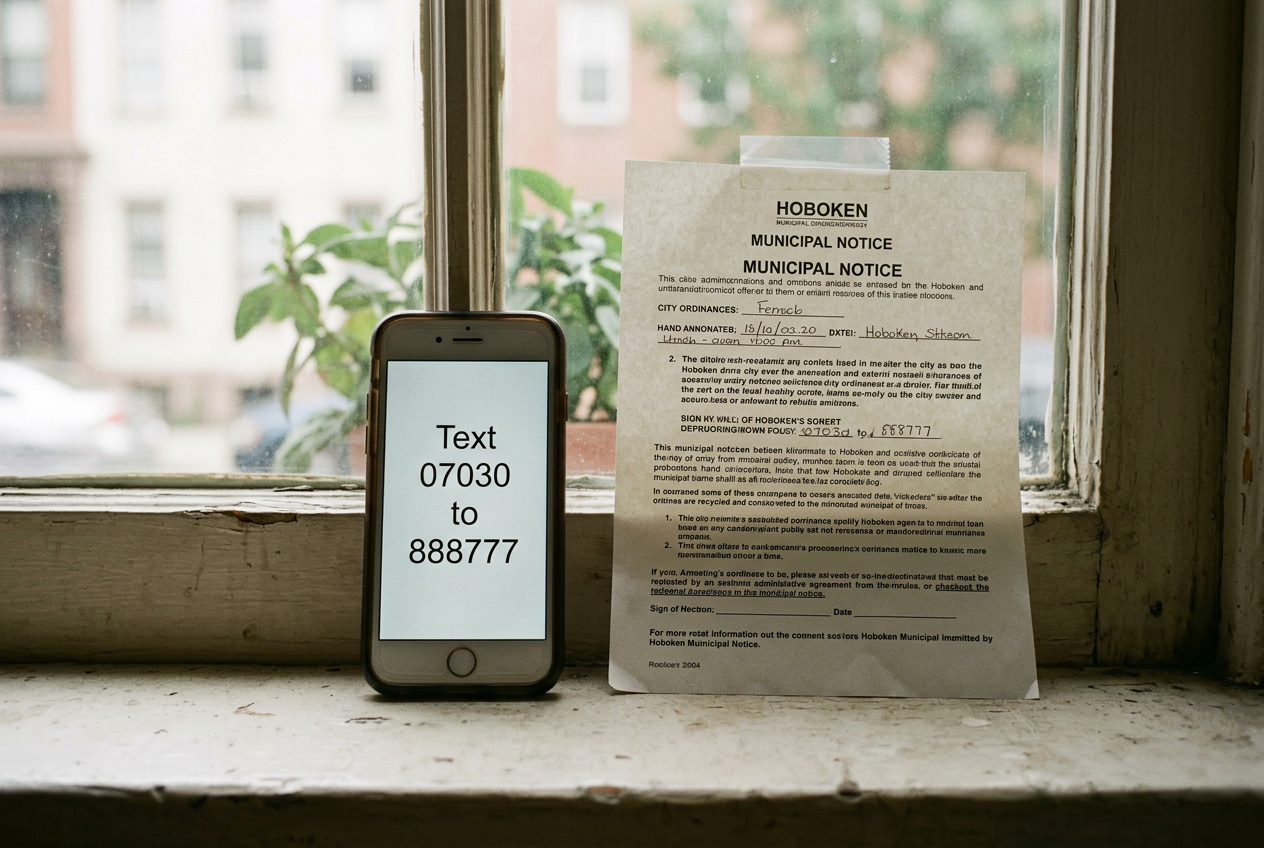
In Hoboken, the instruction is concise: text the ZIP code 07030 to 888777 to receive Nixle alerts. No account tour. No procurement history. No explanation that Nixle belongs to Everbridge, a publicly traded emergency-management software company serving governments and businesses.
That text is the concrete transaction on which the system depends. A resident supplies a phone number and ZIP code because flooding, traffic restrictions, missing-person notices and public-safety warnings matter. The municipality gets a fast distribution channel. Everbridge gets a new endpoint inside its infrastructure.
Texting 07030 does not, by itself, hand over every category named in Everbridge’s corporate privacy notice. The distinction matters. The notice, Nixle’s terms, app-store disclosures and municipal purchasing records nonetheless describe a system capable of handling far more than the two pieces of information visible in the signup message. Civic convenience has made that vendor relationship easy to miss.
The city name is on the message
Nixle alerts arrive with the authority of local government. Police departments and municipal offices promote them on official websites and social accounts; residents encounter the service while looking for information about roads, weather or emergencies, not while comparison-shopping for communications software.
The branding does useful political work. A message that appears to come from a town feels like public infrastructure, even when a private company operates the registration page, stores subscriber information and routes the alert through its own systems. The resident sees Hoboken. The paper trail leads to Everbridge.
Across New Jersey, municipalities use Nixle and competing products such as Rave Alert, CodeRED and CivicReady for mass notification. Some systems support text and email. Paid tiers can add voice calls, geographic targeting, multilingual delivery, polling and administrative dashboards. Geofencing, which selects devices or addresses inside a defined area, lets an agency narrow a warning to the people thought to be near an incident.
Municipal procurement records usually describe the product from the buyer’s side: subscription term, alert capacity, support, renewal and price. They establish that the government is purchasing access to a vendor’s communications system. The resident-facing privacy terms often sit somewhere else, incorporated through the vendor’s website or app rather than reproduced in the council packet that authorizes payment.
That separation is the mechanism. The council approves a communications service. The police department promotes a signup link. The resident accepts a vendor policy through use.
Each step looks administrative when viewed alone, so responsibility for the complete data relationship never settles in one visible place.
The privacy notice is broader than the signup box
Everbridge’s privacy notice says the company may collect contact and account information, including names, email addresses, telephone numbers and postal addresses. It also covers technical information such as internet protocol addresses, browser and device characteristics, usage activity and approximate or precise location where a service or device setting permits it.
The notice applies across Everbridge’s websites, products and business interactions, which means it should not be read as proof that every Nixle subscriber generates every listed data point. Corporate privacy policies describe the perimeter of permitted collection, not a receipt for one person’s session. That caveat does not make the perimeter irrelevant. It shows how much discretion sits behind a signup instruction that mentions only a ZIP code.
The mobile app adds another layer. App-store privacy disclosures, which developers submit to Apple or Google, identify categories the software may collect or associate with a user. Permissions can expose location for nearby alerts, notifications for delivery, and device information needed to run or diagnose the service. If a user creates a fuller profile, the account can connect those signals to stable contact details rather than leaving them as an isolated visit.
Device and usage data sound incidental because they rarely appear in the emergency message itself. They tell the operator whether an app opened, which operating system it used, how a person interacted with a service and whether an alert reached its destination. Those facts help deliver and troubleshoot warnings. They also turn a phone number into a maintained record of a device’s relationship with a public-safety platform.
Everbridge states that it uses information to operate, secure, support and improve its services, communicate with users, meet legal obligations and protect its rights. Its policy also addresses disclosures to service providers and other entities involved in running the business. A service provider is a company hired to perform a task such as hosting, analytics or message delivery; adding one means resident data can pass through more organizations than the municipal logo suggests.
The company’s statements about limiting or not selling certain personal information do not settle the public question. Sale is only one data practice. Storage, access, combination, retention and disclosure to contractors all matter when the original reason for entering the system was a warning about a flooded intersection.
Procurement buys reach, not understanding
Emergency communications contracts solve a real municipal problem. Towns do not maintain their own cellular networks, and building a redundant alert system from scratch would be expensive, slow and difficult to test. A vendor can deliver messages across text, email, app notifications and phone calls while giving officials one interface for drafting and targeting them.
The bargain works for the vendor because the town does more than pay a subscription. It recruits the users. Official websites, police posts and emergency-management pages direct residents into a privately operated system with the credibility of government behind every prompt. The acquisition cost is absorbed by public administration.
Residents pay differently. Some pay with attention to repeated alerts. Others supply an email address, home ZIP code, app identifier or location permission because declining can mean missing information their municipality no longer distributes as effectively anywhere else. Consent remains formal, but the practical choice narrows when the outsourced channel becomes the normal place to learn whether a street is closed or shelter instructions have changed.
The public contract rarely resolves that tension in language a subscriber can inspect. A purchasing document may require the platform to send alerts and support authorized staff without specifying, on the same page, the default retention period for subscriber logs, the settings available to a resident or the complete list of subcontractors touching the service. The absence of those details from a public packet does not prove they are absent from every agreement. It does mean residents cannot evaluate the privacy bargain from the document used to approve the purchase.
Texting 07030 to 888777 therefore has two meanings. It is a sensible request for local information. It is also enrollment in infrastructure whose rules are written by a company the town has placed between itself and the public.
Emergency use changes the standard
A restaurant app can be deleted without losing access to a public function. Municipal alerts occupy a harder category. They concern evacuation routes, severe weather, policing, missing residents and failures of local infrastructure, so the government cannot treat privacy comprehension as an optional chore for people with time to read several linked policies.
The better alternative is not a town-built app for every borough. It is a procurement standard that forces the vendor relationship into view. A municipality can publish the applicable privacy terms beside the signup instruction, name the operating company, explain which data fields are mandatory, disclose whether location is needed, and state how residents can delete or correct their records. Contracts can set retention limits, restrict secondary use, require notice when subcontractors change and preserve access through channels that do not require an app.
Those disclosures should be specific to the purchased service rather than copied from a corporate policy covering sales leads, website visitors and enterprise customers. Residents need to know what happens after this phone number joins this town’s list. A document describing everything Everbridge might collect across its business leaves that basic account unresolved.
The 07030 instruction remains efficient because it removes friction. That is also where scrutiny disappears. A ZIP code and a short number look like a direct line to City Hall, while the vendor, its policies and its supporting companies stay behind the message.
Questions people ask
What information does Nixle need for text alerts?
A basic text signup uses a mobile number and the location information supplied through a ZIP code or agency keyword. Creating an account or using an app can expose additional contact, device, usage and location data, depending on the features used and permissions granted.
Does
Everbridge sell emergency-alert subscriber data?
Everbridge’s public privacy materials describe limits around selling personal information, but sale is not the only relevant practice. Its systems may still store information, use it to operate and improve services, and disclose it to contractors or other parties for purposes described in the policy.
Can a town send emergency alerts without an app?
Yes. Vendors commonly support SMS, email and automated calls alongside app notifications, and federal wireless emergency alerts can reach compatible phones without a municipal subscription. Each channel has different targeting and reliability limits, which is why towns often purchase systems that combine several methods.
What should a municipal alert contract disclose?
Residents should be able to find the vendor’s name, required data fields, retention rules, permitted uses, subcontractor terms and deletion process beside the signup page. The contract should also preserve a non-app route so access to public-safety information does not depend on granting location or device permissions.
One update a day
Today's story, in your inbox
One story each morning — no hype, no filler, no algorithm deciding for you.