
AI Video Disclosure Vanishes Before the Second Upload
A Sora mammoth clip shows the weak point in AI labeling: platforms disclose what they know on their own pages, then let downloads and screen recordings leave that context behind.
August 11, 2026 · 7 min read
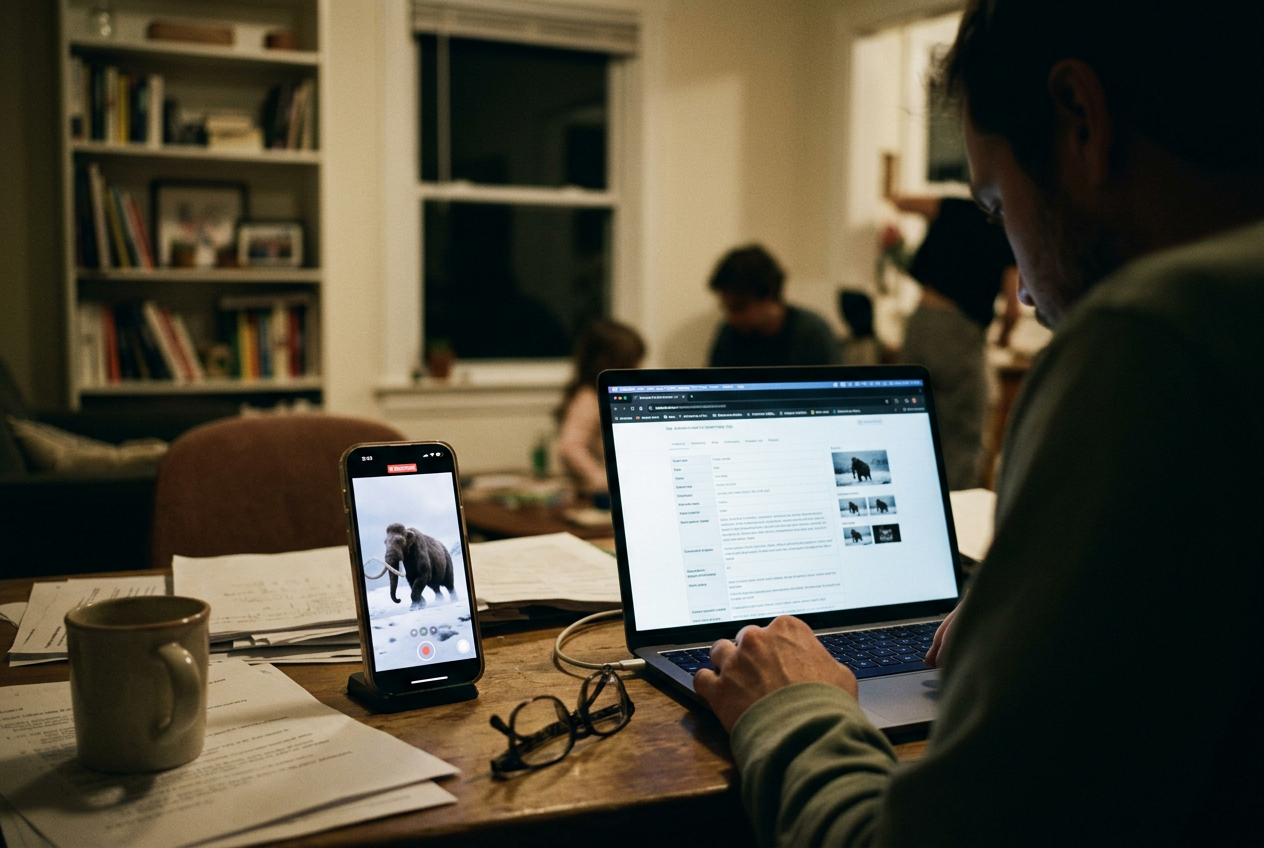
The specimen is a short OpenAI Sora video of woolly mammoths moving through a snowy landscape. It is useful because its origin is not disputed. OpenAI presented the clip as generated video on a Sora page, beside text that supplied the missing context: this scene did not come from a camera pointed at unusually well-preserved mammoths.
On that page, disclosure looks easy. The company controls the clip, player, caption and surrounding interface. The viewer receives the image and its origin together.
Save the video, though, and the page stays behind.
That is the basic failure hidden inside most platform promises about AI labels. A disclosure can be attached to an account, a post or a player without being attached to the media file in a form that survives ordinary distribution. The platforms describe these labels as if they were properties of the content. Often they are properties of the venue.
The distinction matters because viral video does not remain in one venue. It gets downloaded, forwarded through group chats, screen-recorded, cropped into vertical format, overlaid with a reaction face and uploaded again by an account that may have no idea where it began. By its second platform, the mammoth clip can still look essentially the same to a person while becoming a different object to every automated system asked to identify it.
One clip, several kinds of disclosure
People use “watermark” to describe technologies that behave very differently.
A visible watermark is part of the picture, such as a logo rendered over the lower corner. If it is burned into the frames, a normal download preserves it because the logo travels as pixels. A crop can remove it. So can a patch, blur or generative fill.
Screen recording preserves whatever remains visible inside the recorded area, but the person recording controls that area.
Metadata is information stored alongside the picture and sound inside a file. It can identify software, creation settings or provenance, depending on what the producer includes. A platform that transcodes an upload, meaning it decodes the video and creates a new compressed copy for delivery, can discard that information even when nobody is trying to conceal anything.
C2PA Content Credentials are cryptographically signed records that can connect media to its creator, editing history or generating tool. The signature helps a verifier detect whether the credential still matches the associated asset. It does not force every app to retain the credential, check it or show it to viewers.
Invisible watermarks embed a machine-detectable signal into the audiovisual material. Google’s SynthID is a prominent example. These systems aim to survive some edits, but detection depends on access to the correct scanner, enough of the original signal remaining and the receiving platform choosing to run the test. “Invisible” does not mean universal.
Then there is the cheapest marker: the platform label. TikTok, YouTube and Meta services have systems for labeling some synthetic media, including labels applied by uploaders or inferred from technical signals. Policies and interfaces change, but the structural limit does not. A label rendered beside a post is database information held by that platform.
Downloading the video does not download the database row.
The mammoths make this plain. The Sora page can tell a viewer exactly what the clip is, yet that sentence has no reason to appear when someone captures only the moving rectangle. Nothing has malfunctioned. The system was built around the assumption that provenance would be consumed where it was issued.
The screen recording is a provenance shredder
A download can preserve a file byte for byte. A screen recording cannot.
The operating system watches pixels being displayed, captures them and encodes a new video. The result may depict the same mammoths, snow and camera movement, but it has a new container, compression history and creation event. File metadata from the source does not leap across. A cryptographic credential bound to the downloaded asset will not automatically authenticate this newly recorded one.
This is why screen recording matters more than a laboratory demonstration of somebody stripping metadata with a specialist tool. It is built into phones. People use it to grab clips from apps that discourage downloads, capture a segment without its caption or combine footage with their own interface. The provenance loss is a side effect of an ordinary gesture.
Visible marks have a better chance because the recorder captures pixels, but they only survive if they remain in frame. Horizontal video usually arrives on vertical platforms inside a layout decision: crop the sides, add bars or enlarge the center. A watermark near an edge can disappear during that routine conversion. The uploader does not need forensic skills.
They need two fingers.
The resulting repost may still trigger a platform’s synthetic-media detector. It may also match a previously fingerprinted clip, where a fingerprint is a compact pattern used to recognize similar media after some changes. Neither outcome restores the original chain of custody. Detection says a system found a resemblance or signal.
Provenance says where the file came from and what happened to it. Platforms regularly blur those claims because “we detected something” sounds reassuring enough for a policy page.
The second platform starts with less and earns more
The receiving platform has incentives to accept the repost quickly. Another mammoth clip means another watch session, another recommendation candidate and another surface for advertising. Verifying origin adds computation, interface work and the possibility of blocking material that users would otherwise circulate.
The account uploading the clip may benefit too, through attention, follower growth or whatever monetization program applies. The original generator might receive attribution if its mark survives. The viewer pays with time and, in higher-stakes cases, with the labor of deciding whether a depicted event occurred.
Nobody in that chain is strongly rewarded for preserving disclosure. The generator wants its output to travel. The reposter wants clean footage that appears native to the destination. The destination wants supply.
A provenance system that adds friction is being asked to survive inside a market organized around removing friction from publication.
That is why voluntary uploader labels cannot carry the load. They place the disclosure decision with the person who gains the least from making the post look synthetic. Platforms can threaten penalties for failing to label, but enforcement usually begins after distribution, when users or automated systems flag a clip. The mammoths are harmless.
The same path works for fake disaster footage, fabricated street violence or a synthetic public figure speaking into a convincing microphone.
Disclosure has to travel with the media
A stronger design would treat provenance as portable infrastructure rather than decorative UI.
Generating tools can attach signed credentials to exported files. Editing software can preserve the history when it creates a derivative. Hosting platforms can read the credential, display a plain label and keep the record available after download. When a screen recording or aggressive edit breaks the chain, the next platform can say that provenance is unavailable rather than presenting silence as neutrality.
That still leaves invisible watermarks and similarity detection as useful backup systems. They should support provenance, not impersonate it. A detector can produce false positives or miss transformed material; a signed history can be stripped; a visible label can be cropped. No single marker closes every route.
The practical standard is therefore layered and slightly inconvenient. The file needs a durable credential. The frames need a resilient signal. The platform needs a label that explains what it detected and what it could not verify.
Downloads should preserve credentials by default, while transcodes should carry forward compatible provenance instead of treating metadata as disposable packaging.
There is a cost. Platforms must inspect uploads, retain records and expose uncertainty in an interface built to make every clip feel immediate. Generators and editing tools must interoperate rather than promoting their own private badge. Reposters lose some ability to present borrowed synthetic footage as fresh material.
That cost belongs with the companies distributing the clip. They built feeds that can move the Sora mammoths from an official demonstration into a context-free post before a viewer has finished remembering where real mammoths went. A tiny label under the first upload is not disclosure for that system. It is disclosure for a page most viewers will never see.
The final test is mundane. Save the clip, record the playback window, crop the edge and prepare a second upload. If the next platform cannot recover or plainly report the mammoths’ origin, the provenance system ended one screen ago.
Questions people ask
Do visible AI watermarks survive reposting?
They can survive a direct download because the mark is part of the image, but cropping, covering or reframing may remove it. Screen recording preserves only the pixels captured inside the selected area, so a watermark near an edge is especially easy to lose during conversion to vertical video.
Does C2PA prove that a video is real?
No. C2PA can authenticate a signed provenance record and reveal whether the associated asset still matches it. It does not prove that the depicted event happened, and an absent credential does not prove a clip is fake. Its value is a checkable history, provided tools and platforms preserve it.
Why can’t the second platform copy the first platform’s label?
The label usually lives in the first platform’s database, not inside the downloaded video. The second service may receive only a transcoded file with no account history or post context. It must detect a watermark, read preserved credentials or match the clip against known media to reconstruct what the first platform knew.
Who benefits when AI disclosure disappears?
Reposters get cleaner, more ambiguous footage, while platforms get content that can circulate with less friction. Generators may gain reach even when attribution vanishes. Viewers inherit the verification work, particularly when a synthetic clip leaves a clearly labeled demonstration page and reappears as apparent evidence of an event.
One update a day
Today's story, in your inbox
One story each morning — no hype, no filler, no algorithm deciding for you.