The Pope’s Puffer Lost Its AI Label. Here’s How to Check It
A platform warning is easy to crop away. The useful evidence lives in the file’s history, earlier copies, visual structure and the account that put it into circulation.
August 11, 2026 · 8 min read
The white puffer coat looked expensive because the image understood the grammar of expensive things. The collar rose around Pope Francis’s face. A silver crucifix rested over inflated quilting. Every surface appeared clean enough for a luxury campaign, although no coat had been cut, filled or worn.
The viral image of Pope Francis in a white puffer was generated with Midjourney. By the time many people saw it in 2023, that origin had fallen away. The picture arrived through reposts, screenshots and group chats, where it became a free-standing JPEG with no label and very little context. Subsequent reporting identified its creator, Pablo Xavier, but the image traveled faster than its history.
That gap is now routine. Platforms can attach an AI warning to a post, yet the warning usually belongs to the interface rather than the image. Crop the screen and it is gone. Download the file and some records may disappear.
Send it through another service and the service may recompress it, changing the file while preserving the scene. The label was never a durable fact. It was furniture around the fact.
Verification therefore needs a chain of evidence. The Pope’s puffer is useful because its origin is known, while the version in front of you may contain none of that history.
Start with the copy you received
Keep the highest-resolution version available. Save the post URL, account name, caption and approximate time you encountered it before opening an editor or messaging app, since those details can become more useful than the pixels. If the image came through a private chat, record that route without exposing the sender.
This costs a few minutes and no subscription. It also prevents a common mistake: spending an hour analyzing a screenshot while the original post, complete with an AI disclosure or generator tag, remains one tap away.
Look at the boundaries. A cropped social-media frame can reveal that a label once sat below the image. A black bar may cover a watermark. Repeated compression, visible as blocky edges around the Pope’s white collar or crucifix, tells you that the file has traveled, though it does not tell you whether a camera or a generator started the trip.
Do not enhance the image and treat the result as new evidence. Sharpening software invents edge contrast; generative enlargement can add details that never existed. Preserve one untouched copy and work from duplicates.
Read the file history, if any survived
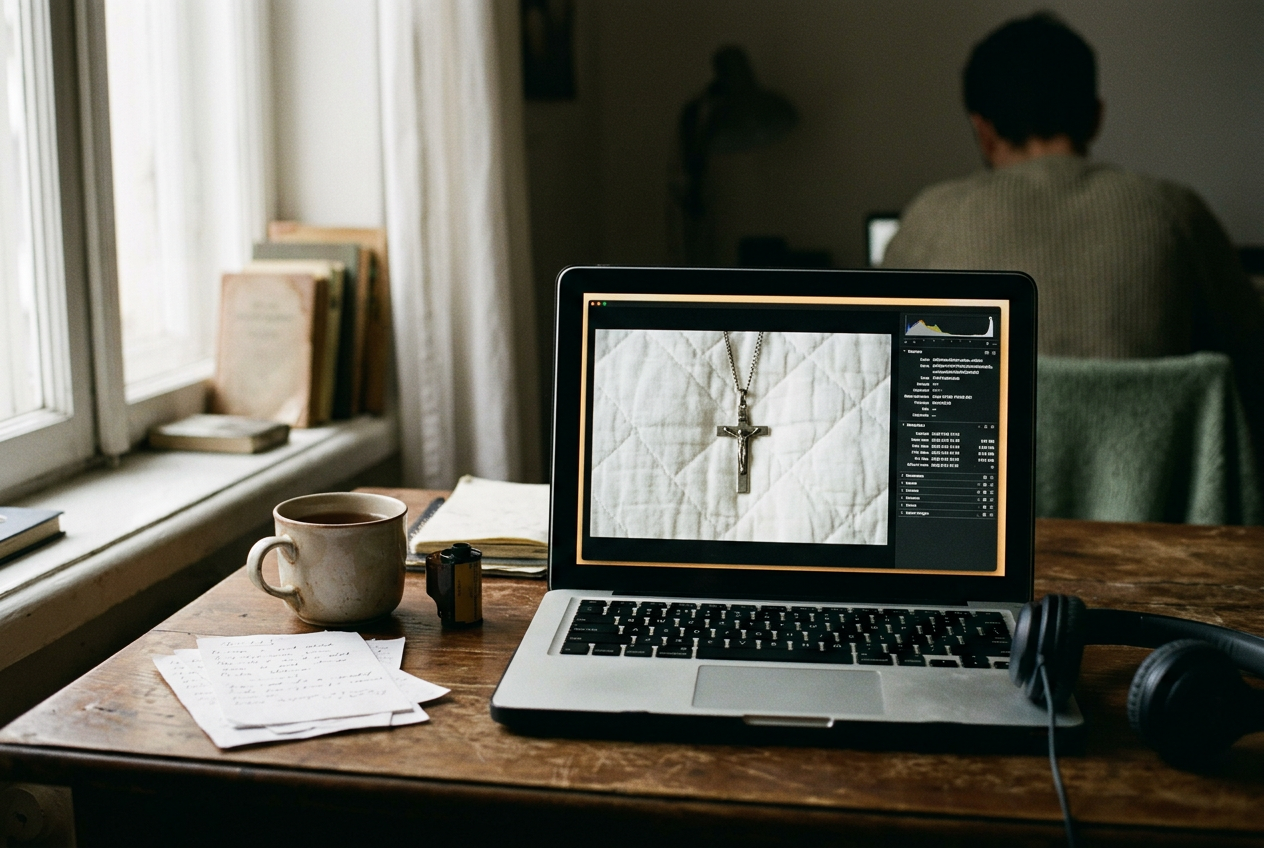
Provenance metadata is information stored with a file about its origin and editing history. On a computer, inspect the image’s file information for software names, creation fields, copyright records and editing applications. EXIF, a common metadata format used by cameras and phones, may include device and exposure details. IPTC fields can carry captions and creator credits.
A generator name is strong evidence. A normal camera model is weaker than it looks, because metadata can be copied, altered or preserved after part of a photograph has been synthetically edited. An empty panel proves almost nothing. Social platforms routinely remove metadata for privacy, storage or processing reasons, and screenshots begin with a new file history.
Then check for Content Credentials. These use the C2PA standard, a system for attaching cryptographically signed records of a file’s creation and edits so later changes can be detected. Adobe’s Content Credentials inspection tools can display that history when participating software has attached it.
A valid credential can establish that a particular tool signed a particular file state. It does not establish that every visible claim inside the picture is true, nor does the absence of a credential make the image fake. The system covers only files and tools that participate, and a screenshot steps outside the chain.
This is the first structural limit. Provenance works best when cameras, generators, editors and platforms preserve it together. Each company can advertise responsible labeling while quietly allowing the chain to break at export. The user receives a warning that behaves like a removable sticker, then gets blamed for failing to perform forensics on the residue.
Search for the image’s earlier lives
A reverse-image search compares a picture with indexed images rather than searching only its caption. Run the full Pope image through more than one service, such as Google Lens, Bing Visual Search and TinEye, because their indexes and ranking choices differ. Search a tight crop of the puffer and crucifix as well as the complete frame. Cropping can bypass borders, captions and minor edits added by reposters.
The goal is not to find a visually similar pontiff. It is to build a timeline. Open promising results and note which versions include a source credit, generator disclosure or fuller composition. Search distinctive caption fragments in quotation marks.
If an account claims to have photographed the scene, inspect whether that claim appeared before or after older posts describing it as generated.
Search rankings are not chronological records. Google Lens may prioritize a prominent news article; TinEye’s oldest indexed result is merely the earliest copy its crawler found. A small forum post or private Discord upload may predate both. Treat the search as a map of circulation, not a birth certificate.
With the Pope’s puffer, outside reporting and earlier posts supply what a stripped copy cannot. They connect the image to a named maker and Midjourney. That source trail carries more weight than a stranger circling the coat’s quilting in red.
Inspect structure without playing spot-the-finger
Visual inspection still matters, but the old checklist has aged badly. Current image models can render five plausible fingers, readable signs and coherent reflections. Real photographs can contain motion blur, computational phone processing, awkward anatomy and bad Photoshop. A single strange hand is evidence to examine, not a verdict.
Read the whole object instead. On the Pope image, follow the coat’s construction from collar to shoulder, across the quilted body and down to the overlap around the crucifix. Ask whether seams continue where the implied garment requires them, whether repeated panels keep their depth, and whether the chain occupies the same physical space as the padded surface. This is a test of structural continuity, meaning whether an object’s parts remain consistent across the image.
Move outward. Check whether glasses meet both ears, whether shadows agree with the brightest surfaces, and whether background figures retain workable bodies rather than dissolving into crowd texture. Look for small regions that carry meaning, such as insignia, lettering, jewelry clasps or buttons, because generators have often treated these as decorative probability rather than engineered objects.
None of these observations stands alone. The puffer’s strongest feature is its broad plausibility: papal white becomes luxury outerwear, the crucifix supplies status, and the centered portrait borrows the visual authority of editorial photography. People who enjoyed the image were not uniquely gullible. The picture was built from familiar signals, viewed at feed speed on a small screen.
Treat detector scores as leads, not rulings
Automated AI-image detectors estimate whether pixel patterns resemble material from known generators. Their scores can change after cropping, compression, color adjustment or a screenshot. New generators may fall outside the detector’s training data, while heavily processed photographs can trigger false positives.
If you use one, test the untouched file and record the tool, result and version date shown. Do not convert a probability into a declaration. Several detector scores that agree may justify more investigation, but they do not outrank a documented source chain. Avoid uploading private photographs, identification documents or images of vulnerable people to an unknown detection site; the convenience is not worth surrendering another copy.
Detection is an arms race with a lopsided business model. Generators improve by making outputs harder to distinguish, detector companies gain attention by promising certainty, and platforms would rather automate judgment than pay enough people to investigate context. The remaining uncertainty lands on moderators, journalists and ordinary users.
Trace the account, then state only what you know
Return to the first uploader you can locate. Read nearby posts. A creator who shares prompts, variations or work-in-progress images offers a stronger trail than an aggregation account posting dozens of unrelated spectacles. Check whether reputable reporting has contacted the maker or documented the tool.
Look for another frame from the same generation session, since near-duplicates can connect a detached image to its original set.
Accounts are evidence, not character witnesses. A person may post both photographs and generated work. A watermark may belong to a reposter. A confident caption can be copied thousands of times without becoming documentation.
At the end, classify the claim rather than forcing a binary answer. “Verified as generated” requires a credible origin record, an admission by the maker, a valid provenance trail or comparably strong documentation. “Likely generated” means several independent signals agree but the source remains incomplete. “Unresolved” is a legitimate result.
For a low-stakes meme, unresolved may be enough to stop digging. For an image offered as evidence of war, arrest, abuse or a public figure’s conduct, do not repost it as fact while the chain is missing. Contact the claimed source, seek other images of the event and compare reporting from people who were there. The white puffer was a joke with excellent tailoring.
The same distribution machinery carries images designed to punish real people.
Questions people ask
Can metadata prove that an image was made by AI?
Metadata can provide strong evidence when it names a generator or includes a valid Content Credential showing creation and edits. It can also be altered or stripped, so missing metadata proves nothing, while camera metadata cannot rule out later synthetic changes.
Which reverse-image search should I use?
Use at least two services with different indexes, such as Google Lens, Bing Visual Search or TinEye. Search the complete image and meaningful crops, then compare dates, captions and credits yourself; the first result displayed is rarely the earliest publication.
Are online AI-image detectors reliable?
They are useful for generating leads, not verdicts. Compression, screenshots, editing and unfamiliar generation models can change a score, while processed photographs may be flagged incorrectly. A documented source trail carries more weight than a percentage from an opaque tool.
What should
I do before reposting a suspicious image?
Save the original link and inspect its context, metadata, earlier copies and claimed source. If the image could harm someone or influence a high-stakes event, describe it as unverified or do not share it; your caption will travel no better than the platform label did.
One update a day
Today's story, in your inbox
One story each morning — no hype, no filler, no algorithm deciding for you.