Bottle-Service Tables Turn Dancers Into Club Decor
In hybrid clubs, the highest-spending tables increasingly dictate the floor plan, staff choreography and even the usable shape of the music.
August 11, 2026 · 8 min read
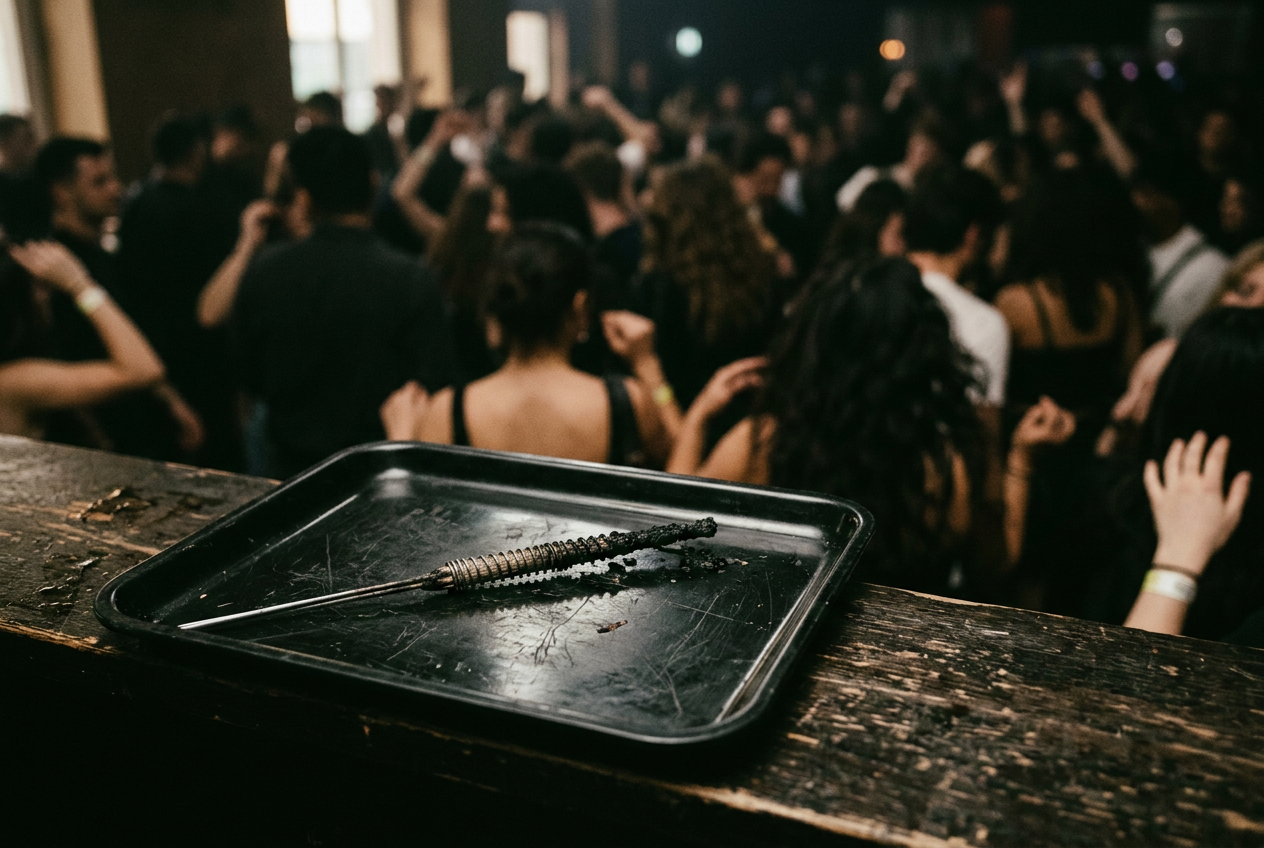
The bottle-service sparkler enters before the bottle. A thin wire burns above a tray held at shoulder height while security clears a path through the same bodies the venue has spent the night packing together. Phones rise. The floor parts.
Whatever the DJ was building now has a competing cue, brighter and easier to understand.
This interruption lasts less than a track. The design around it lasts all night.
In rooms where a dance floor and high-margin table service share the same air, the dancers appear to occupy the center. They get the speakers, the sweat and the promotional photographs. The tables look peripheral, arranged along walls or raised a step above the floor. Follow the staff, though, and the hierarchy reverses.
Servers face the booths. Security protects routes between the service station and reserved seating. Lighting marks each delivery. The center exists to be seen from the edge.
That sparkler is useful because it makes the room’s priorities briefly physical. Music asks people to stay inside a rhythm. Bottle presentation asks them to acknowledge a transaction.
The floor plan has a customer in mind
A table minimum is the required spend attached to reserved seating, usually agreed before or shortly after arrival. It turns uncertain bar purchases into a more predictable commitment, which makes the table unusually legible to an operator. The dancer who paid admission may buy several drinks, one drink or nothing. The booth arrives with revenue already attached.
Architecture follows legibility.
The hybrid room often keeps enough open floor to qualify as a club while placing its most protected square footage around that opening. Low tables, couches and barriers consume the edges where dancers might otherwise circulate or cool down. Raised platforms improve sightlines, meaning the unobstructed views between one part of the room and another, for seated customers. The crowd becomes the content of that view.
This changes how the floor fills. A long, narrow dance area can look dense from a booth even when movement is awkward inside it. Pinch points appear near bars, bathrooms and table entrances. People crossing the room repeatedly cut through the dancers because the protected route belongs to bottles and staff, not to anyone trying to stay with a set.
A good crowd repairs itself after each crossing. It closes the gap and finds the beat again. The venue treats this resilience as free labor.
The sparkler comes through that gap. Security does not need to dislike dancing to break the floor apart. Staff are following the transaction with the clearest value and the manager most likely to notice a delay.
Service choreography beats musical choreography
A DJ works with accumulation. A transition lands because of what preceded it; tension matters because release has been withheld. Even a blunt party set needs continuity, since bodies take time to agree on tempo, spacing and attention.
Table service runs on a different clock. The bottle should arrive while the buyer is watching, the group is assembled and the presentation can be registered by nearby customers. Those conditions do not necessarily coincide with a musical peak, so the venue creates one with handheld light, a procession and a burst of collective phone recording.
The DJ may keep playing. That does not mean the music remains in charge.
Lighting is especially effective here because it can redirect the room without stopping the track. A dark floor supports immersion and makes small changes feel important. A bright sparkler moving above head level becomes the dominant event, particularly when several staff members form a visible lane around it. The buyer receives recognition.
Other tables receive a product demonstration. Dancers provide scale.
This is advertising performed by the room itself. It needs no banner and no announcement. Every raised phone extends the display, while the packed floor proves that the purchase happened somewhere desirable rather than in a quiet lounge with expensive upholstery.
The mechanism works even on people who find it embarrassing. Annoyance still turns heads.
You can hear the sound system losing the argument
Bottle service does not always make a club quieter. It can produce the stranger outcome of a room that is punishingly loud but musically weak.
Sound coverage depends on speaker placement, room treatment and gain staging, the setting of levels through each part of the audio chain. A dance floor designed around even coverage lets bass and higher frequencies arrive with some consistency across the area intended for movement. Add booths, partitions, reflective surfaces and protected conversation zones, and the operator inherits conflicting demands. Table customers need enough volume to feel inside the event, but many also expect to speak, order and perform sociability across a low table.
The compromise often favors impact over detail. Bass announces the club without requiring close listening. High frequencies can become harsh near one speaker and indistinct farther away. Staff need to communicate, so service areas develop pockets where music recedes; dancers pushed into circulation lanes encounter abrupt changes in level as bodies and furniture block the system.
A DJ can respond only within limits. More volume does not repair uneven coverage, and a busier mix does not restore attention after the room has been trained to treat every bottle delivery as a headline event. The set becomes another utility: energetic enough to sustain purchases, familiar enough not to interrupt table conversation, flexible enough to survive repeated visual intrusions.
The question is no longer whether the DJ can be heard beside the sparkler. Of course the speakers are audible. The question is whether the room allows musical decisions to remain consequential.
Dancers are valuable until they need something
A hybrid club needs dancers because empty space looks bad from reserved seating. Movement signals demand. Density flatters the table purchase and improves photographs, especially when the camera can frame a bottle in the foreground and a crowd behind it.
Yet dancers generate value in a form the venue struggles to charge for directly. They arrive early enough to establish a floor, respond to unfamiliar records, tolerate crowding and make hesitant customers feel that participation is safe. None of this appears as a reserved spend. It appears as atmosphere, a word that politely removes labor from the picture.
Watch how quickly that value loses against service operations. A dancer setting down water near a booth boundary becomes a security concern. Someone pausing in a bottle lane gets moved. Space for coats, rest and cooling competes with sellable floor area, so bodily comfort is deferred to the bathrooms, the smoking area or nowhere.
The people creating the visual proof of a successful night receive the least stable claim on the room.
This hierarchy also shapes booking. A DJ who can hold dancers without alienating table customers fits the model better than one whose set demands patience, darkness or sustained attention. The venue need not issue explicit instructions for the incentive to work. Promoters learn which nights keep spenders seated.
DJs notice which transitions trigger intervention from the lighting booth or requests from management. Selection does the rest.
A club can choose a different center
The alternative is not mysterious. Separate table service from the main dance area, protect circulation routes that do not bisect the floor and aim the sound system at people who came to listen. Keep bottle presentation visually contained. Give the DJ booth a clear view of dancers rather than a commanding view of reserved seating.
Those choices cost money because they reduce premium inventory or require more space than one room can profitably support. A venue may sell fewer tables, spend more on acoustic treatment or accept that some customers cannot purchase dominance over the room. This is why bad hybrid design persists. It is rarely a failure to understand club culture.
It is a decision about which customer deserves certainty.
The sparkler eventually burns down. A staff member removes the spent wire, the phones lower and the dancers close the service lane again. The DJ has several minutes to rebuild what the transaction interrupted, until another bright tray reaches the edge of the floor.
Questions people ask
Why do clubs prioritize bottle service over the dance floor?
Reserved tables attach a committed spend to a defined piece of floor space, while revenue from dancers remains less predictable. Staff and managers can monitor a table’s orders directly, so service routes, security attention and lighting cues tend to follow the customers whose value is easiest to measure.
Does bottle service always make the music worse?
No, but tables create competing demands for sound, sightlines and staff attention. A venue with separate zones and well-planned speaker coverage can contain those conflicts. Trouble starts when the dance floor doubles as a corridor, showroom and backdrop for transactions happening around its edge.
Why do bottle-service sparklers interrupt a DJ set if the music keeps playing?
They replace a musical cue with a brighter visual one. Security opens the crowd, staff form a procession and phones turn toward the buyer, redirecting attention at a moment chosen by service timing rather than by the DJ’s pacing.
What would a dancer-first club layout change?
It would protect the dance floor from service traffic, preserve even sound coverage and place reserved seating outside the room’s main visual axis. The tradeoff is commercial: fewer premium tables and less ability to sell public recognition as part of the bottle.
One update a day
Today's story, in your inbox
One story each morning — no hype, no filler, no algorithm deciding for you.