Fentanyl Test Strips Are Easy to Misread. The Faint Line Counts.
A strip can detect fentanyl in the tested solution. It cannot measure potency, clear an uneven batch or promise that what remains is safe.
August 11, 2026 · 8 min read
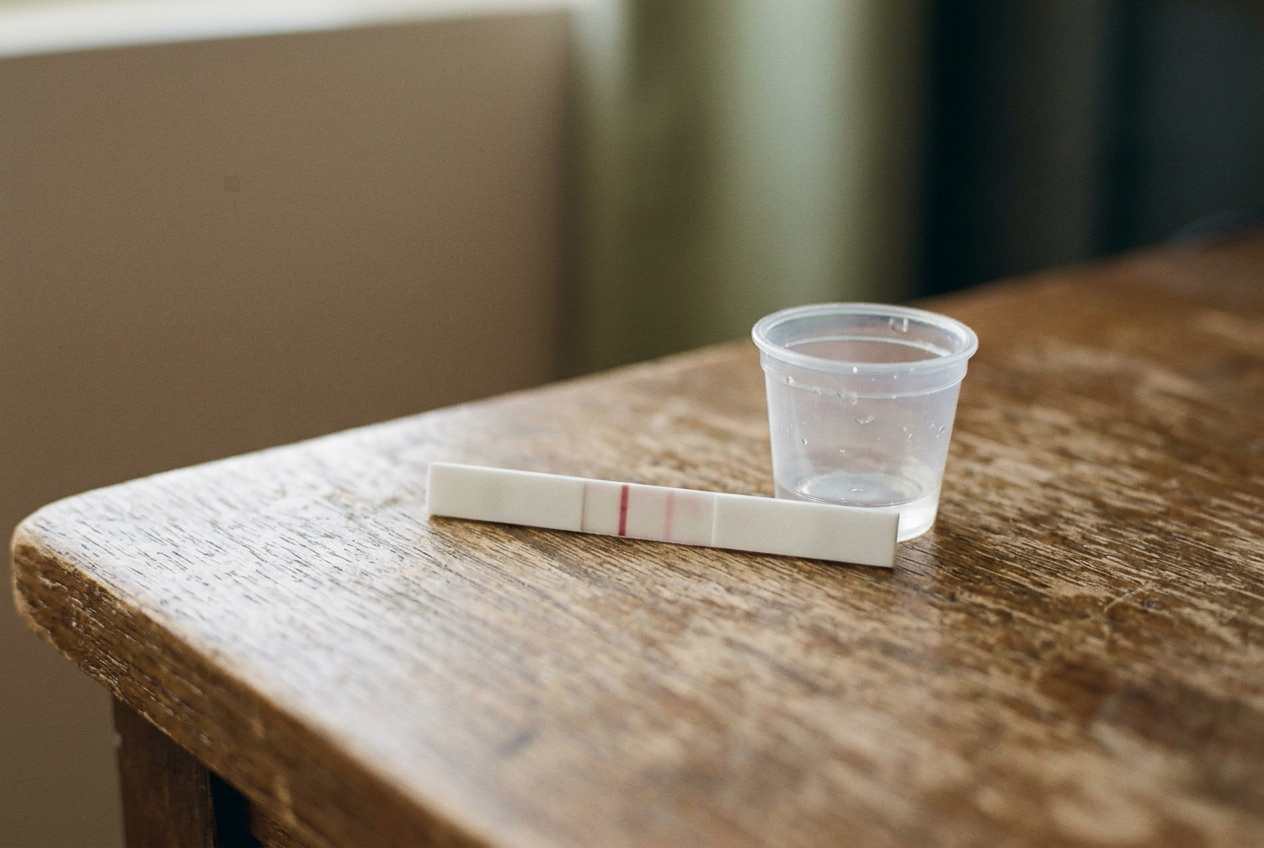
On the table is a white lateral-flow strip, a test built to move liquid across a treated membrane. Its control line is dark pink. The second line is pale enough to disappear when the strip tilts away from the light. Many people read that faint line as uncertainty, contamination or a weak positive.
On most fentanyl test strips, it means the opposite. Any visible test line, even a faint one, is read as negative, provided the control line appears and the result is checked during the time window printed in the instructions. One control line without a test line usually means positive. The design is counterintuitive because these are generally competitive assays: fentanyl in the solution prevents the test line from forming rather than making it darker.
That small reversal matters. So does everything that happened before the strip reached the table.
This is reporting about harm reduction, not medical advice or a guarantee that any substance is safe. Instructions differ among strip manufacturers, and local drug-checking programs can give product-specific guidance.
What the strip is measuring
A fentanyl test strip does not inspect a pill, powder or residue directly. It tests a liquid solution. The strip contains antibodies, proteins designed to bind particular chemical structures, which react when enough fentanyl or a detectable fentanyl-related compound is present in the portion of liquid that moves through the membrane.
The result is qualitative. It answers whether the target was detected above that test's threshold in that solution. It does not report how much fentanyl is present, how potent the material may be or whether the concentration could cause an overdose. A positive result from a trace amount and a positive result from a heavily contaminated sample can look identical.
Detection also has boundaries. Some strips recognize certain fentanyl analogs, compounds with chemical structures related to fentanyl, but sensitivity varies. They do not rule out nitazenes, xylazine, benzodiazepines or other unexpected drugs unless a separate test designed for that substance is used. The market has moved faster than any single strip can follow.
Chemistry does not honor the category printed on the packet.
Prepare the sample, not just the strip
Return to the strip with the pale second line. Before it was dipped, the material was mixed in a clean container with the amount of water specified by that strip's instructions. That detail carries more weight than the dramatic moment when the lines appear.
Start by checking the package. Use instructions for the exact product rather than a screenshot detached from its brand, because the required water volume, dipping time and reading window can differ. Check that the packaging is intact and that the strip has not expired or been stored in heat or moisture outside the manufacturer's limits.
Next, prepare the sample on a clean surface with a clean container. When feasible, testing a solution made from the entire amount gives a more representative result than touching the strip to residue from one corner of a bag. Some harm-reduction programs teach whole-sample testing for this reason, although it takes more preparation and may not fit how a person planned to handle the substance.
If the entire amount cannot be tested, mix the material thoroughly and collect small portions from different areas. For multiple pills, testing scrapings from more than one pill offers more information than testing one tablet and declaring the supply cleared. It still leaves uncertainty. A fragment from one edge cannot report what sits in another pill or even elsewhere inside the same pill.
Add the volume of water directed for the substance and strip being used. More concentrated is not more accurate. A solution containing too much drug relative to water can interfere with the assay and produce a false positive with some substances, including concentrated samples of methamphetamine or MDMA. Product instructions or a drug-checking service may direct the user to dilute and retest when interference is suspected.
Dip only the absorbent end, stopping at the marked line, and leave it in the solution for the stated time. Place it flat on a clean surface. Read it inside the manufacturer's window. A strip left sitting for too long can develop evaporation marks or other changes that were never meant to be interpreted.
This costs a few minutes, a clean container and, ideally, enough control over the sample to mix it well. Those requirements sound minor in a clinic leaflet. They are less minor in a club bathroom, a parked car or a rushed exchange, which is why distribution without usable instructions is only half a harm-reduction program.
Read the lines in the right direction
For the common competitive-style strips, two lines mean fentanyl was not detected in the tested solution. The test line may be much lighter than the control line. That pale second line on the table still counts.
One control line with no test line usually means fentanyl was detected. No control line means the test failed, regardless of anything visible elsewhere, and the sample needs a new strip. Always compare the result with the diagram supplied with the product, since line position and labeling are not universal.
A positive result can also reflect cross-reactivity, which occurs when the strip responds to another compound with a sufficiently similar chemical structure. A negative result can come from poor sampling, excessive dilution, incorrect timing, degradation or a fentanyl-related compound the strip does not detect well. The strip is evidence. It is not a laboratory report.
Photographs introduce another interpretation problem. Weak lines disappear under warm lighting, camera processing and screen compression, while marks that appeared after the valid reading window can look persuasive in a later image. Read the physical strip under good light at the instructed time. Do not ask a social feed to perform analytical chemistry from a blurry upload.
The sample can defeat the test
The largest limitation is not hidden inside the strip. It is in the drug supply.
Powders do not become uniform merely because they share a bag. Different particle sizes settle and cling differently during handling. Counterfeit pills may vary from one tablet to the next, and poor mixing during illicit production can produce concentrated areas often called hot spots. Fentanyl can therefore be absent from the tiny portion tested while remaining elsewhere in the material.
The clear cup in this demonstration contains a mixed solution. If the strip's faint second line is read correctly, it says fentanyl was not detected there. Pouring a little water over residue in an apparently empty bag would support a much weaker claim, because the rinse might never contact the particles carrying fentanyl. Testing one pill from a group has the same inference problem at a larger scale.
Even whole-sample testing cannot certify safety. It can reduce sampling error when the material is thoroughly dissolved, but the strip still cannot measure dose or find substances outside its detection range. Nor can it predict a person's tolerance, drug interactions or the effect of using after a period of abstinence, when opioid tolerance may have fallen.
This is the mechanism underneath the reassuring language of a negative test. The strip can work correctly while the conclusion drawn from it is wrong. Public messaging often compresses those two events into a single promise because a promise fits on packaging. Harm reduction requires the less marketable sentence: the result belongs to the solution that crossed the membrane.
What to do with the result
The lowest-risk response to a positive or uncertain result is not to use the substance. People who proceed despite the risk can reduce, though not remove, the danger by avoiding use alone, keeping naloxone available and making sure someone nearby knows how to recognize and respond to an opioid overdose. Naloxone reverses opioid overdose temporarily and may require repeat dosing while emergency help is called.
A negative strip should not remove those precautions. Mixing opioids with alcohol, benzodiazepines or other sedating drugs can increase the risk of breathing slowing or stopping, while an unexpected opioid can affect someone who did not intend to take one. If a person is unresponsive or not breathing normally, treat it as an emergency, give naloxone if available and follow local emergency and rescue-breathing guidance.
The faint line remains useful. It corrects one common mistake and supplies one piece of evidence. Its value disappears only when institutions present that evidence as clearance, then leave the person holding the strip to absorb every uncertainty the test was never built to resolve.
Questions people ask
Does a faint second line mean the sample contains a little fentanyl?
Usually no. On common competitive fentanyl strips, any visible test line within the instructed reading window counts as negative, regardless of how pale it is. Check the diagram for the exact product, since the control and test positions can differ, and repeat an invalid or ambiguous test with a new strip.
Can
I test one pill and trust the rest of the batch?
No. Counterfeit pills can vary between tablets, while fentanyl may be distributed unevenly inside a pill. Testing one pill provides information about the prepared portion of that pill, not every tablet sold with it. Combining samples from multiple pills can reduce sampling error but cannot eliminate it.
Why would a fentanyl test strip show a false positive?
Some drugs or cutting agents can cross-react with the assay, especially when the solution is too concentrated. Follow the water ratio printed for the strip and substance. If the manufacturer or a drug-checking program recommends further dilution and retesting, that comparison may help distinguish interference from a repeat positive.
Does a negative fentanyl test mean a drug is safe to use?
No. It means fentanyl was not detected above the strip's threshold in the liquid tested. The untested material may differ, and the strip does not measure potency or rule out other opioids, xylazine and unrelated contaminants. Overdose precautions still matter after a negative result.
One update a day
Today's story, in your inbox
One story each morning — no hype, no filler, no algorithm deciding for you.