Google Closed One Door on Location Warrants. Police Have Others.
Maps Timeline now lives primarily on users’ phones, blocking the broad searches Google once ran for police. The rest of the location-surveillance market remains open.
August 11, 2026 · 7 min read
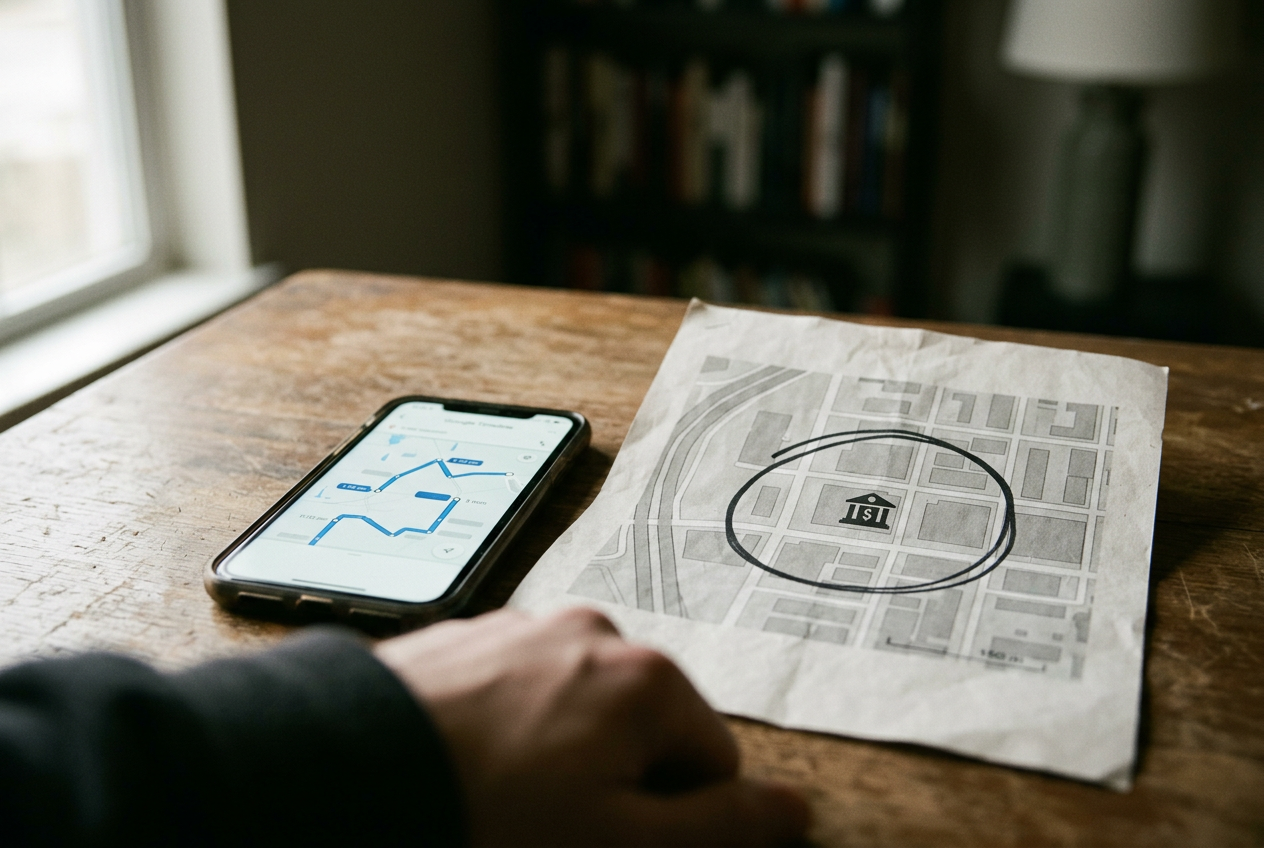
A 150-meter circle around a Virginia credit union shows what Google changed.
After a 2019 robbery, investigators obtained a geofence warrant, a demand for information about devices detected inside a defined place during a defined period. Google searched its centralized Location History database and initially found 19 devices within the circle. Investigators narrowed the group, obtained identifying account information for several users and charged Okello Chatrie.
The warrant did not begin with Chatrie’s name, phone number or Google account. It began with the circle. Everyone whose participating device had reported a location inside it became a candidate for police review, including people suspected of nothing.
Google has now dismantled the technical arrangement that made that search possible. Maps Timeline, the feature formerly called Location History, is being stored primarily on the user’s device rather than in a central Google database. Google can no longer take a circle like the one around the Virginia credit union and search across every participating account for devices that passed through it.
That is a real privacy gain. It is also narrower than the victory lap suggests.
What Google removed
Location History was always opt-in, although Google placed the prompt inside products used for navigation, recommendations and records of past trips. Once enabled, it could collect precise location points from a phone and associate them with a Google account. Google stored that material in an internal system commonly known as Sensorvault.
For police, Sensorvault offered something unusual. Most warrants start with a person or account and ask a company for records about that target. A geofence warrant reversed the order: officers supplied coordinates and a time window, then asked Google to identify accounts only after examining who appeared there.
The process generally moved through stages. Google first returned pseudonymous device identifiers, meaning labels that concealed the users’ names but still distinguished one device from another. Investigators could request additional movement data to decide which devices interested them, then require Google to disclose subscriber details for selected accounts. Court filings showed variations in the sequence, but the power came from the same source: Google could query a centralized archive belonging to many people at once.
The 150-meter circle was therefore more than a line on a map. It was a search key.
Under Google’s newer design, recent Timeline records remain on each phone. Users may transfer their history when changing devices and can choose an encrypted cloud backup, but Google says the backup is designed so the company cannot read it. The default deletion period also became shorter. Users who failed to migrate older records by the deadline assigned to their account risked losing them.
This architecture matters more than a revised warrant-review policy would have. A policy can bend under political pressure, a sealed court order or a new executive. A database that no longer exists at the provider cannot be searched in the old way. Google has said it lacks the technical ability to produce the broad geofence results it once supplied.
The company did not abolish police interest in location. It stopped holding one especially convenient pool of it.
A warrant can move closer to the body
On-device storage changes where investigators must go. If police lawfully seize a phone and obtain authority to search it, locally stored Timeline records may become part of the proposed search alongside photographs, messages and app data. Whether investigators can extract those records depends on the warrant’s scope, the device’s security, its condition and the forensic tools available.
That route costs more work than sending Google coordinates. Officers need a particular device, a legal basis tied to its owner and some way into the handset. A geofence demand could generate suspects from a place; a device search usually follows suspicion already directed at someone. The distinction is not cosmetic.
It separates a dragnet from a targeted search, even though the person at the end may still surrender years of movement records.
Cloud accounts also retain material that can help build a location case without reproducing Timeline. Providers may hold subscriber information, login timestamps, IP addresses and records from other services, depending on how those products work and what the user enabled. An IP address is not a GPS coordinate, but investigators can combine it with provider records or other evidence to place an account in a region, connect sessions and establish a chronology.
Google’s change applies to a particular product and storage system. It does not turn every Google service into an encrypted box, erase data already disclosed in an investigation or prevent demands aimed at a known account. The old 150-meter circle no longer opens Sensorvault. A warrant bearing a person’s email address may still open other files.
The phone company has its own map
Cell carriers create location records because phones must communicate with nearby towers. Historical cell-site location information, often shortened to CSLI, records which cell sites handled a device’s connections and can show its movement with varying precision.
In Carpenter v. United States, the Supreme Court held that police generally need a warrant to obtain an extended period of historical CSLI. The ruling placed an important limit on warrantless collection, but it did not eliminate carrier demands. Investigators can seek a warrant for a known phone, request more immediate forms of network location under disputed legal standards, or use tower dumps, which ask for devices that connected to specified towers during a period.
Carrier data is not a direct replacement for Google’s former archive. Cell sectors often cover a wider and less tidy area than GPS-derived points, particularly outside dense cities, while a tower dump can include a large number of uninvolved devices. Yet police do not need every source to deliver the same precision. They can layer records: a carrier connection, a license-plate reader hit, a store camera and an account login may together do what no single dataset can.
This is how surveillance capacity survives the closure of one channel. The institution changes suppliers.
The broker route survives without Google
The commercial location market sits farther from public view. Apps may collect location through software development kits, packages of code added for functions such as analytics or advertising. Data can then pass through vendors, advertising exchanges and brokers, where device identifiers and coordinates are packaged into products for marketers, investigators or government customers.
Police and federal agencies have purchased access to broker tools including products associated with Fog Data Science and Babel Street, according to public reporting and procurement records. These systems have offered searches based on places, device advertising identifiers and movement histories. The legal argument for buying access is straightforward and aggressive: the government is acting as a customer rather than compelling a company to disclose records.
Civil-liberties groups dispute that distinction when a purchase reveals sensitive movement that would otherwise require judicial approval. Regulators have also brought cases against location-data companies over the sale or use of information tied to clinics, houses of worship and other sensitive places. Those actions constrain particular firms and practices. They do not amount to a comprehensive federal ban on the domestic trade in location data.
Broker data carries its own defects. Advertising identifiers can change. Collection may be intermittent, coordinates can be inaccurate and the chain between an app, an intermediary and a police interface may be difficult for a defendant to inspect. A dataset can be commercially useful while remaining too messy to support the certainty its map display implies.
Messy does not mean harmless. Repeated nighttime coordinates can suggest a home, while daytime patterns can expose a workplace or clinic. Once a broker or investigator links a pseudonymous identifier to a person, an apparently anonymous trail becomes a dossier. The user rarely knows which app supplied the points or which company sold them onward.
Money keeps this channel open. App publishers and data intermediaries monetize access; brokers aggregate and repackage it; agencies pay subscription or contract fees for interfaces that reduce technical records to searchable maps. Google’s on-device decision removes its own centralized archive from broad geofence production. It does not disturb that supply chain.
Architecture did what the courts had not
Federal courts have disagreed about geofence warrants. In the Chatrie litigation, a trial judge found the warrant constitutionally defective but allowed the evidence under the good-faith exception, which can preserve evidence when officers reasonably relied on a warrant. An appeals court later concluded that obtaining the Google data at issue was not a Fourth Amendment search. In a separate case, the Fifth Circuit treated geofence warrants as unconstitutional general warrants, while also declining to suppress the evidence there.
The doctrinal split matters for old cases and for other reverse-search systems. Google’s storage change, however, reached the operational question first. Courts can debate whether officers may draw that 150-meter circle. Google can no longer run the old query across Timeline accounts.
That should not be mistaken for a general settlement on location surveillance. The protection follows the database, not the category of information. If records stay on a locked phone, police face one set of barriers. If a carrier stores them, a warrant can reach them.
If an app passes them into the advertising market, an agency may try to buy them.
Privacy improved where Google stopped keeping the searchable pile. The pile exists elsewhere.
Questions people ask
Can police still get a person’s Google Maps Timeline?
Google can no longer perform the old broad search across centrally stored Timeline histories. Records kept on a seized phone may still be sought through a device-search warrant, while other Google account records can remain available depending on the service, settings and legal demand.
Are geofence warrants now impossible?
Google’s former Location History geofence method has largely been disabled by the move to on-device storage. Similar reverse-location demands could still target another provider that holds searchable location records, and police retain tower dumps, broker tools and other methods that begin with a place rather than a named suspect.
Does deleting Timeline stop all location tracking?
No. Deleting or disabling Timeline affects that Google feature, not records generated by cell carriers, other apps, advertising systems, license-plate readers or a phone’s remaining local data. Each source follows its own retention rules and technical design.
Why can police buy location data without a warrant?
Agencies have argued that ordinary commercial purchases do not compel disclosure and therefore fall outside warrant requirements. Courts and regulators have not produced one nationwide rule covering every broker transaction, leaving a market where access may depend less on probable cause than on contracts, procurement approval and available funds.
One update a day
Today's story, in your inbox
One story each morning — no hype, no filler, no algorithm deciding for you.