Jersey Club Is Being Choreographed for the Vertical Frame
The phone camera gives Jersey club a larger public and a smaller stage. On the same floor, dancers now negotiate the room, the camera operator and the feed.
August 11, 2026 · 7 min read
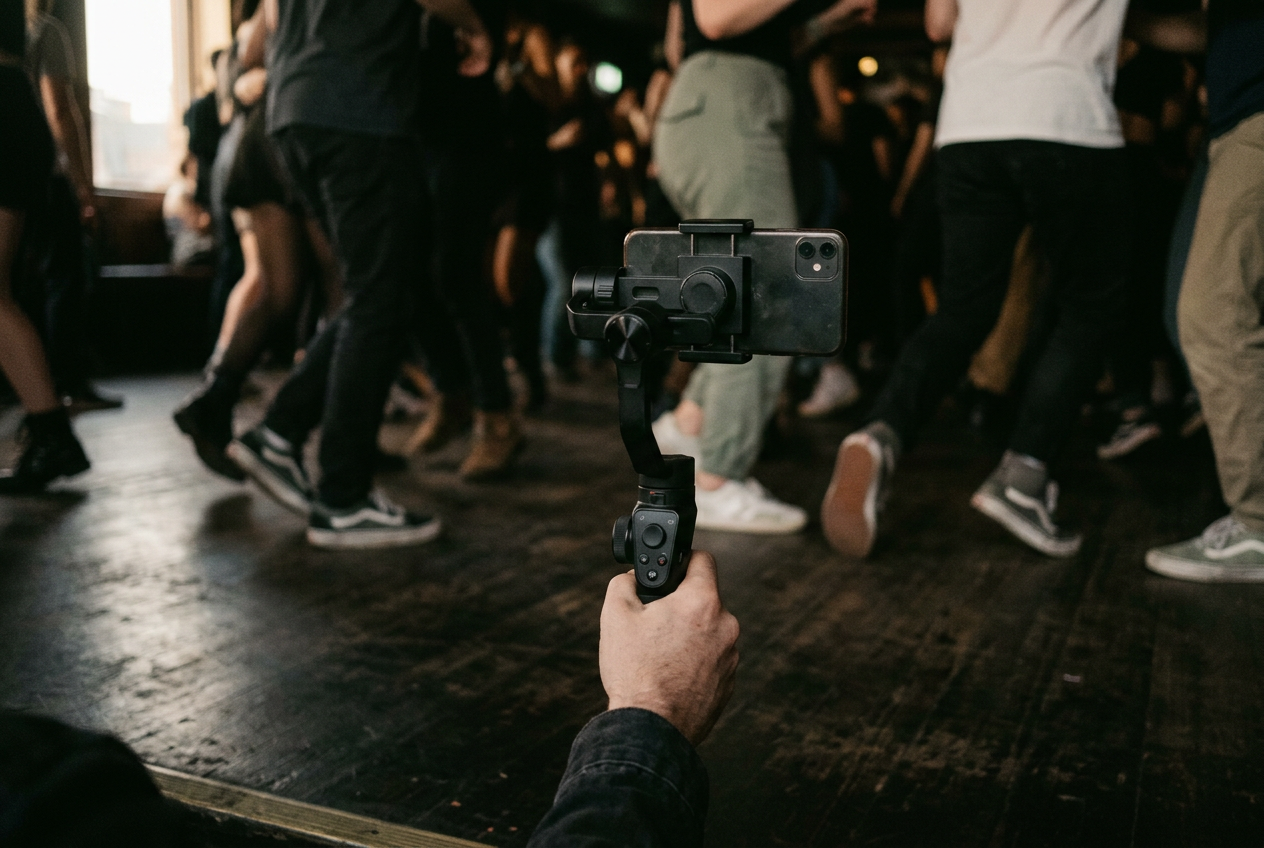
Start with the black three-axis phone gimbal. A smartphone sits upright in its spring-loaded clamp, the screen in a 9:16 aspect ratio, a frame roughly twice as tall as it is wide. Small motors counter the operator’s wrist movement. Held around sternum height, it turns a crowded floor into a stack of full-body portraits, provided everyone else gets out of the way.
That last condition matters.
In publicly available footage from Jersey club parties, DJ sets and dance events, the gimbal does not hover outside the action like a security camera. Its operator enters the circle, backs up as a dancer advances, lowers the lens for footwork and then raises it before somebody’s shoulder blocks the shot. The rig needs a lane. The dancer needs the same lane.
The people who came to dance become a movable wall.
This is where the familiar argument about exposure misses the mechanism. Documentation does not merely carry a regional scene onto TikTok, Instagram Reels and YouTube Shorts. Once promoters, DJs and dancers know which fragments travel, the vertical clip starts shaping the event before the upload. The camera stops being evidence that a party happened.
It becomes one of the party’s clients.
The gimbal wants a clean event
Jersey club was not designed for visual tidiness. The music grew in Newark and nearby New Jersey cities through local DJs, dancers, crews, parties and mixtapes, drawing from Baltimore club while developing its own hard kicks, chopped vocals and instantly recognizable bed-squeak sample. Tracks move quickly. Familiar phrases get cut into commands.
A transition can feel less like a polite blend than a floor being pulled sideways.
The dancing answers that instability. Jersey club footwork depends on speed, weight shifts and a live exchange between the person in the center and the ring around them. A cypher, meaning a circle where dancers take turns entering the middle, makes room for repetition and interruption. Somebody can lose the beat, recover, borrow another dancer’s move or abandon the obvious move entirely.
The pleasure is cumulative. It belongs to the room’s memory.
The gimbal prefers a different unit. It wants a legible beginning, one body in the center, an identifiable move and a reaction before the viewer’s thumb returns to duty. This does not require an explicit instruction from TikTok or Instagram. Recommendation systems, the software that decides which posts to distribute, test clips against viewer behavior such as watch time, completion and interaction.
The exact formulas remain private, but the production lesson is visible: context is expensive, while immediate recognition travels.
A vertical frame can hold a full dancer if the operator steps back. In a packed party, stepping back means moving other people or letting them block the shot. Get closer and the frame loses shoes, which is a substantial editorial decision in a dance form where the feet carry information. Hold the phone higher and the body flattens into upper-body gesture.
Turn the camera toward the crowd and the clip loses the solitary figure that platforms and repost accounts can label cleanly.
The black gimbal solves shake. It cannot solve competing claims on the floor.
The room supplies the footage for free
The financial arrangement makes the camera difficult to resist. A promoter can turn one night into weeks of posts. A DJ receives proof of crowd response and material for booking pitches. The videographer may be paid by the event, an artist or a media partner, though many clips also come from guests doing unpaid camera work with their own phones.
Platforms receive a stream of inexpensive video that keeps users watching and creates more surfaces for advertising.
Dancers occupy the least stable position in that chain. Their performance may be the reason a clip moves, yet appearing in a popular post does not trigger an automatic payment. A visible handle can bring followers, teaching inquiries, bookings or brand work, but those are possible downstream rewards rather than compensation for the footage itself. If the post omits a credit, the dancer becomes atmosphere.
If the audio is detached and reused, the producer can disappear too.
Music payment is no cleaner. Short-form platforms license catalogs through arrangements with labels, distributors, publishers and rights organizations; a viral view does not translate into a simple, public per-view payment to every person who made the track. The sound page can carry a recording farther than any local flyer ever could while separating the kick pattern, dance and regional authorship into different pieces of metadata. One piece gets named.
Another becomes a trend.
This is why visibility cannot settle the argument. Jersey club artists have gained wider touring routes, collaborations and media attention as the sound has moved through pop, rap and short-form video. Lil Uzi Vert’s “Just Wanna Rock,” produced by McVertt and Synthetic, made the genre’s relationship to dance difficult for mainstream coverage to ignore. That reach is real.
So is the tendency to treat New Jersey as a supplier of moves and rhythmic effects rather than a place with its own workers, venues and history.
The platform does not need to erase the source deliberately. It only needs to reward the version that arrives with the least explanation.
A filmed party begins rehearsing itself
The change appears in the body before it appears in the caption. A dancer who notices the lens may turn front, repeat the cleanest phrase or hold the ending long enough for the camera to register it. People at the edge open a corridor. Friends lift their phones.
The DJ may let a recognizable section breathe because the floor and the cameras have aligned around it.
None of this makes the performance false. Club dancers have always played to witnesses, and documentation has preserved scenes that larger cultural institutions ignored until there was money nearby. The problem begins when one witness becomes structurally dominant, because the vertically framed moment can be posted immediately, measured publicly and shown to a much larger audience than the people who bought entry.
That feedback loop trains events. Promoters need regular content to remain visible between parties, so camera access becomes part of production rather than an incidental annoyance. DJs know that a strong reaction clip can communicate demand more efficiently than a long recording. Dancers understand that one readable move may circulate farther than a difficult sequence whose force depends on build, proximity and response.
Everyone is making rational choices. Together, they produce a narrower document.
The narrowing is aesthetic as well as regional. Short clips privilege peaks over transitions, individual command over collective drift and repeatable signatures over the strange passage that only worked once. A feed can show thousands of Jersey club clips while teaching viewers that the form consists mainly of a few recognizable steps attached to a drop. Abundance creates its own shortage.
Return to the gimbal. Its motors keep the horizon level even when the operator is pushed, which makes the resulting clip look calmer than the room felt. Bodies outside the selected lane survive as hands, shoulders and reaction faces. The mess becomes a border around one marketable event.
Better documentation takes up less authority
The alternative is not a phone ban. That would protect a fantasy of underground purity while depriving artists and dancers of archives, discovery and evidence of their work. Regional scenes have good reasons to distrust gatekeepers who offer preservation only after deciding the culture is respectable.
A better arrangement starts by treating filming as labor with obligations. Promoters can establish limited capture windows instead of allowing camera operators to occupy the center all night. A wide camera placed at the perimeter can record exchanges that a close vertical shot removes. Longer edits can keep the approach, mistake and recovery rather than extracting only the payoff.
Credits should name dancers, DJs and producers in the original post, where the information has a chance of surviving reposts.
Payment remains the harder part. When an event commissions content, the content budget should acknowledge the people whose performance supplies it, particularly when a dancer is deliberately pulled into a clear circle for a promotional clip. That costs more than tagging somebody after the post travels. It also distinguishes documentation from harvesting.
There will still be moments built for the feed. Jersey club is too adaptive, competitive and knowingly theatrical to pretend otherwise. The useful boundary is whether the camera receives a moment from the party or reorganizes the party to obtain one.
At the edge of the circle, the black gimbal is an excellent tool. In the middle, held upright while everyone adjusts around its frame, it is already doing choreography.
Questions people ask
How has TikTok changed Jersey club?
TikTok has helped Jersey club tracks and dances reach listeners far outside New Jersey through reusable sounds, recommendations and imitation. It also favors clips that become legible quickly, which can strip away longer musical transitions, cypher dynamics and the names of dancers or producers who created the material.
Why do vertical videos change the dancing at parties?
A vertical phone frame usually needs one clear subject and enough distance to include the dancer’s feet. On a crowded floor, camera operators create space by entering the circle or asking others to move, which encourages front-facing, repeatable performances and turns nearby dancers into an audience for the shot.
Who gets paid when a Jersey club clip goes viral?
There is no single payment path. Platforms, rights holders, distributors and publishers operate under licensing and advertising arrangements, while promoters and artists may gain attention or bookings. A dancer shown in the clip is not automatically paid and may receive only a tag, if the original uploader identifies them at all.
Can
Jersey club be documented without flattening the scene?
Yes, but the camera has to surrender some control. Wider shots, longer edits, perimeter filming, limited capture periods and durable credits preserve more of the room’s exchange. When events commission promotional footage around a featured dancer, paying that dancer is more useful than describing exposure as compensation.
One update a day
Today's story, in your inbox
One story each morning — no hype, no filler, no algorithm deciding for you.