New Jersey Bands Get Good on the Rehearsal Room Clock
Hourly studios sell more than privacy. Their clocks, house amps, load-in rules and distance from transit determine which New Jersey bands rehearse enough to become convincing.
August 29, 2026 · 8 min read
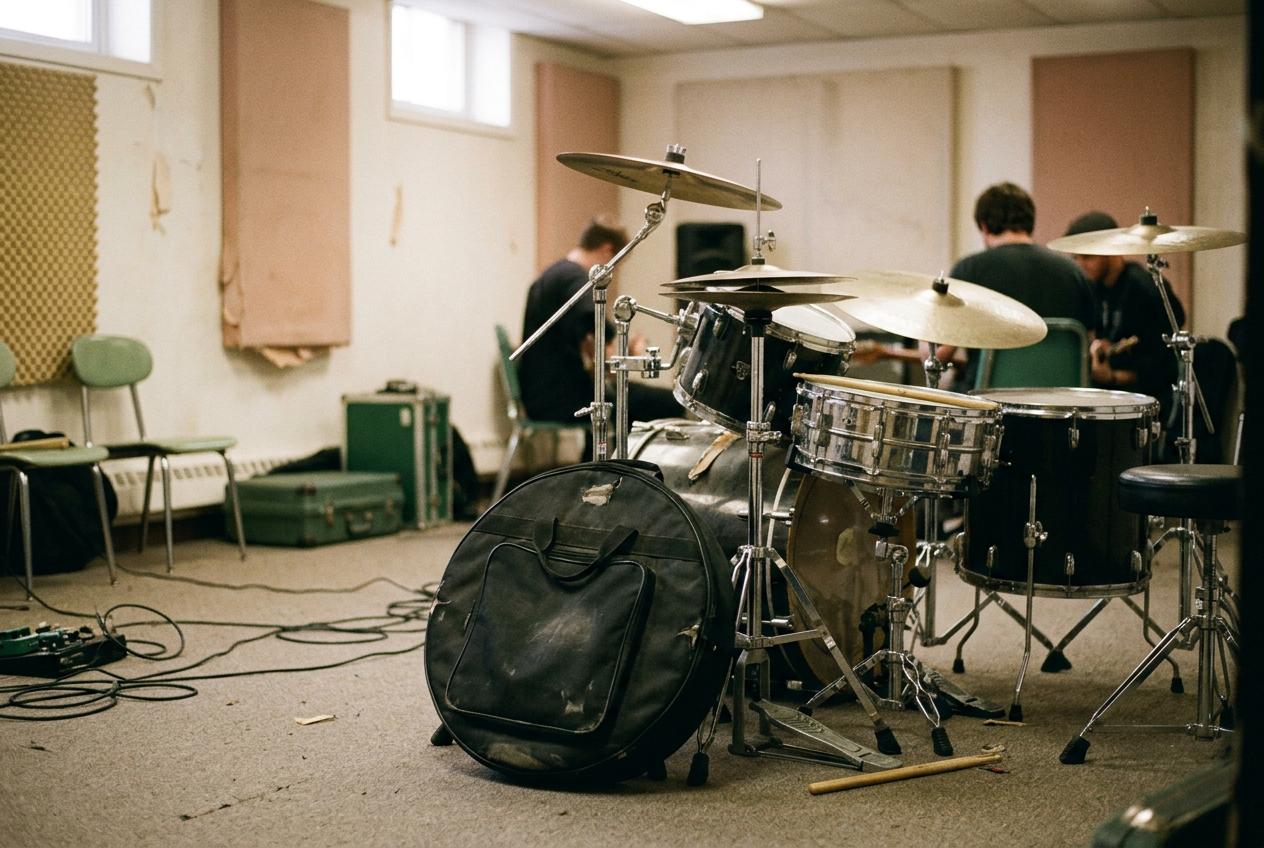
Start with the black nylon cymbal bag.
It is the least glamorous object in a band and one of the more reliable measures of whether rehearsal will work. Inside are several brass discs separated by cloth sleeves, heavy enough to punish one shoulder on a walk from NJ Transit or the PATH. Many hourly studios provide a drum shell pack, meaning the kick drum and toms, but drummers commonly carry their own cymbals and other “breakables,” the small, heavily used parts that wear quickly and define how the kit responds.
That bag explains more about New Jersey’s regional underground than another argument over whether a band belongs to hardcore, shoegaze, indie rock or whatever hybrid label will help a distributor place the single. The sound begins earlier. It begins with who can reach a room in Hoboken, Totowa, Rockaway or Asbury Park after work, what the room already contains, and how much of a paid block remains after four people drag their equipment through the door.
The rehearsal room is the scene nobody photographs because it offers little public proof. No crowd. No stage light. No useful image of demand.
Yet this is where demand becomes possible.
The clock starts before the first song
Public-facing materials from New Jersey facilities including Soundwars Studios in Hoboken, SmackTone Studios in Totowa, Backroom Studios in Rockaway and Lakehouse Music Academy in Asbury Park present variations on the same practical offer: reserve a room, use some amount of house equipment, and leave when the block ends. The differences matter, but the model is consistent. Privacy has been divided into bookable units.
At an hourly studio, paid time commonly has to absorb load-in, setup, line checks, rehearsal, troubleshooting and load-out. A guitarist who brings a pedalboard has to run power and cables. The drummer opens the black cymbal bag, mounts each cymbal and adjusts the stands. Vocals must be balanced through the PA, the public-address system that amplifies microphones in the room.
If an amp hums or a cable fails, the band has not entered a dramatic struggle with the muse. It is spending rehearsal money on maintenance.
A two-hour booking is therefore not two hours of playing. Bands that know the room lose less time because they remember where the outlets are, which microphone cable crackles and how far the bass amp can be pushed before the low end turns useless. Regular practice creates musical fluency, but it also creates operational fluency. The band that loads efficiently gets more repetitions for the same payment.
This rewards a particular kind of group. Its members arrive on time. Their jobs release them at compatible hours. Their equipment can move through a hallway without a second trip to the car.
They can afford to book again before the previous rehearsal has faded from memory. None of those conditions appears in a streaming genre tag, though each one affects whether a chorus tightens, a tempo settles and a new song survives its awkward first attempts.
The hourly room does not merely host the band. It selects for the band that can use the clock.
Shared gear writes part of the arrangement
House gear lowers the cost of entry. It also narrows the practical choices available inside the session.
A room with guitar amplifiers, a bass rig, a drum kit and a vocal PA allows several musicians to arrive without hauling full backline, the amplifiers and large instruments positioned behind performers. That is essential in a state where many players live in apartments, share houses or cannot leave loud equipment assembled between rehearsals. It also means the room’s maintenance decisions enter the music.
If the house guitar amp has a usable clean channel but an unpleasant overdrive sound, a player may rely more heavily on pedals. If the drum hardware slips, the drummer plays around it or spends minutes fixing it. If the PA has limited headroom, the amount of clean volume available before distortion, singers push differently and guitarists are told to turn down. Songs change under those pressures.
Quiet passages disappear when the room’s noise floor swallows them. Complicated transitions get cut because the band cannot afford to spend half the booking repairing eight bars.
The black cymbal bag remains personal because cymbals carry touch, wear and tonal preference in a way that a shared drum shell often does not. That compromise is the rehearsal economy in miniature: the studio supplies the expensive bulk that is difficult to transport, while the musician carries the smaller pieces that affect feel and can be damaged through communal use.
Studios benefit because shared backline makes rooms useful to more customers and shortens turnover between bookings. Musicians benefit because a full amplifier cabinet does not have to ride from Jersey City to Hoboken or from Newark toward Morris County. The cost appears elsewhere. Players adapt to unfamiliar controls, accept whatever has survived repeated sessions, and reproduce arrangements that can be set up quickly.
This helps explain why some local bands become lean before they become known. Fewer unusual instruments. Fewer members whose schedules must align. Reliable pedal settings.
Songs that can be restarted without a long technical reset. That is not aesthetic purity. It is rehearsal compatibility.
New Jersey distance is measured in transfers
Calling something a New Jersey scene can conceal how difficult it is to move across New Jersey.
Hoboken sits inside a dense transit network, with PATH, rail, light rail and buses connecting it to parts of Hudson County, Newark and New York City. Totowa and Rockaway impose a different calculation. Asbury Park has rail service, but a band member traveling from inland or northern towns may still face a long sequence of local trips. A studio can look nearby on a regional map while remaining effectively inaccessible to somebody carrying a guitar case and the black cymbal bag after a shift.
Cars solve part of the problem and create another bill. Fuel, tolls, insurance, parking and maintenance become music expenses even when nobody categorizes them that way. The member with the largest vehicle often becomes unpaid logistics staff, collecting an amp from one town and a drummer from another before the official booking begins. If that person leaves the band, the group may lose transportation along with a musician.
Transit-dependent players must work backward from the last usable connection. A rehearsal cannot run late merely because a bridge section is improving. Weekend service changes and longer nighttime waits reduce the available block further, while carrying equipment through transfers limits what can be brought at all. A compact synthesizer can travel.
A large cabinet usually cannot. The regional sound is shaped by these mundane differences in portability.
New York coverage often treats New Jersey as overflow: cheaper housing, extra warehouse space, a place from which musicians commute into the city’s supposedly central rooms. That view misses the internal geography. Hudson County, Passaic County, Morris County, New Brunswick and the Shore do not form one convenient circuit. They form overlapping networks organized around cars, rail lines, work schedules and the few rooms a group can repeatedly reach.
A band does not need access to every room. It needs dependable access to one.
Rent becomes a musical filter
Private rehearsal space offers continuity. Equipment can remain assembled. A half-written song can wait on the stands. The band can practice without watching the minute hand.
It also requires a lease, enough square footage, tolerance from neighbors and confidence that every member can keep paying.
Hourly rooms convert that large fixed obligation into smaller purchases. This widens access for people who cannot carry a monthly room, but it penalizes frequency. Every additional rehearsal produces another charge, another trip and another negotiation over availability. The studio gets paid for occupied blocks.
The band pays whether the session is productive or spent replacing a cable.
That payment structure separates bands with similar talent. One group rehearses weekly because its members have stable income and synchronized evenings. Another meets when retail schedules, caregiving and gig work permit. The first band gets more chances to sound inevitable.
By the time both reach a New Brunswick basement show, a Newark bill or an Asbury Park venue, the difference may be described as chemistry.
Chemistry is frequently repetition with its receipts removed.
This is also why venue access alone cannot sustain an underground. A stage gives a band one night. A rehearsal room gives it the repeated, private failure required to deserve that night. Grants, arts initiatives and nightlife policy tend to favor visible outcomes such as performances, festivals and audience counts because those are legible to institutions.
Practice produces no crowd photograph and no bar sales. Its value arrives later, attached to somebody else’s event.
The rehearsal business carries that invisible interval. It pays commercial rent, maintains equipment, manages bookings and absorbs the wear caused by strangers using the same hardware. There is no need to romanticize it. Some rooms are better maintained than others, and an equipped room is not automatically affordable once transportation and lost time are included.
Still, the studio supplies infrastructure that platforms pretend artists generate by uploading consistently.
Consistency starts with a key code, a reservation and enough money left to return.
The label comes last
Streaming services receive the finished track after the access problem has already selected the participants. Their categories flatten that history. A platform can identify distorted guitars, soft vocals or fast drums; it cannot hear that the drummer chose those cymbals because they fit in one padded bag, or that the bassist simplified a part because the band had twelve minutes left before load-out.
Genre remains useful among musicians, audiences and record stores. Marketing departments turn it into a claim of origin. A playlist label suggests that sound gathers naturally from taste, influence and identity, when much of it has passed through standard amplifiers, shared kits, apartment noise rules and the radius of a member’s car.
New Jersey’s rehearsal rooms deserve attention precisely because they resist the polished story. They show skill accumulating through access. They show rent translated into repetitions. They show why two promising bands can begin in the same county and develop at different speeds without either lacking commitment.
At the end of the booking, the drummer removes the brass cymbals, slides them back into the black nylon bag and carries them out. The room resets for the next band. That exchange, more than the playlist name applied months later, is where the scene reproduces itself.
Questions people ask
Why do
New Jersey bands use hourly rehearsal studios?
Many musicians cannot play at full volume in apartments or keep a private room under a monthly lease. Hourly studios divide that expense into individual bookings and may include drums, amplifiers and a PA, letting bands practice without owning or transporting every piece of large equipment.
How does public transit affect which bands can rehearse?
Transit determines which rooms remain practical after work and how much equipment each member can carry. Transfers, nighttime waits and the distance between a station and a studio can shorten rehearsals, while car access lets bands reach more locations and move heavier gear at an additional cost.
Does shared rehearsal gear change a band’s sound?
Yes, although rarely in a way that receives credit. Musicians adjust arrangements to the available amplifiers, drum hardware and PA volume, while portable personal items such as pedals and cymbals preserve some control. Repeated use of the same room turns those compromises into stable musical decisions.
Who gets paid in the hourly rehearsal model?
The studio collects for the reserved block and uses that revenue toward rent, staff, utilities, booking systems and equipment maintenance. Band members cover the room and their transportation, usually before a show produces any income, which makes regular rehearsal an investment that some groups can sustain more easily than others.
One update a day
Today's story, in your inbox
One story each morning — no hype, no filler, no algorithm deciding for you.