New Jersey Body-Camera Video Is Edited Before You See It
New Jersey records more police encounters than before. What reaches the public is a separate export shaped by exemptions, staff time and vendor redaction software.
August 11, 2026 · 8 min read
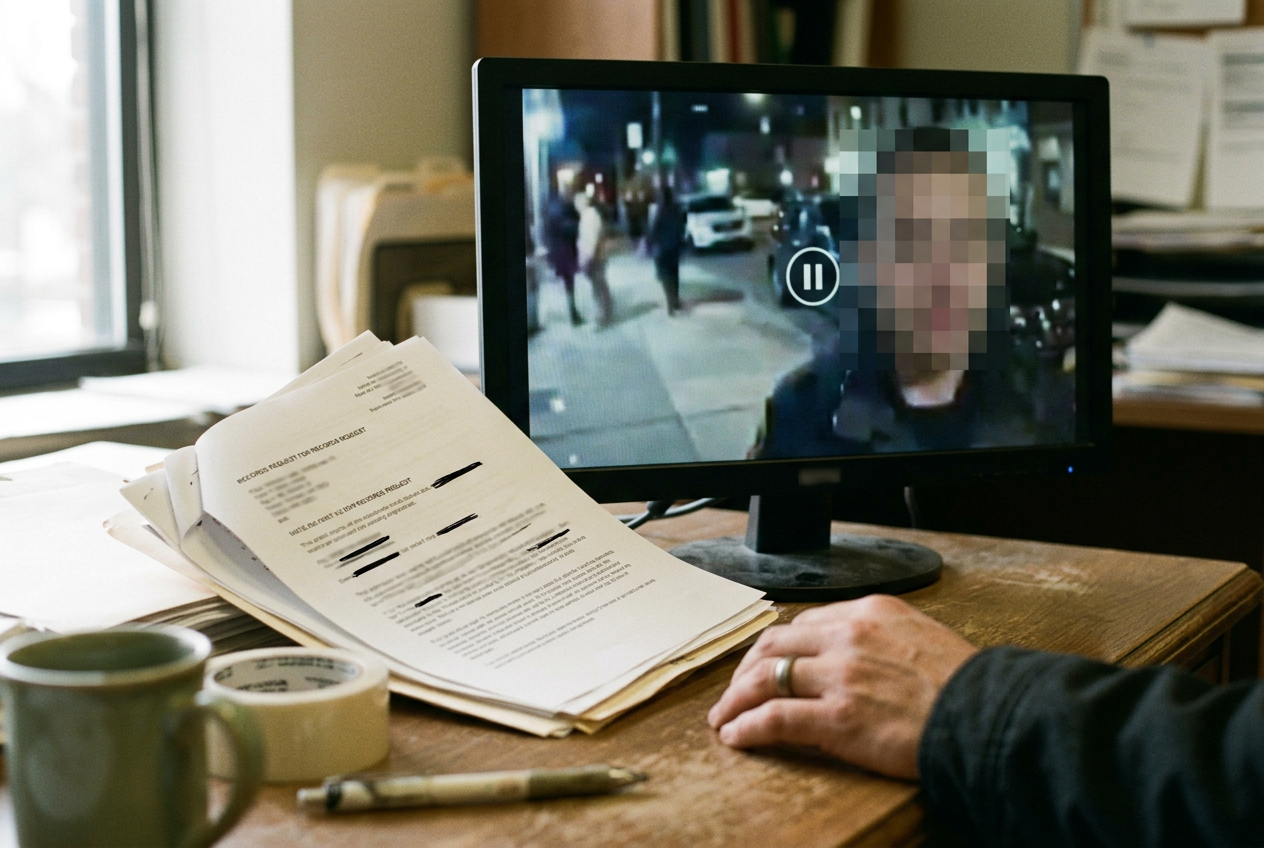
The useful object here is not the camera clipped to an officer’s uniform. It is the exported MP4 that arrives after a public-records request: flattened, blurred, sometimes muted, and detached from much of the information held inside the police evidence system.
That file looks like the event. Legally and technically, it is a derivative made for disclosure.
New Jersey’s body-camera mandate expanded the number of police encounters recorded across the state. It did not create a direct public window into those encounters. Between capture and release sits another apparatus, built from the Open Public Records Act, privacy rules, Attorney General directives, local review practices and software sold by evidence-management vendors.
The camera records first. The institution decides what the recording becomes.
The
Rivera file established a right, not a pipeline
A useful way into this system is the body-camera footage sought by Richard Rivera after a fatal police shooting in Elizabeth in 2019. The Union County Prosecutor’s Office denied his request, invoking the criminal-investigatory-records exemption in New Jersey’s Open Public Records Act, usually called OPRA.
That exemption covers certain records connected to a criminal investigation when no law requires the agency to make or keep them. It is broad, but it is not a magic phrase that converts every police file into a secret.
In 2022, the New Jersey Supreme Court held in Rivera v. Union County Prosecutor’s Office that body-camera recordings made under binding Attorney General directives were required by law. The court rejected the claim that those videos could be excluded from OPRA solely as criminal investigatory records, while leaving room for the government to argue that other, record-specific exemptions applied.
The distinction matters. A New Jersey Supreme Court interpretation of OPRA binds lower state courts. Attorney General directives also bind law-enforcement agencies under the attorney general’s supervisory authority. A vendor’s settings do not bind anyone, despite how final a gray button marked “redact” can feel.
Rivera moved the legal boundary. It did not require police to place raw evidence files online, nor did it erase privacy protections, court orders, juvenile-confidentiality rules or the narrower OPRA provisions an agency may invoke after examining a particular recording. Access still requires a request unless a separate release policy applies, followed by review and the production of a public copy.
The Rivera file therefore sits at the center of the problem. The court recognized that the recording could be a public record. The public still does not walk into the evidence system and retrieve it.
A request enters the records office, not the camera
A resident usually begins with an OPRA request identifying the agency, incident and footage sought. Precision helps because a request for every recording associated with a broad period can trigger demands for clarification, longer processing or a special service charge when the agency claims the work requires extraordinary time.
The records custodian then locates responsive material, often with help from police personnel who control the evidence platform. Someone must determine which officers recorded the encounter, whether the requested time range includes pre-event buffering, whether another agency holds part of the footage and whether the system contains multiple versions.
Pre-event buffering means the camera continuously holds a short rolling segment and saves it when recording is activated. Depending on the device and policy, that segment may contain video without corresponding audio. To a viewer, the resulting silence can look like redaction even when it was created by the camera’s capture settings.
Next comes legal review. An agency may assess whether release would expose a child, reveal protected medical information, identify an uninvolved person, interfere with an active investigation or violate another confidentiality rule. Some grounds permit withholding. Others require it.
The agency should connect each deletion to an identifiable legal basis, although denial letters can reduce that analysis to citations that force the requester to do the translation.
This is where “public” stops meaning available and starts meaning eligible for processing.
A records deadline does not eliminate the labor. Long recordings may need frame-by-frame inspection, particularly inside homes, hospitals or vehicles where computer screens and private conversations drift into view. The public paid for the camera and usually pays again for storage subscriptions, evidence-platform licenses and staff review. Under OPRA, an agency may also attempt to pass extraordinary processing costs to the requester, which turns a nominal right into a price calculation.
The second system produces the version you see
Police body cameras rarely operate as isolated recording devices. Their files enter a digital evidence-management system, a controlled repository that stores video, metadata and access histories. Axon Evidence is a prominent example used by law-enforcement agencies; other vendors sell comparable storage and disclosure tools.
These platforms preserve an evidentiary version while allowing authorized users to create working copies. Redaction software can track a face across frames, blur a license plate, cover a laptop screen or mute part of the audio. Automated detection may suggest where an object appears, but a person still decides what requires concealment and whether the software followed it correctly.
That distinction is easy to lose. The software performs the edit. The agency supplies the legal judgment.
If a blur slips for several frames, a private person may be exposed. If the box expands too far, it can cover an officer’s hands or another fact relevant to the encounter. Audio redaction can remove a name while also erasing tone, interruption and nearby speech. A cut made to protect medical information may obscure how long officers waited before providing aid.
Redaction is sometimes necessary. It is never neutral.
Vendor software also determines how expensive redaction feels to the agency. A department with licenses for automated tracking can process a long clip differently from a small office relying on manual tools, and both may describe their effort as compliance even when the resident receives sharply different results. Procurement becomes access policy without appearing in the statute.
Axon and similar companies are paid for more than cameras. Agencies may purchase cloud storage, device management, evidence sharing and redaction capabilities through continuing contracts. This encourages technological dependence: years of footage accumulate in a proprietary environment, staff learn its workflow, and moving to another provider becomes more difficult than replacing hardware.
The public export is one output of that commercial system. It may omit the original file format, detailed metadata and the platform’s audit trail, which records actions such as viewing, tagging or creating a redacted copy. The MP4 can show an officer approaching a car. It may not show who reviewed the footage, which masks were added, whether a redaction was revised or how the agency classified the encounter internally.
Return to the Rivera file. Its public status came from law, but any released viewing copy still had to be located, assessed and rendered. The ruling could open the door. It could not show what happened inside the editing room.
Exemptions become powerful through repetition
An exemption is supposed to answer a defined problem. A privacy rule protects a person whose bedroom appears in the background. A confidentiality law shields a child. An investigation provision may protect information when release would cause a concrete public harm.
In practice, the government controls the first decision, the original file and the explanation for what disappeared. A requester who suspects over-redaction usually cannot compare the public copy with the evidence version. Challenging the agency requires more correspondence, an administrative complaint or litigation, while the institution continues holding the material needed to prove the challenge.
New Jersey also recognizes a common-law right of access, a route separate from OPRA that asks a court to balance the requester’s interest against the government’s reasons for secrecy. It can reach records that OPRA does not compel the government to release, but it is case-specific and less automatic. A right that depends on balancing, persistence and possible legal action is a real right. It is not cheap visibility.
Proactive release can reduce some of this imbalance, especially after serious uses of force, because the public does not have to guess which agency possesses the decisive recording. Yet an agency-selected release remains an agency-selected release. It may feature one officer’s angle, begin after the first disputed act or carry redactions that viewers cannot evaluate from the video alone.
The better disclosure is not necessarily the raw upload. Bystanders should not lose their privacy because an officer entered their home. The stronger model would pair necessary redactions with a usable accounting: which portions were altered, the legal ground for each category, the duration removed and whether unredacted material was withheld in full. A downloadable redaction log would make the exported MP4 easier to audit without publishing protected information.
The system already keeps records of its own activity. Those records tend to remain on the other side of the interface.
Visibility is being confused with possession
Body-camera policy is often discussed as if recording solved the old evidence problem. There is now a file, so there must now be accountability. That skips the institutional work between possessing evidence and surrendering power over it.
A camera can establish that an encounter was captured. It cannot make the custodian search promptly, stop an agency from reading an exemption broadly or force redaction software to preserve the context around a covered face. Those decisions happen after recording, when public attention has moved on and the request has become an administrative task.
The exported MP4 remains useful. It may contradict an official account, establish timing or reveal conduct that written reports softened. But it should be read as a disclosed record, not as untouched reality. Its black boxes and silent intervals carry legal judgments.
Its frame carries procurement decisions. The missing audit trail belongs to the story too.
The body camera watched the encounter. The second system decided what the resident could watch back.
Questions people ask
Is
New Jersey body-camera footage a public record?
Often, yes, but public-record status does not guarantee release without alteration. The New Jersey Supreme Court held in Rivera that footage required by Attorney General directives was not excluded solely under OPRA’s criminal-investigatory-records exemption, while allowing agencies to raise other exemptions tied to the specific video.
Why is body-camera footage blurred or muted?
Agencies redact footage to protect information covered by privacy and confidentiality rules, including identifying details about children, medical information or uninvolved people. Evidence software applies the blur or audio mute, but government staff choose what to conceal and must rely on a lawful reason for doing so.
Does the public receive the original body-camera file?
Usually the requester receives an exported viewing copy rather than direct access to the evidentiary version. The export may exclude detailed metadata and the platform’s audit history, so it can show the encounter without revealing every decision made during review and redaction.
Who pays for body-camera redaction?
Public agencies pay staff and vendors for storage, evidence management and redaction tools. A requester may also face a special service charge when an agency says a request demands extraordinary work, making the scope of the request and the department’s software capacity part of the practical cost of access.
One update a day
Today's story, in your inbox
One story each morning — no hype, no filler, no algorithm deciding for you.