New Jersey Body-Camera Footage Comes With an Editing Bill
New Jersey calls police body-camera video public, then lets agencies charge requesters for reviewing and redacting it. The right survives on paper while the invoice decides who can use it.
August 11, 2026 · 8 min read
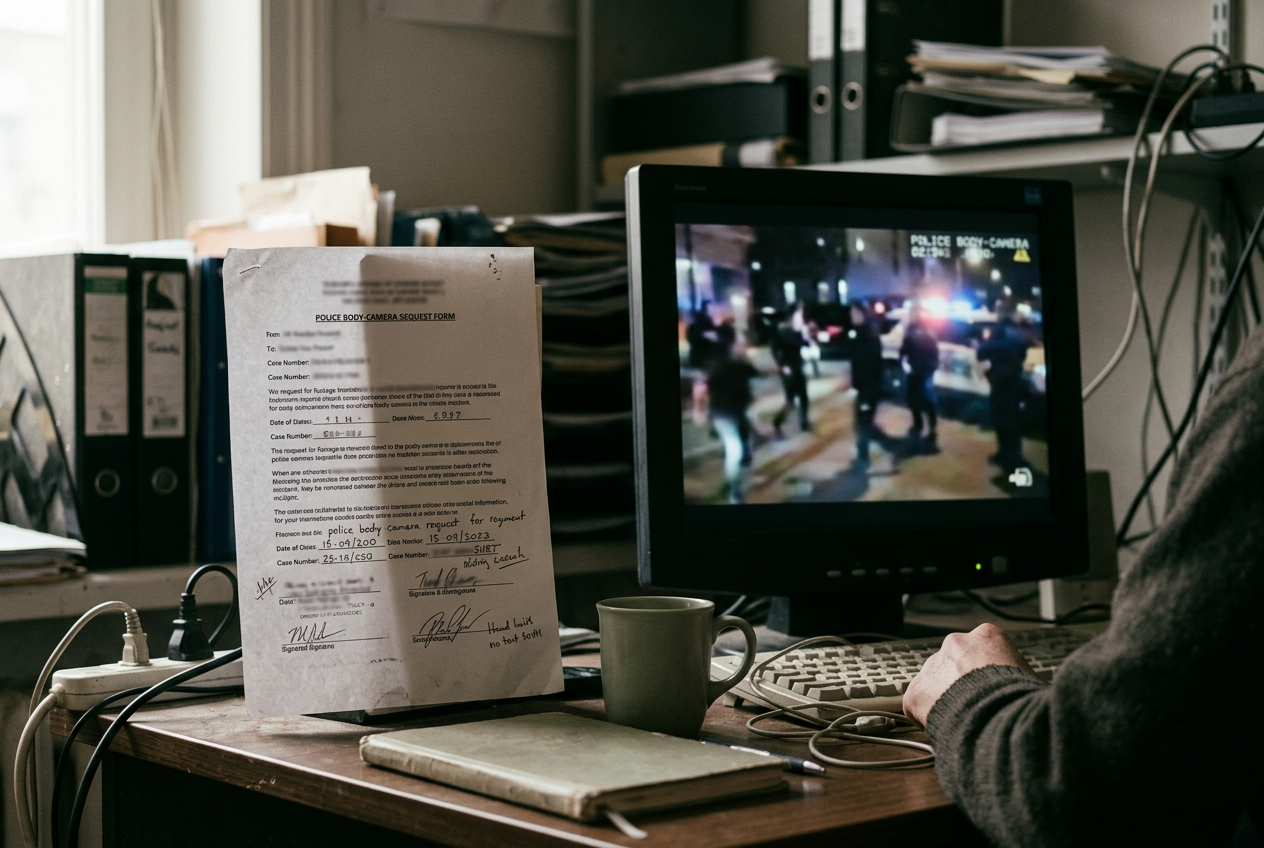
Start with one ordinary request: the body-camera recording made by one officer during one identified encounter, narrowed by date, approximate time and location. No department-wide archive. No fishing expedition. One video that already exists because the state required the camera to record it.
That request looks cheap until someone has to watch the file.
New Jersey’s Body Worn Camera Law places recordings under the Open Public Records Act, or OPRA, the state law that lets people inspect and copy government records. The same legal structure also lets an agency bill the requester for reviewing body-camera footage and removing protected material. A face may need blurring. A name may need muting.
A computer screen, apartment interior or glimpse of medical treatment may need obscuring frame by frame.
The public owns the record in the abstract. The requester finances the version the government is willing to release.
The request is narrow. The price is not.
A comparison of published request procedures for the New Jersey State Police and police departments in Newark, Jersey City and Paterson produces the same basic route: identify the record, give enough detail for a custodian to find it, then wait while the agency determines whether it can release the footage and what must disappear first. None of those routes turns a body-camera request into a product with a predictable posted price.
That matters. The standard request can name one officer, one encounter and one stretch of time, yet the requester still cannot calculate the final charge from the video’s running time alone. Review depends on what appears in the frame, how many people enter it, whether the officer moves through private spaces and whether other cameras captured the same event. Ten minutes beside an empty road is different from ten minutes inside an occupied home.
The recurring object here is one video file. The officer presses no special button to create a public copy, and the agency does not preserve a clean accountability edition alongside the evidentiary original. When a request arrives, the department retrieves the file, reviews it for legal restrictions and produces a second version. Public access begins as post-production.
Under current OPRA rules, body-camera requests receive a longer response period than ordinary records requests. The statutory clock is generally 20 business days, and an agency may seek more time when it says the work cannot be completed within that window. That deadline requires a response, not necessarily a finished video in the requester’s inbox. A custodian can acknowledge the request, identify complications, request clarification or provide a cost estimate.
Twenty business days can become the opening position.
Redaction is where the meter starts
Redaction means removing protected information while releasing the rest. In a paper record, that may involve covering a name or deleting a paragraph. Video is more laborious because the protected detail can move across thousands of frames while speech, radio traffic and background conversations continue on separate audio tracks.
New Jersey law recognizes that work and permits a reasonable fee for reviewing and redacting body-camera recordings. OPRA also permits a special service charge when fulfilling a request requires an extraordinary expenditure of time and effort. Those are binding statutory tools, not optional language from a department FAQ.
The difficult word is “reasonable.” It does not give a requester a statewide rate card. An agency may calculate labor using the employee it considers necessary for the task, estimate the time required and ask for payment or a deposit before completing the work. The requester then has to decide whether to narrow the request without seeing the footage that would show what can safely be cut.
That is the mechanism underneath the access problem. The department controls the file, the description of the necessary editing and the first estimate of its cost. The requester controls only the size of the request and the willingness to pay. Even a good-faith estimate can turn access into a blind purchase, while an inflated or poorly explained estimate can end the matter without the agency issuing a formal denial.
A denial can be challenged. A bill often works more quietly.
The one identified video returns here. If it shows an arrest in a public parking lot, redaction may be limited. If the officer follows someone into a home, speaks with children or records a person receiving medical care, the legal right to the file remains while the releasable image shrinks and the labor charge grows. Privacy deserves protection.
Making an individual requester buy every blur is a policy choice, not a technical necessity.
The exemption language does two jobs
The Body Worn Camera Law identifies recordings that require protection, including footage made in certain private or sensitive locations and images involving medical care, nudity, grievous injury, death, minors or crime victims. Other laws can protect confidential information, security details and records whose release would create a recognized privacy harm.
Those categories do not automatically erase an entire recording. Agencies should redact protected portions and release reasonably separable material, meaning content that remains understandable after the exempt parts are removed. In practice, exemption language also tells the requester why the edit may take longer and cost more.
Police video occupies a peculiar legal position because it is both an accountability record and a record of people at vulnerable moments. The camera may capture a person’s bedroom, medication, child or worst hour without that person choosing to make any of it public. A serious access system needs redaction. It does not follow that journalists, families and residents should fund that system request by request.
New Jersey’s courts have already rejected the idea that police recordings become categorically secret merely because they concern an investigation. In Paff v. Ocean County Prosecutor’s Office, the state Supreme Court held that dashboard-camera recordings required by an attorney general directive did not qualify for OPRA’s criminal-investigatory-record exemption, which applies only when a record is not required by law to be made. Body-camera files have their own statute and exclusions, but the underlying point matters: police cannot convert a required recording into a secret record by attaching an investigative label.
What can be withheld remains fact-specific. What can be charged remains financially decisive.
A public record priced like custom work
The agencies compared here differ in size and records infrastructure, but the requester meets the same structural uncertainty. Public instructions explain how to submit a request. The law supplies a response window and authorizes review costs. Neither gives the public a reliable way to know, before filing, whether one identified video will cost nothing, a manageable amount or more than the requester can spend.
Large newsrooms can negotiate scope, pay an estimate or challenge a denial. Civil-rights organizations can build repeat requests into litigation and advocacy budgets. A person trying to understand an encounter involving a relative usually has neither capacity. The fee rule lands evenly only in the administrative sense.
Agencies do incur real costs. Someone must inspect the footage, apply the governing exemptions and check the edited copy. Yet departments already pay for cameras, storage systems, evidence management and prosecutorial access because recording police activity is a government function. Redaction for public release is treated differently: the government records everyone, then presents transparency as bespoke client work.
There are less exclusionary options. The state could require departments to publish their redaction methods and labor rates, waive charges when disclosure primarily serves public accountability, cap fees for a narrowly identified incident or fund regional redaction units so that small departments do not pass irregular staffing costs to individual requesters. Agencies could also release commonly requested critical-incident footage proactively, with privacy edits paid from public funds.
None of those changes would abolish exemptions. They would decide who pays to enforce them.
OPRA still offers formal remedies. A requester can challenge a denial or disputed fee through the Government Records Council, the state body that adjudicates public-records complaints, or in Superior Court. A separate common-law right of access may apply after a court balances the requester’s interest against the government’s reasons for secrecy. Litigation, however, is not a practical substitute for an affordable records counter.
A right that requires a second legal proceeding has already lost much of its everyday value.
Return once more to the single video file. The request names the event. The government already stores the recording. The law presumes some level of access.
What stands between the requester and the image is an editing system whose cost is set after the request arrives, by the institution depicted in the footage.
That is not a clerical detail. It is the gate.
Questions people ask
Is
New Jersey police body-camera footage public?
Generally, yes. The Body Worn Camera Law places recordings under OPRA, but sensitive content can be withheld or redacted under statutory exemptions and privacy rules. Public status therefore does not guarantee release of an unedited file, and some recordings may contain so much protected material that little usable footage remains.
How long can a New Jersey body-camera request take?
OPRA generally gives agencies 20 business days to respond to a body-camera request, longer than the ordinary records deadline. A response may provide the footage, deny access, request clarification, quote a fee or seek an extension, so the statutory period does not always mark the date of delivery.
Can police charge for redacting body-camera video?
Yes. New Jersey law permits a reasonable fee for reviewing and redacting body-camera recordings, and OPRA allows special service charges for extraordinary work. The absence of a uniform statewide price means the requester may not know the cost until the agency has assessed the footage.
What happens if the fee is unaffordable?
The requester can narrow the time period, seek a waiver, dispute the charge through the Government Records Council or file in Superior Court. Those options consume time and may require legal help, which is why a redaction estimate can block access without functioning as a formal denial.
One update a day
Today's story, in your inbox
One story each morning — no hype, no filler, no algorithm deciding for you.