Police Body-Camera Footage Arrives With a Cut List
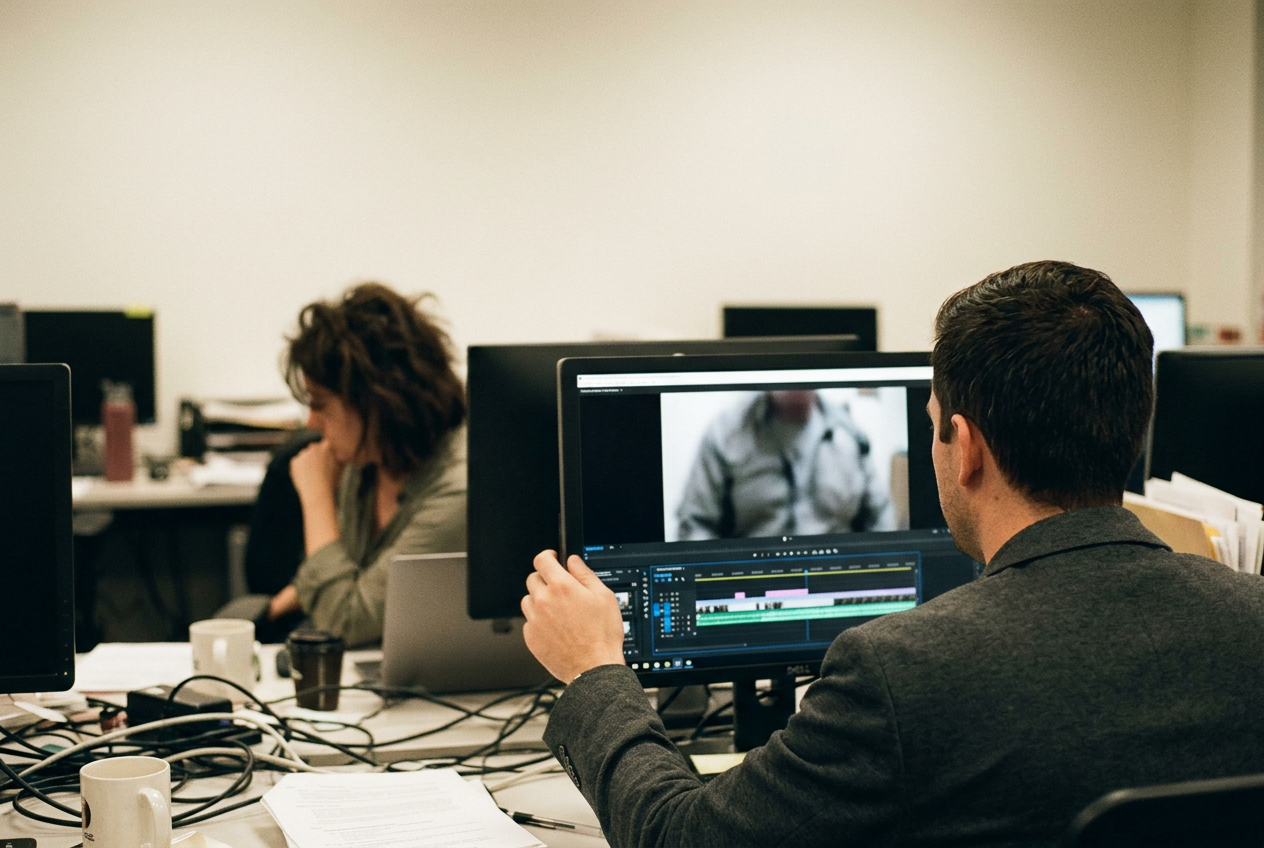
The clip at the podium has already passed through police lawyers, communications staff and editing software. Redaction can be necessary. The sequence remains an argument.
August 13, 2026 · 8 min read
In December 2021, the Los Angeles Police Department released what it calls a critical incident community briefing about the killing of Valentina Orellana-Peralta. She was 14. An officer responding to an assault inside a Burlington store fired three rifle rounds at the suspected attacker; one round passed through a fitting-room wall and killed Valentina, who was inside with her mother.
The department’s briefing assembled 911 audio, dispatch traffic, store surveillance and body-camera footage into a narrated chronology. Labels appeared on screen. Clips started and stopped. The three shots arrived only after viewers had been walked through calls describing violence and reports that the attacker might have a gun, although police later said no firearm was found.
None of that means the images were fake. It means the first widely circulated version was a police production, edited by the institution whose officer fired through the wall.
That distinction tends to vanish at the podium. A chief says the department will now “show the video,” television stations take the feed, social platforms strip out the preamble, and an exported briefing becomes known as body-camera footage. The body camera supplied some of the material. Police supplied the cut.
The original is not the thing on television
A body camera records files with timestamps and technical metadata, information stored alongside the video about its creation, device and handling. Depending on the camera’s settings, it may also maintain a pre-event buffer, a short loop captured before the officer presses record. That buffer often lacks audio, which is why released footage can begin with silent movement before sound abruptly appears.
After an incident, the camera file is uploaded to an evidence system. Access can be logged, retention rules applied and copies made for investigators, prosecutors or defense lawyers. The public version usually comes later. Staff export a derivative file, meaning a new copy altered for viewing or disclosure, then blur faces, mute information, add captions or combine recordings.
Even a clip described as “unedited” may have been converted into a different file format, trimmed at the beginning or end, or processed to hide exempt material. That is not automatically deceptive. A hospital screen can expose medical information. A driver’s license can reveal an address.
A child’s face may require protection. The useful question is narrower: what changed between the evidence file and the release copy, and who documented the changes?
Most viewers never receive enough information to answer it. Agencies rarely publish the export history, a redaction log or a hash, which is a digital fingerprint used to show that a file has not changed. Instead, the department asks the public to trust a disclaimer saying the briefing offers preliminary information.
The fitting-room wall in the LAPD footage does not care about the disclaimer. It marks the consequence. Everything placed before that wall in the sequence helps decide whether viewers encounter the shooting as an officer’s choice, an inevitable end to a frantic emergency, or some managed combination of both.
Redaction is law applied with editing software
Police departments do not have one national release rule. Federal public-records law generally does not govern local police video, so access turns on state statutes, court decisions, departmental policy and the posture of the case. Some jurisdictions presume disclosure after a set period. Others give agencies broad room to withhold footage during an investigation or require a court fight from the person seeking it.
Common exemptions cover personal privacy, juvenile identities, confidential witnesses, medical details and material that could interfere with an active case. Those categories sound definite until someone has to draw the mask around a moving body or decide whether an officer’s conversation is investigative strategy rather than embarrassing chatter.
Redaction software tracks a face, license plate or screen across frames. Audio can be replaced with silence or a tone. An agency may obscure an injured person while leaving armed officers visible, which can protect dignity without destroying the event’s basic geometry. It may also blur most of the frame so aggressively that distance, movement and lines of sight become impossible to judge.
The legal exemption does not dictate every pixel. Editors do.
That labor costs staff time and money, particularly when an incident produces hours of footage from multiple officers. Vendors sell tools that automate tracking and transcription, but automation still misses reflections, loses faces when bodies overlap and mishears speech under sirens. Delay can be legitimate. It can also be convenient, especially when the department releases a polished summary quickly while telling reporters that minimally edited files require months of review.
The incentive is plain. A communications unit needs a watchable clip before the news cycle moves on. Lawyers want to avoid disclosures that could create liability or complicate a prosecution. Command staff want to show control.
The person filmed, meanwhile, may be dead, jailed, hospitalized or unable to obtain the footage without paying fees and learning a public-records system built for repeat players.
Sequence manufactures the obvious
One camera rarely contains the whole event. Officers arrive at different times and activate their devices at different moments. Internal clocks can drift. A surveillance camera may record at another frame rate, while dispatch audio follows its own timestamp.
To build a briefing, an editor chooses a common timeline and decides when to leave one perspective for another.
That decision can clarify an encounter. It can also create causation through proximity. Put a threatening 911 call immediately before an officer raises a weapon and the call feels like knowledge the officer possessed, even if the caller’s wording changed through dispatch or the officer never heard it. Repeat a slowed clip after the shooting and an indistinct hand movement acquires the authority of a conclusion.
In the LAPD briefing, the calls and surveillance footage establish danger before viewers enter the store through the officer’s camera. The information matters. So does the order, because the officer’s split-second view and the department’s later access to every recording are different bodies of knowledge.
A responsible release separates them. It identifies what officers heard before arrival, what each camera captured and what investigators learned afterward. A less responsible one folds hindsight into the opening act, then calls the result context.
Television rewards the fold. Producers need a short segment, officials offer a preassembled chronology, and the clip with labels is easier to air than several long files whose clocks do not quite agree. Police do not need to order anyone to adopt their frame. They only need to make their version cheaper, faster and more legible than the alternatives.
Captions can turn uncertainty into evidence
Captions look administrative. They are editorial.
Speech recorded on a body camera is often muffled by clothing, movement, distance and overlapping radio traffic. A department that captions uncertain audio must decide where one word ends and another begins. Once printed on screen, a disputed phrase becomes difficult not to hear. The caption trains the ear.
Labels do similar work. “Suspect,” “weapon” and “officer-involved shooting” may reflect police terminology, but each carries a theory of the event. An arrow pointing toward a dark object tells viewers what deserves attention. A freeze-frame selects the fraction of a second on which judgment will rest, while the frames before and after it become supporting material.
Accessibility requires accurate captions. Public accountability requires agencies to distinguish direct transcription from description, mark unintelligible passages and correct errors without quietly replacing the file. A clean sans-serif label is still a claim.
Return to the three rifle shots. The body camera lets the public see the officer fire. Surveillance footage helps show the store around him. The narrated briefing tells viewers how to travel from the first emergency call to the fitting-room wall.
Those are different functions, although the finished video packages them as one continuous act of disclosure.
A release can show its work
Police could publish the narrated briefing alongside longer, minimally edited clips, each with visible time information and a note explaining any clock adjustment. A redaction log could identify where material was blurred or muted and cite the legal basis without exposing the protected information. The agency could also provide an index showing which cameras exist, which were released and which were withheld.
None of this eliminates judgment. It makes judgment inspectable.
Departments will argue that fuller releases consume storage, review time and staff hours. They do. Yet body-camera programs already require expensive hardware, cloud evidence systems, vendor contracts and personnel trained to manage disclosure. Public interpretation is not an accidental side task attached to that spending.
It is one reason cameras were sold to the public as accountability infrastructure.
The more realistic alternative is not a mythical untouched video that explains itself. It is a release in which police disclose their edits with enough precision that journalists, lawyers, families and residents can reconstruct the choices. News organizations should identify edited briefing packages as edited briefing packages, preserve official captions as attributed claims and resist airing a department’s sequence as though the camera assembled it.
The frame may be official. It remains a frame.
Questions people ask
Can police legally edit body-camera footage before releasing it?
Usually, yes. State disclosure laws and court rules often permit or require agencies to redact private, identifying or investigative material. The legal authority to redact does not settle how much context police should release, how clips should be ordered or whether every alteration should be documented.
Does
“unedited body-camera footage” mean it is the original file?
Not necessarily. The public copy may have been exported, converted, trimmed or redacted even when the encounter itself was not rearranged. A stronger release includes file information, timestamps and an edit or redaction log so viewers can distinguish necessary processing from narrative assembly.
Why do police release a narrated video before the full footage?
A narrated briefing is faster for newsrooms to air and easier for a department to control. It can satisfy political pressure for disclosure while lawyers and records staff continue reviewing longer files, giving the official interpretation a large head start over independent analysis.
What should viewers look for in a police video release?
Check whether the footage is a briefing or a direct camera export, whether captions are attributed, and whether multiple cameras were synchronized or withheld. Notice what appears before the use of force, where the video cuts, and whether the agency explains every blur, mute and missing interval.
One update a day
Today's story, in your inbox
One story each morning — no hype, no filler, no algorithm deciding for you.