The Tyre Nichols Footage Starts After the Alleged Driving
The four released videos documented police violence in detail. They could not show the alleged reckless driving used to justify the stop, because no released camera recorded it.
August 11, 2026 · 8 min read
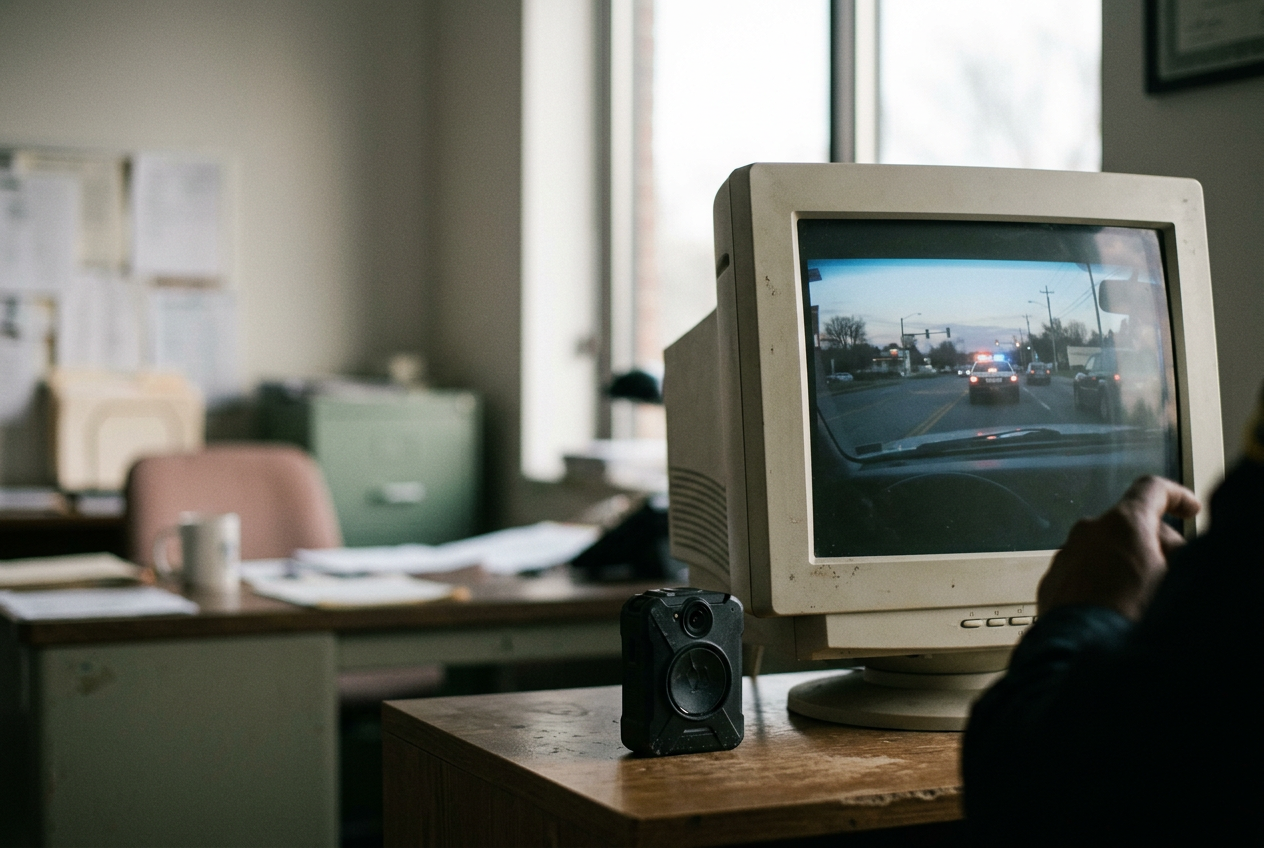
The first body-camera file released after Memphis police killed Tyre Nichols begins with an officer arriving at a stop already in progress. Nichols’s car is boxed in. Officers are moving toward him. Within seconds, they drag him from the driver’s seat.
The alleged reckless driving that police used to explain the stop is not there.
In January 2023, Memphis released four principal recordings: three from body-worn cameras and one from a fixed police camera mounted above the street. Together, they showed officers pursuing Nichols, beating him and leaving him without prompt medical care. The footage contradicted the department’s initial account of a confrontation in which Nichols had resisted and officers had used pepper spray. It also exposed something less spectacular but just as important.
A camera can document an encounter with terrible clarity while remaining silent about why the encounter began.
Memphis Police Chief Cerelyn Davis said publicly that the department’s review had not found evidence substantiating the reckless-driving allegation. The released footage could not settle that point. It started too late.
That first frame is the problem in miniature. Body-camera video often enters public life under the language of disclosure, as though an institution has opened a window. What it has usually done is publish a bounded set of files, recorded according to its equipment and activation rules, processed by its staff or contractors, then released on a timetable shaped by lawyers, investigators and political pressure. The images may be real.
The package is still an edit.
The first cut happens at activation
A body-worn camera does not record an officer’s entire shift as a continuous, reviewable film. Policies generally require activation during stops, searches, arrests and other enforcement activity, but the officer often initiates recording by pressing a button. Some systems can also activate through signals from a patrol car, a drawn weapon or another paired device. Those triggers depend on equipment, configuration and compliance.
Many cameras maintain a pre-event buffer, a short rolling cache that can be attached to the saved file after activation. Depending on the model and agency settings, that buffer may preserve video without sound. It does not recover an hour. It cannot show what happened before the buffer began, and it cannot supply audio that the device was not configured to retain.
This makes activation a form of editorial power, even when nobody intends to edit anything. If an officer activates after approaching a car, the public receives the approach without the driving that supposedly justified it. If activation begins after force starts, the file may show a person struggling under several officers without showing the decisions that put those officers on top of them. The recording gains the authority of an eyewitness while inheriting the limits of a late witness.
Those limits are not neutral. Officers know departmental policy, control the device in many systems and can explain a failure to activate through mistake, urgency or malfunction. The person stopped has no corresponding button. A camera worn on an officer’s chest also follows the officer’s body, so hands, car doors and other officers regularly block the view at the moment force is used.
Return to that first Nichols file. It preserves commands, movement and escalation once the arriving officer leaves his vehicle. It does not preserve the alleged act that made police intervention lawful in the first place. The most consequential absence sits before the timestamp.
Release means choosing a public record
The Nichols release was unusually extensive by the standards of police disclosure. Multiple angles appeared together, including the elevated fixed camera that captured violence missed or obscured by the body-worn devices. That breadth mattered. Without the pole-camera view, the public account would have depended more heavily on recordings attached to moving officers.
Even a multi-camera release remains a selection. A department may possess body-camera files from every officer at the scene, dispatch audio, patrol-car video, surveillance footage, photographs and recordings from later interviews. Evidence collected for an investigation is not automatically the same material published for public review. State records laws differ, exemptions for active investigations can be broad, and prosecutors may argue that disclosure could affect witnesses or a future trial.
The institution therefore decides which files count as responsive, which angles add value and which records remain withheld. In some cities, police publish a critical-incident video: an edited presentation combining narration, selected clips, maps, still images and slowed footage. The format is efficient. It is also advocacy with production values.
Memphis did not need a narrated package to make the underlying point visible. The four-file menu set the perimeter. The viewer could examine the traffic stop, pursuit and beating, but not the conduct alleged before the stop because the release contained no recording of it. The city disclosed what its systems had captured.
That is different from disclosing the whole event.
Redaction changes time as well as detail
Before publication, agencies commonly blur faces, vehicle plates, computer screens and the interiors of private homes. They may mute names, medical information or statements from witnesses. Redaction, the removal or concealment of material before disclosure, can protect children, bystanders and people receiving medical care. It can also make an encounter harder to understand.
A blurred patch may cover an officer’s hand. Muted audio may remove the transition between a command and the use of force. If an agency exports clips rather than complete files, the viewer may not know whether missing seconds contain protected information, inactivity or evidence unfavorable to the official account. A visible black screen with an explanation preserves elapsed time.
A clean cut can erase it.
The original evidence usually remains in the agency’s possession or in cloud storage operated by a vendor such as Axon. Public procurement records show that body-camera programs are not purchases of cameras alone. Departments pay for storage, software licenses, evidence management and redaction tools, often through multi-year contracts. Every additional hour considered for release creates review work and possible legal exposure.
The cheap public option is a smaller package.
That cost is real, but it points toward the institution’s priorities rather than resolving them. Agencies found money to record large parts of public life and to store those recordings in proprietary systems. Public access is treated as a separate expense, activated after a death, lawsuit or sustained demand.
Delay gives the first account room to harden
Nichols died after the stop in early January 2023. The public footage arrived later that month, after his family and their lawyers had viewed it and after officials had made decisions about discipline and criminal charges. The interval was shorter than delays in many other cases. It still gave the state time to investigate itself before the public could inspect the central record.
Delay affects more than attention. Police reports, union statements, charging documents and official briefings can establish a vocabulary before video appears. Words such as resistance, threat and struggle then become captions waiting for pictures. Once the footage is released, viewers are invited to test it against a story already in circulation rather than encounter the record without institutional instruction.
Families may receive controlled access before publication, sometimes in a government building and under conditions that limit copying. That can spare relatives from learning details through social media. It is not the same as public accountability, and officials sometimes invoke a family’s private viewing as evidence that a broader delay is respectful, even when the family has asked for release.
The first Nichols frame becomes useful again here. By the time most people saw officers pull him from the car, they had already heard that the stop concerned reckless driving. The camera supplied no visual basis for that claim. The claim arrived first anyway.
Authentic footage can still make a case
Calling a release an edit does not mean the images are fabricated. It means authenticity answers only one question: whether the recorded pixels and sound correspond to what the device captured. It does not answer why recording began there, why that file was selected, what was concealed, what remains elsewhere or why publication occurred at that moment.
A credible release would preserve those distinctions. Agencies could publish an index of every known recording with start and end times, identify withheld files and state the legal basis for each withholding. Redactions should leave elapsed time visible. Metadata, information attached to a file about its creation and handling, should accompany the public copy where disclosure does not create a specific safety risk.
The original file should also carry a cryptographic hash, a digital fingerprint that changes if the file changes, allowing later reviewers to verify that evidence has not been altered. None of this requires publishing a dying person’s unblurred body or a witness’s home address. Privacy and auditability can coexist when agencies explain each intervention instead of presenting the export as self-evident truth.
Independent custodianship would go further. When the same department controls the camera policy, stores the evidence, reviews officer compliance and decides what the public receives, every stage answers to the institution under scrutiny. Civilian oversight bodies or records offices with enforceable access could manage release without waiting for police communications staff to decide that the package is ready.
The alternative costs staff time, storage access and political control. That is why it remains uncommon. The existing arrangement turns cameras sold as accountability tools into evidence systems owned by police, with public visibility available on institutional terms.
Questions people ask
Do police body cameras record everything before an officer presses the button?
No. Many models hold a short pre-event buffer, which may preserve video without audio, but its length and configuration vary. Anything before that window is absent. If the officer activates late, the saved file can begin after the alleged offense, initial command or first use of force.
Is redacted body-camera footage fake?
Not necessarily. Blurring, muting and clipping can protect private information while leaving the underlying event authentic. The problem is that viewers often receive no complete account of what changed. A trustworthy release identifies every redaction, preserves elapsed time and retains the original file for independent review.
Why do police departments delay releasing body-camera video?
Departments cite active investigations, witness integrity, privacy review and the time required to process several recordings. Those concerns can be legitimate. Delay also lets officials establish an account before the public sees the evidence, while the people recorded have little control over either the narrative or publication schedule.
What should the public look for in a body-camera release?
Check where each file begins, whether audio starts later than video, which officers had cameras and whether other recordings are listed. In the Nichols release, the decisive missing material was basic: none of the published cameras showed the alleged reckless driving that police said brought officers to his car.
One update a day
Today's story, in your inbox
One story each morning — no hype, no filler, no algorithm deciding for you.