New Jersey Can Give You Body-Cam Video You Cannot Reuse
New Jersey treats body-camera footage as a public record. The same system can deliver it late, heavily muted or in a format that defeats scrutiny.
August 11, 2026 · 8 min read
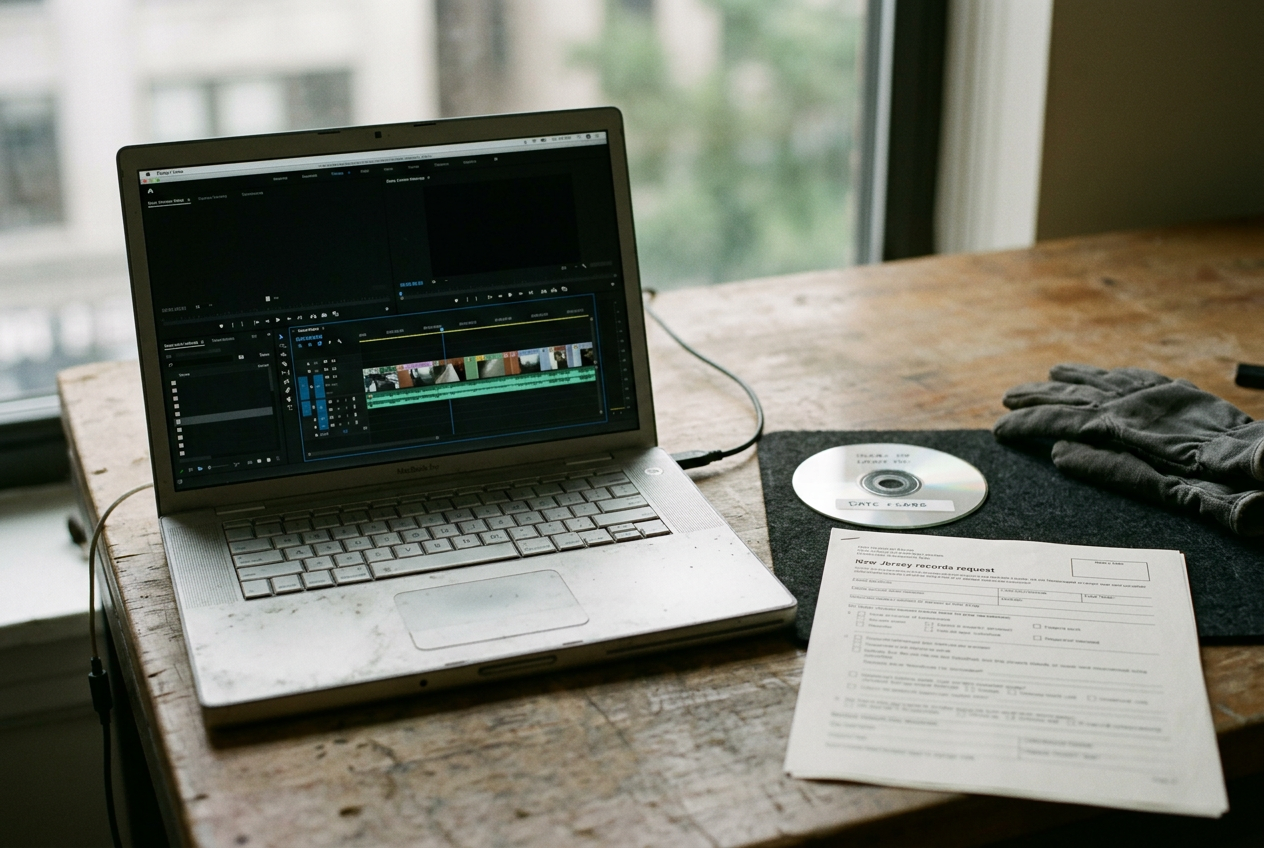
Use one ordinary file as the test: the uninterrupted body-camera recording of a nighttime traffic stop, with its original audio, timestamps and basic file metadata. Nothing cinematic. No sprawling demand for every officer’s footage over six months. One encounter, identifiable by location, approximate time and the agency involved.
On paper, New Jersey gives you a route to that recording. In practice, the file can pass through several gates before it reaches you, and each gate can reduce its value without producing a clean denial that anyone must defend. The agency can make you refine the request, extend the response time, review the footage frame by frame, remove images and sound, charge for unusual labor, then export what remains in a form chosen by its records system.
You receive video. The transparency box gets checked. The usable evidence may be somewhere else.
The right is real, but narrower than it sounds
New Jersey’s Open Public Records Act, usually called OPRA, creates a statutory right to inspect or copy government records. Body-camera recordings are generally treated as government records under state law, subject to exemptions and restrictions covering privacy, criminal investigations and sensitive scenes.
That distinction matters. A record can be presumptively public while portions of it remain legally shielded. Footage inside a home, images of minors, medical information, the identity of a victim or material tied to an active investigation can trigger withholding or redaction, depending on the circumstances and the law being applied. The agency must still identify a legal basis for what it removes.
It does not get a free-floating power to erase whatever looks bad.
The statute is binding. Court interpretations of it are binding within their jurisdiction. New Jersey Attorney General policies govern how law enforcement agencies record, retain and handle footage, but an operational policy is not automatically a public license to obtain every resulting file. Government Records Council guidance explains the records system, while council decisions and court rulings resolve particular disputes.
An agency FAQ is an agency FAQ. Nice typography does not promote it into law.
There is also a common-law right of access, a separate route under which a court balances the requester’s interest against the government’s reasons for secrecy. That route can reach material OPRA does not, but it demands more argument and usually more time. A right that becomes useful only after litigation is still a right. It is also a filter for money and stamina.
Return to the nighttime traffic-stop recording. The request needs to identify a record rather than ask the department to investigate its own archive and answer a broad question. The more precisely the encounter is described, the harder it is to dismiss the request as improper research. Yet the requester may not know the officer’s name, camera identifier or incident number, because those details are often contained in the records being sought.
That is the first mechanism. The institution holds the index and can demand specificity from the person who does not.
Twenty business days is not a publication schedule
New Jersey gives agencies more time to handle video than the ordinary OPRA response period. Body-camera footage can require a response within 20 business days because someone may need to watch it, identify protected material and produce a redacted copy. Extensions can follow when an agency says the work cannot reasonably be finished on time.
The justification is not invented. Video redaction is labor. A reviewer may have to follow a child across moving frames, conceal a computer screen, remove an address spoken once in background audio and preserve the surrounding encounter. Automation can help track an object, but somebody still has to check what the software missed.
A badly redacted video can expose a victim or witness for years.
The problem is that news value and legal accountability run on another clock. A recording released after officials have held press conferences, witnesses have absorbed the official account and public attention has moved on does not perform the same democratic function as footage released while the facts remain contested. It may still matter in court or in a later investigation. It no longer enters the first version of the story on equal terms.
Delay also works without a final refusal. The custodian acknowledges the nighttime traffic-stop request, seeks clarification, estimates review time, proposes an extension and later supplies a partial export. Every step can look administratively reasonable in isolation. Together they let the agency set the tempo of outside scrutiny.
That arrangement works particularly well for institutions because no single email has to say no.
Redaction can remove the event’s meaning
Visual blurring gets most of the attention because it is visible. Audio redaction does quieter damage.
A muted name may be necessary. A long silent passage can conceal tone, commands, warnings, distress or the point at which officers changed their account of what was happening. If the export does not mark why each section was muted, the viewer cannot tell whether the missing sound protected a child, covered a tactical detail or swept away material the agency found inconvenient.
OPRA requires a legal basis for denied access, including partial denials, but a denial letter and a video timeline do not always line up in a way that lets a reader audit each cut. The requester may receive exemption language broad enough to be legally recognizable while remaining useless for understanding why the crucial 18 seconds disappeared.
The nighttime traffic-stop file can therefore be disclosed and still fail as a record of sequence. The image shows an officer moving toward the driver. The audio drops. It returns after the driver is on the ground.
Those muted seconds are not a cosmetic defect. They may contain the commands that explain whether the physical response followed compliance, confusion or resistance.
Privacy deserves protection. Institutional embarrassment does not. A credible system has to distinguish them in a form the public can test, rather than treating redaction software as a black marker with a procurement contract.
A copy is not the same as a usable copy
OPRA addresses the medium of production. If an agency maintains a record in the requested medium, it generally must provide it that way; if it does not, the law contemplates conversion or access through another meaningful medium. “Meaningful” is the load-bearing word. It does not necessarily mean native, editable, searchable or ready for publication.
A police evidence platform may store the original recording alongside metadata, audit logs and internal links. Metadata means information about the file, such as creation time, duration, device identifier or export history. Those elements may not travel together when the agency presses export. The requester can receive an MP4 stripped of useful metadata, a lower-resolution copy, files split into unexplained segments or a disc containing a player that behaves badly on current computers.
None of those outcomes is as clean as a denial. The picture opens, eventually. The records office can say it produced the footage. A reporter or defense investigator must then determine whether timestamps survived, whether compression erased detail, whether separate clips overlap and whether the audio track has been altered only through disclosed redactions.
Requesting the native file can help define the desired record, but OPRA does not force an agency to create a new record, compile an analysis or build a custom publication package. Audit logs, redaction worksheets and metadata may need to be requested as distinct existing records. If the vendor system does not export them with the footage, the legal right to the video does not automatically pull the surrounding technical history along.
This is where procurement becomes records policy. Police departments buy camera hardware, storage and evidence-management software with public money, and the vendor’s export options later shape what the public can inspect. A contract designed around prosecution, internal review and evidence retention may treat public reproduction as an afterthought. The department gets a controlled chain of custody.
The requester gets whatever the export button permits.
For the nighttime stop, the difference is concrete. A native MP4 with intact timestamps can be synchronized against dispatch audio or another officer’s camera. A screen recording inside a proprietary viewer may look similar while frustrating frame-level comparison, verification and editing. Both are “video.
” Only one travels well as evidence.
The requester can inherit the agency’s costs
Ordinary duplication charges are not supposed to become a revenue stream. Yet OPRA permits special service charges when fulfilling a request requires an extraordinary expenditure of time and effort, and video review or redaction can trigger that fight. The agency should explain the proposed charge and give the requester a chance to narrow the demand.
That sounds neutral until the object of the request is considered. Police created the recording under a mandatory accountability system. The department selected the storage platform and retention workflow. Then a member of the public may be asked to absorb the exceptional cost of making that publicly funded evidence safe enough to see.
Large requests do create real burdens, especially for small departments. One tightly identified traffic-stop file is the better test. If even that recording requires a long extension, extensive muting and a specialized export fee, the body camera is functioning first as an internal evidence device and only second as a transparency tool.
The alternative is not raw uploads of every encounter. Agencies could budget public access into camera contracts, require interoperable exports, preserve original metadata, produce time-coded redaction logs and publish footage of major incidents through downloadable files rather than viewer-only pages. Those choices cost money. So does the present system, except it pushes the cost into repeated staff review, requester disputes and litigation.
Access on paper is easy to announce because the hard decisions arrive later, one file at a time. The nighttime traffic-stop recording reaches the requester on a disc. The audio player opens. The timestamps do not survive the export.
The institution has complied far enough to end the press release.
Questions people ask
Is
New Jersey police body-camera footage public?
Generally, body-camera recordings are government records subject to OPRA, but that does not make every frame public. Privacy protections, investigative exemptions and body-camera-specific restrictions can justify withholding or redaction. The agency must connect a denial to law rather than rely on a general claim that police video is sensitive.
How long can a New Jersey body-camera request take?
Video requests can receive a longer response period than ordinary records requests, commonly up to 20 business days, and agencies may seek reasonable extensions for review and redaction. That deadline governs the records process, not the news cycle, so footage may arrive after the official account has dominated public discussion.
Can police charge to redact body-camera video?
An agency may seek a special service charge when a request requires extraordinary labor, including extensive video review or redaction. The charge is not automatic merely because the record is video, and disputes can turn on how much work was necessary, how the amount was calculated and whether the request could be narrowed.
Does
OPRA guarantee an editable or native video file?
No. OPRA supports access in a requested medium when the agency maintains the record that way, but it does not promise a publication-ready package. Metadata, audit history and redaction documentation may exist separately, while an exported copy can technically play yet remain difficult to authenticate, synchronize or edit.
One update a day
Today's story, in your inbox
One story each morning — no hype, no filler, no algorithm deciding for you.