New Jersey Colleges Treat Protest Tents Like Venue Gear
After the 2024 encampments, public colleges sharpened rules on sound, structures, guests and overnight presence. The result regulates protest like a booked event, with facilities staff holding the switches.
August 19, 2026 · 8 min read
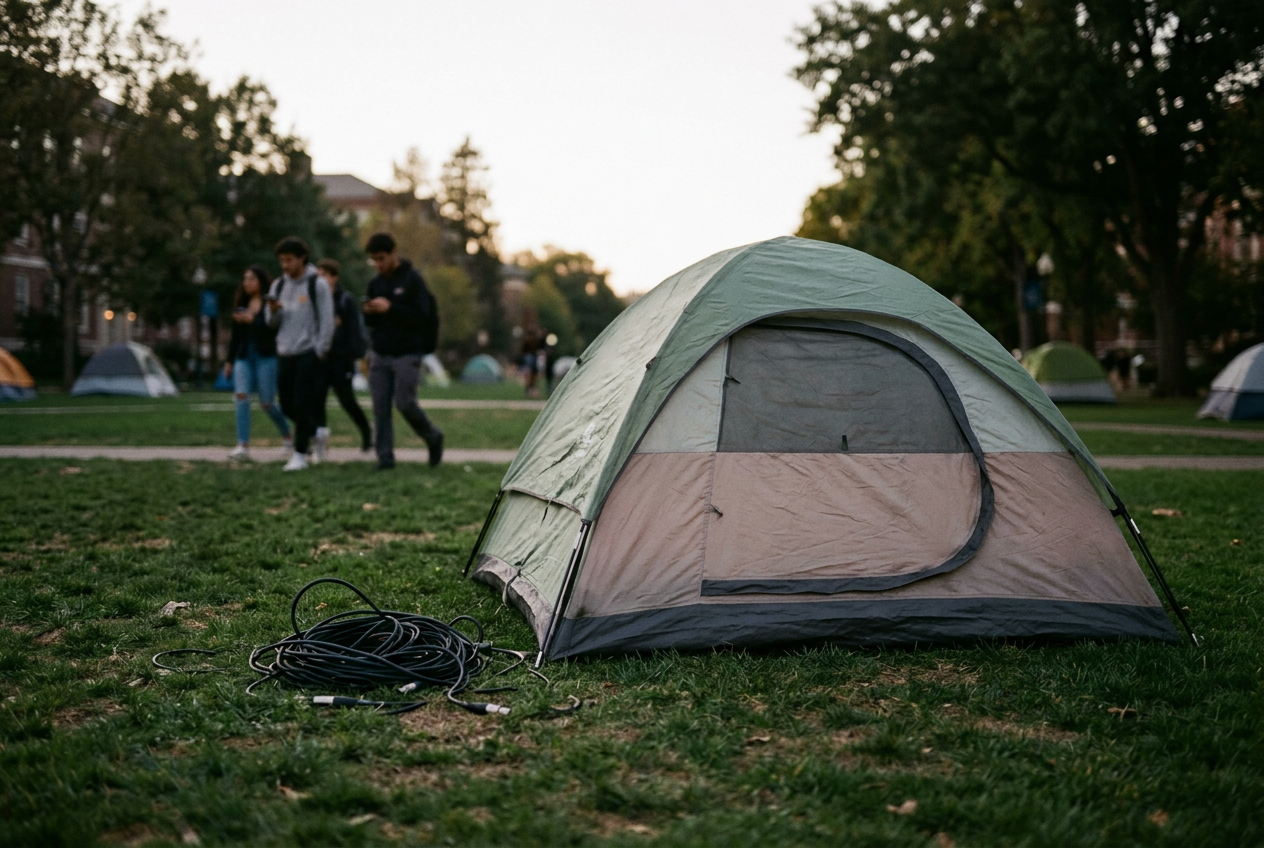
The object that explains the policy is a small camping tent on Rutgers University’s Voorhees Mall.
In spring 2024, tents turned a daytime demonstration into an encampment. A tent is cheap equipment: fabric, flexible poles, stakes if the ground allows them. It takes minutes to raise. Administratively, though, it changes almost everything.
The protest now contains a temporary structure. It occupies university property after ordinary operating hours. It can shelter someone who is sleeping, store supplies, attract guests and remain in place when administrators would prefer the crowd to reset to zero.
That is why the tent matters more than another placard. A sign carries a position. A tent creates duration.
After pro-Palestinian encampments spread across US campuses in 2024, colleges revised policies, republished old ones and stressed enforcement powers that had previously sat deep inside facilities manuals. New Jersey’s public institutions were part of that shift. The resulting documents rarely prohibit a political position. They regulate the equipment, schedule and membership of the gathering instead.
Read together, policies and guidance from Rutgers, Montclair State University, Rowan University and The College of New Jersey resemble venue contracts. They divide expression into operational categories: amplified sound, temporary structures, access by people without university identification and presence after closing. Each category gives administrators a point at which a political dispute can be translated into a property-management decision.
That translation is the mechanism. It is also the cover.
The protest becomes an event
A public college cannot ordinarily exclude speech because officials dislike its viewpoint. It may impose time, place and manner restrictions, meaning rules about when expression happens, where it happens and how it is conducted, provided those rules meet constitutional requirements and leave meaningful alternatives.
The phrase sounds neutral because it is supposed to be neutral. Its practical force depends on who writes the schedule, who approves exceptions and which alternative still reaches an audience.
Rutgers operates across campuses with separate student centers, academic buildings, lawns and reservation systems. Its rules on disruption, facilities and amplified sound allow the university to distinguish between protest as expression and protest as an activity affecting university operations. That distinction becomes decisive once speakers arrive, a canopy goes up or people stay overnight. The political content may remain untouched while the physical conditions that make the protest visible are removed.
The College of New Jersey similarly places expressive activity inside rules governing campus space and conduct. Planned events can encounter reservation procedures, while sound, structures and extended occupation trigger concerns beyond the words being spoken. Rowan’s public-facing rules connect assembly to safety, access and the university’s continued operation. Montclair State’s framework also separates campus affiliates from outside participants and treats university property as managed space rather than an unrestricted town square.
The policies are not identical, and their language can change between semesters. Their shared architecture matters more than matching clauses. A conventional event has an organizer, a start time, an end time and equipment that facilities staff can inspect. A protest often becomes effective by refusing one of those conditions.
The venue model solves that refusal for the institution. If an action lacks an approved sponsor, exceeds its reservation or introduces unapproved equipment, administrators no longer have to argue about Palestine, policing, tuition or labor. They can point to the booking rules.
Amplified sound sets the political clock
Amplification is usually defended as a classroom issue. Lectures, examinations and office work cannot proceed beside an unrestricted public-address system. That concern is real. It also gives the university control over the hours when a protest can be heard by the people whose attention it seeks.
Across New Jersey campuses, amplified sound is commonly restricted by location, academic schedule, noise standard or prior approval. The exact route varies. One school may send organizers through event services; another may rely on a broader disruption rule. Either way, the microphone becomes licensed infrastructure.
Without amplification, a speaker reaches the people already standing close. With it, the action crosses a lawn, enters nearby walkways and interrupts the normal acoustic order of campus. Scheduling sound during a lunch period or outside teaching hours preserves an opportunity to speak, but it can also move the protest away from administrators, trustees or crowds attending a major university event. The alternative exists on paper.
Its political value is lower.
This is content moderation performed through a volume control. No one deletes the message. The institution reduces its distribution.
The comparison to platform governance is useful because both systems separate a formal right to post from the practical ability to reach anyone. A social platform can leave content online while limiting recommendation. A college can leave protesters on the lawn while denying the speaker system. In both cases, the institution points to a neutral operational category and avoids stating a position on the underlying claim.
The tent turns time into a violation
Return to the tent on Voorhees Mall. During daylight, it can be described as protest equipment. After closing, it becomes evidence of camping, an unauthorized structure or continued occupancy.
Rules against overnight presence give campuses a clean enforcement threshold. The crowd does not have to become violent. Classes do not have to stop. The clock supplies the violation.
Temporary-structure rules add another route. Universities regulate tents and canopies for reasons that include emergency access, fire safety, underground utilities and damage to grounds. Larger campus events routinely accommodate structures through planning, inspection and staff coordination. A protest assembled quickly may have neither the lead time nor the institutional sponsor needed to enter that process.
The issue is not that every tent must be allowed everywhere. The issue is discretion. An approval system can protect a walkway, but it can also require organizers to identify themselves, predict attendance, accept a fixed end time and wait while the moment that produced the protest passes. Spontaneous speech enters a workflow designed for club fairs and alumni weekends.
An overnight ban then removes the encampment’s central tactic: continuity. Protesters can return the next morning, which universities can present as an adequate alternative. They must rebuild the crowd, supplies and attention each day. Administrators begin with cleared ground.
That small camping tent carried no amplification and made no statement by itself. Its offense was persistence.
Guest access narrows the public
Guest rules control who can help sustain that persistence. Public colleges are public institutions, but their campuses are not automatically open for every purpose at every hour. Policies often distinguish students and employees from people with no current university affiliation, particularly inside buildings or during disruptions.
Montclair State, Rowan, TCNJ and Rutgers each maintain mechanisms for managing visitors, even where outdoor expressive activity remains available to some members of the public. Depending on the campus and space, an outside participant may face sponsorship requirements, identification checks, restricted building access or removal for violating university rules. Those controls become more consequential during a protest than during an ordinary visit.
Coalitions do not follow enrollment records. Alumni, local residents, union organizers, faith leaders and students from neighboring schools may all form part of an action. A guest-access rule lets the university separate that coalition at the perimeter without judging its politics. Students retain a bounded opportunity to demonstrate.
Outside support becomes conditional.
The administrative advantage is considerable. Non-affiliates are easier to characterize as trespassers once permission is withdrawn, while students remain subject to conduct proceedings that can reach beyond the protest itself. The same gathering is split across two enforcement systems.
This is where surveillance enters the venue model. Reservations produce organizer names and contact details. ID checks establish affiliation. Structure approvals identify who owns the equipment.
None of this requires covert monitoring. The paperwork builds the map.
Neutral language still distributes power
Some restrictions are necessary for a functioning campus. Emergency routes have to remain open. A lecture cannot compete indefinitely with loudspeakers outside its windows. Buildings close.
Those facts do not settle how rules should be written or enforced. A policy can be facially neutral, meaning its wording does not target a viewpoint, while still giving officials broad power to choose which interruption counts as intolerable. Terms such as disruption, interference and safety need interpretation. Administrators make that interpretation under pressure from trustees, donors, elected officials, parents and lawyers.
The comparison across New Jersey’s public colleges shows a common institutional preference. Speech is easiest to tolerate when it behaves like programming: reserved, sponsored, timed and removable. Protest becomes harder to sustain as it acquires the properties that make it effective, including reach, outside support and occupation beyond the working day.
Not every relevant rule was created after the 2024 encampments. Some long predate them. The change was also one of emphasis. Colleges gathered scattered rules into protest guidance, reminded students that camping and unauthorized structures were prohibited, and made clear that enforcement would travel through facilities and conduct systems.
Old language gained a new target.
That is the paper trail to watch. A direct ban invites a constitutional fight over viewpoint discrimination. A denied sound request, an unapproved canopy and an overnight closing notice look narrower. Each can be defended separately.
Together, they can reduce a protest to people holding signs during approved hours, audible only to one another.
The tent on Voorhees Mall showed why administrators care about the distinction. Once it came down, the opinion it represented still existed. The occupation did not.
Questions people ask
Can a public college ban overnight protest encampments?
Public colleges generally have more authority to regulate overnight use of property than to prohibit a political viewpoint. An encampment can trigger rules on camping, structures, sanitation, access and closing hours. Whether a particular restriction is lawful depends on its wording, application, available alternatives and the kind of campus space involved.
Why do amplified-sound rules matter if protesters can still speak?
A protest’s reach depends on more than permission to stand somewhere. Limiting microphones and speakers can confine speech to people already gathered nearby, especially when approved hours avoid busy events or decision-makers. The message remains technically available while its distribution is reduced through scheduling and facilities control.
Can colleges restrict guests at a campus protest?
Public ownership does not make every campus building or lawn an unrestricted public forum. Colleges may set visitor and access rules, but those rules still raise constitutional concerns if officials apply them selectively. Guest controls also change the action itself by separating students from community members, alumni and organizers who help maintain it.
What should readers look for in a campus protest policy?
Read beyond the section labeled speech. Check facilities rules, sound policies, visitor procedures, closing hours and student-conduct provisions, then note who can approve exceptions and whether deadlines permit spontaneous action. The decisive restriction may appear in the document governing tents rather than the one promising free expression.
One update a day
Today's story, in your inbox
One story each morning — no hype, no filler, no algorithm deciding for you.