New Jersey Prison Tablets Make Every Tap a Storefront
A locked-down tablet can make prison life less isolated. New Jersey’s contracts also turn messages, music and books into metered products paid for by people with nowhere else to shop.
August 11, 2026 · 7 min read
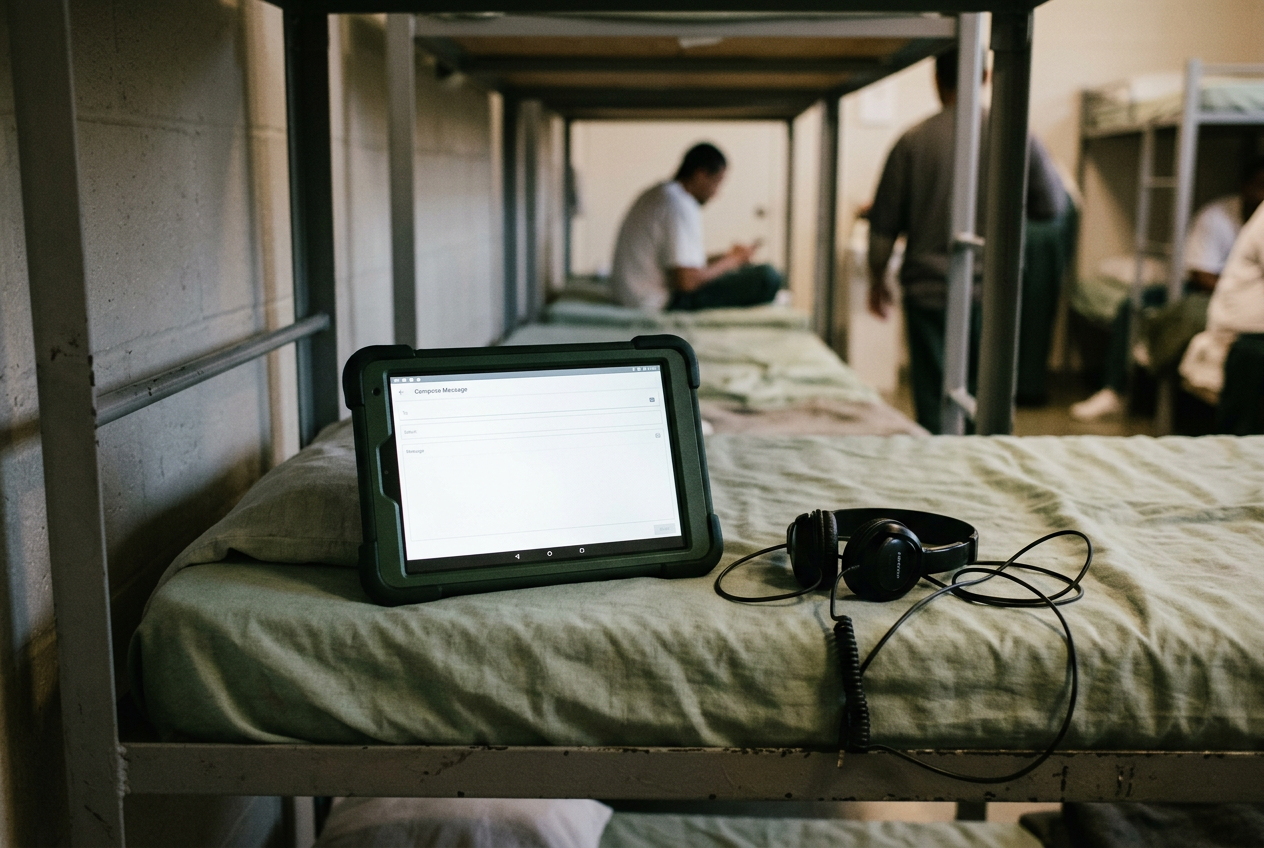
Start with the Compose Message screen.
It looks close enough to email to borrow email’s social meaning: write something, attach a photograph, press send. Inside a New Jersey prison, however, the message travels through a correctional vendor system, where access can require prepaid digital credits and every step is governed by departmental rules. The note may be screened. The attachment may cost more.
Delivery can be delayed, rejected or disabled without turning the tablet into a useless object, because the object was never sold as an open communications device.
That distinction carries the business model. New Jersey’s correctional tablets are secure terminals, meaning the vendor controls the software, permitted contacts, available catalog and payment system while the Department of Corrections controls eligibility and surveillance. They do not offer the ordinary internet. They offer a menu.
The menu is where public policy becomes retail.
The free hardware bargain
Correctional technology companies like to emphasize the tablet itself, particularly when devices are issued without an upfront charge or supplied under a contract described as costing the state little. A free device sounds like access. In practice, it can function like a game console sold near cost because the profitable part begins after activation.
Public New Jersey materials direct incarcerated users and their families into contracted systems for electronic messaging, money transfers, telephone access and other digital services. JPay, part of Securus Technologies, has long appeared in the state’s electronic service infrastructure, while the wider correctional communications market also includes ViaPath Technologies, formerly Global Tel Link. These companies do more than carry data. They design the storefront through which approved data may be bought.
The tablet’s physical limits make that control unusually durable. You cannot install another messaging app when the first one charges by the message. You cannot compare music stores, borrow an ebook from the county library’s app or move a purchased file to a cheaper device. A correctional tablet uses a closed ecosystem, a system in which one operator controls compatible software and transactions, and prison rules enforce the closure more effectively than any consumer loyalty program could.
The Compose Message screen remains useful. That is precisely why the charge works.
A family member may be able to send a letter through the Postal Service, but electronic messaging promises speed and photographs without the logistics of paper, envelopes and prison mailrooms. The available alternative is slower and can be unreliable. When ordinary communication already faces institutional friction, the vendor does not need to make its product excellent. It needs to make the other route feel worse.
The catalog sets the terms
Music on a correctional tablet is not merely a collection of songs. It is a licensed catalog inside a device that cannot reach the broader market, with selection, file rules and continued access determined by contracts and vendor policy. The incarcerated listener cannot shop elsewhere if an album is missing or overpriced. Consumer choice begins and ends at the approved icon.
Ebooks work similarly. Vendor materials often advertise large libraries, but a headline catalog size says little about what a particular prison makes available, what costs money, which public-domain titles pad the count or whether a purchased book remains accessible after a device replacement or transfer. Physical prison libraries still exist, though their hours, staffing and collections vary. The tablet does not need to abolish the library to weaken it as an alternative.
It only needs to be available in the cell while the library is somewhere else, open on someone else’s schedule.
Movies, games and other entertainment deepen the arrangement because confinement creates long periods of controlled time. Calling these products optional misses the setting. Entertainment is optional in the same sense that quiet, distraction and contact are optional: a person can survive without buying them, while the institution has already restricted most free substitutes.
Public reporting by The Marshall Project and the Prison Policy Initiative has documented this pattern across US correctional systems. Vendors place tablets in facilities, then recover money through communications and media purchases, sometimes alongside commissions or other financial benefits written into government agreements. The exact service mix differs by jurisdiction, which is why the contract, rate sheet and policy manual matter more than the promotional page.
A contract can describe the hardware as no-cost while assigning the expense elsewhere. Families load accounts. Incarcerated people spend wages that are generally tiny by outside standards. Vendors collect transaction revenue.
The agency gains a communications system, administrative tools and a controlled entertainment channel without budgeting for the full social value of access.
No-cost to the department is not no-cost. It is cost transfer with better stationery.
Moderation doubles as market control
New Jersey’s correctional messaging policies permit monitoring and restrict content, contact and use. Some oversight follows from legitimate security concerns, and confidential legal communication requires separate protections. Yet the same technical structure that screens a message also prevents competition, because the approved vendor sits between sender and recipient as carrier, cashier and rule enforcer.
That combination matters. In the consumer internet, moderation and payment are often handled by the same platform, but users can usually leave, at least in theory. A person in prison cannot switch institutions to find a better ebook store. Their family cannot download a rival app that reaches the same tablet.
Account suspension is therefore more than a platform penalty. It can cut off the fastest available channel to someone living under state control.
The vendor also receives valuable operational information: who communicates, when accounts are funded, which services are used and how frequently. Correctional systems already generate extensive surveillance data, and tablet platforms consolidate more of daily life into searchable infrastructure. Public policies may disclose monitoring, but disclosure does not create bargaining power. Clicking through is not meaningful consent when the alternative is disconnection.
This is the buried incentive behind the language of modernization. Digital delivery lowers the cost of distributing another copy of a song, book or message, yet closed access allows the seller to meter each use as though scarcity were unavoidable. Security supplies the rationale for exclusivity. Exclusivity supplies the margin.
Families become the revenue layer
Prison technology charges rarely stay inside the prison. Families often fund communication accounts and media purchases because they want regular contact, especially when distance, work schedules, disability or transportation makes visiting difficult. The invoice follows the relationship.
That changes how the Compose Message screen should be read. It is not a tiny luxury shop serving an individual consumer. It is the checkout counter placed between a household and one of its members, with emotional urgency doing work that advertising would normally have to perform.
Small charges are particularly effective here. Each purchase may look manageable in isolation, while repeated messages, attachments and entertainment accumulate over months or years. The user sees a menu item. The vendor sees recurring revenue from a population whose available alternatives were set by the same government that selected the vendor.
This arrangement also blurs public accountability. The Department of Corrections can say the contractor sets a fee. The contractor can say the department approves the service and imposes security requirements. Procurement documents divide responsibility into technical clauses, while the family encounters one practical fact: pay through the designated system or use a slower, narrower route.
The state still made the market. It decided that one company could occupy the device, defined which communications count as approved and accepted a structure in which basic media access could support the contract. Even where New Jersey receives no direct cut from a particular purchase, vendor revenue can subsidize equipment and services the state would otherwise have to fund publicly. The payment is still financing correctional infrastructure.
It has merely been routed through private accounts.
Access without a cash register
A better tablet program would separate essential access from premium purchases. Basic electronic messages, a meaningful library of ebooks, educational material and a baseline entertainment catalog could be funded as prison services, with any paid extras clearly priced and portable where licensing allows. Contracts could require public rate schedules, limits on markups, regular audits and usable data on rejected messages and service suspensions.
Procurement should also treat family spending as part of the contract’s cost. A bid that charges the department less by extracting more from users is not cheaper in any honest accounting; it has shifted the bill toward households with the least leverage and called the result efficiency.
The correctional tablet is not worthless. Being able to read in a cell, hear familiar music or receive a photograph can make confinement less isolating. That usefulness does not excuse the storefront. It explains why the storefront is profitable.
Return to the Compose Message screen. The blank box is available. The network behind it belongs to somebody else, the rules can change without negotiation, and the person pressing send cannot take their business across the street.
Questions people ask
Are New Jersey prison tablets free?
Some correctional tablet arrangements provide hardware without an upfront charge to the incarcerated user or at little direct cost to the agency. That does not make the service free. Messaging, media, account funding and other features may carry charges that are paid by incarcerated people or their families.
Can incarcerated people use normal email or streaming apps?
No. Correctional tablets use closed networks and approved applications rather than the open internet. The department and its contractor control contacts, content, available media and account access, so users cannot install a competing email service, ebook app or music store.
Who makes money from prison tablet purchases?
The contracted platform collects revenue from paid messages, media and related transactions. Depending on the agreement, a correctional agency may also receive commissions, equipment or services supported by that spending; even without a direct commission, user payments can underwrite infrastructure the state would otherwise need to fund.
One update a day
Today's story, in your inbox
One story each morning — no hype, no filler, no algorithm deciding for you.