New Jersey Schools Are Turning Student Writing Into Alerts
District software can scan a student’s email, search history and unfinished Google Docs for signs of danger. The alert may outlive the context that produced it.
August 11, 2026 · 7 min read
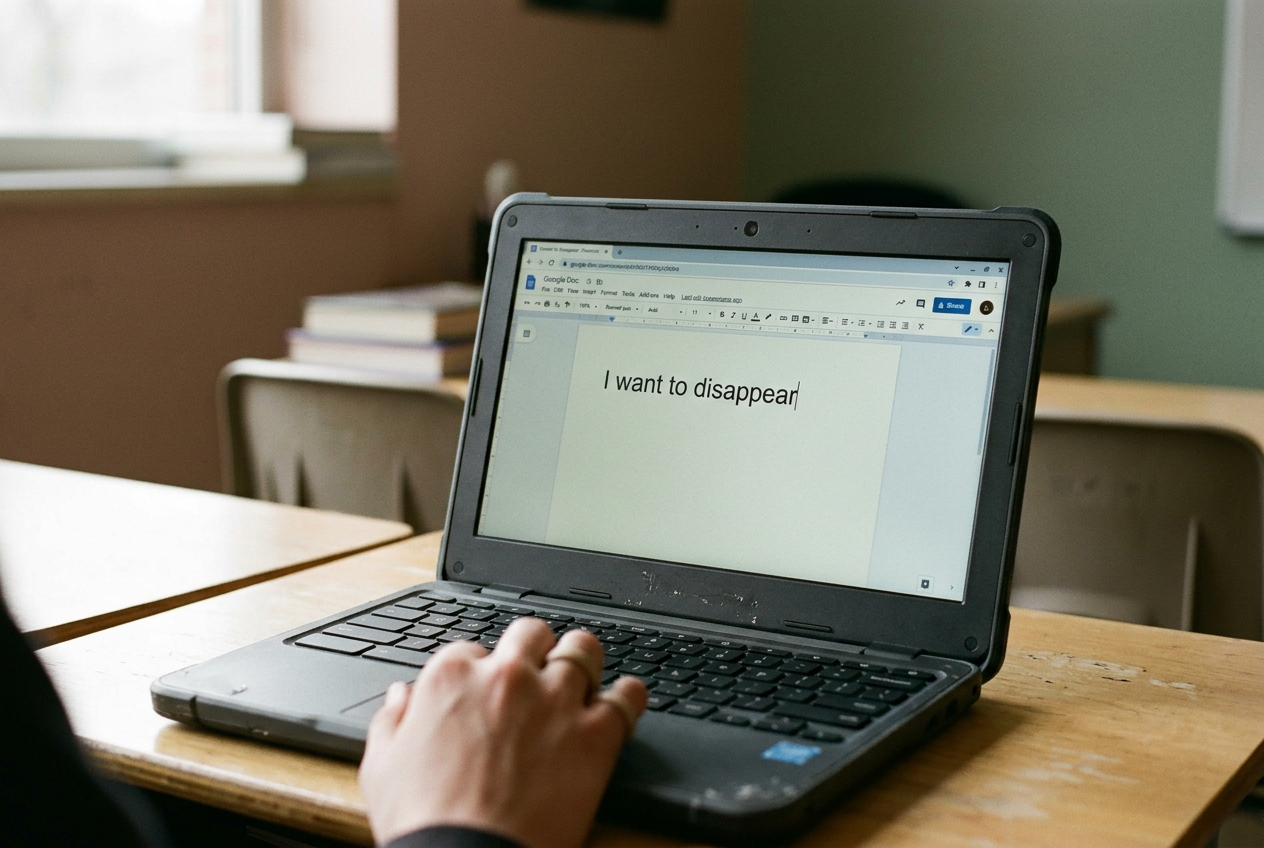
Consider an ordinary sentence in an unfinished Google Doc: “I want to disappear.” It could describe suicidal thinking. It could belong to a poem, a screenplay, a history assignment or a note that the student deletes ten seconds later.
To a threat-detection system, those possibilities begin in the same place. The sentence is content associated with a school account, available for automated analysis and possible escalation. Once flagged, it can move from a private draft into an alert reviewed by adults, attached to a student’s name and handled under district safety procedures that families rarely see in full.
That movement is the product. Vendors sell schools a way to notice danger earlier by watching more of what students do. Districts buy a promise that no warning sign will sit unread in an inbox or document. The contract pays for detection.
The student lives with interpretation.
The monitoring stack
Publicly posted technology materials, board records and family notices from New Jersey districts show a market built from overlapping products rather than one statewide system. Gaggle, GoGuardian and Securly appear across district documentation in different combinations, while Bark for Schools represents the no-cost end of the same monitoring model. Product names alone do not establish which optional modules a district has enabled, a distinction that many public notices leave unresolved.
Gaggle is the clearest example of software built to read student-created content. It connects to district-managed Google Workspace or Microsoft 365 accounts and examines material such as email, chat messages and cloud documents. Automated classifiers, software that assigns content to categories based on learned patterns, identify possible concerns. Human reviewers can then examine flagged material and send an alert to designated school staff.
Severe cases may prompt direct contact outside ordinary school hours.
GoGuardian is often introduced to families as classroom-management or web-filtering software. Its Beacon product adds self-harm detection by analyzing activity associated with managed accounts and devices, including searches and browsing behavior. This matters because a district notice that says “GoGuardian” may describe a teacher’s ability to manage browser tabs, the operation of a network filter, Beacon’s risk alerts or some combination of them. The brand is not the scope.
Securly has the same problem. Districts may use its filter to block websites while separately licensing Aware, which analyzes activity in school email, documents and other services for signs of self-harm, bullying or violence. Human review is available through additional services. A public board agenda that approves “Securly” without the module, data sources and review arrangement tells parents very little about what the district bought.
Bark for Schools monitors supported school accounts for categories of potentially harmful content and offers that monitoring without a subscription charge, while the company sells other products and services. Free does not mean institutionally neutral. It lowers the procurement barrier and makes content scanning easier to adopt before a district has written a useful public explanation of its limits.
Clifton Public Schools has published family-facing information about Gaggle monitoring, while technology and privacy materials from districts including Montclair and Cherry Hill identify products in the wider GoGuardian and Securly ecosystem. These records are uneven. One page names a vendor but not the module. A board resolution may authorize spending without reproducing the operating rules.
A privacy notice may list data categories while saying little about the people who can read an alert.
The gaps are part of the mechanism. Procurement treats monitoring as software. Students encounter it as authority.
What the machine is asked to notice
Vendor materials describe categories that sound self-evident until language enters them: suicide and self-harm, violence, bullying, sexual content, drugs and other threats to student safety. The labels suggest settled facts. The source material is messier.
A detection system can weigh keywords, phrases, images, searches, account behavior and the surrounding text available to it. It does not diagnose a student. It produces a risk signal calibrated according to thresholds that vendors generally describe more fully than districts disclose. Those thresholds matter because every setting distributes error.
A lower threshold catches more possible danger and sends more harmless material to reviewers. A higher one reduces noise and risks missing something urgent.
Return to “I want to disappear.” A human reader with the full assignment might recognize a line of fiction. A reviewer seeing an excerpt, file title and limited conversation history may reasonably choose caution. The school then receives an alert shaped by two prior judgments: the vendor’s model decided the content was worth surfacing, and a reviewer decided it was worth escalating.
Neither judgment needs to be malicious for the sentence to change status. It began as writing. It has become safety information.
Context does not arrive automatically. Students use metaphor, quotation and exaggeration. They write horror stories and health assignments. Queer students may discuss identity or rejection in language that overlaps with categories for sexual content, abuse or emotional distress.
Disabled students and students already receiving mental-health support can generate more institutional concern because adults read new material through an existing file.
The problem is not that schools should ignore a direct disclosure of imminent harm. The problem is that vendors market expanded visibility as if visibility settles meaning. It does not.
The alert has a second life
After an alert reaches a district, software gives way to local policy. Someone must decide whether to contact the student, call a parent, involve a counselor, request a wellness check or refer the matter to law enforcement. The vendor may recommend urgency, but school officials exercise the authority.
Parent notices tend to emphasize protection and account ownership: district systems are for educational use, activity may be monitored, students should not expect privacy. Contracts and privacy policies answer a different set of questions, including what data the vendor processes, which subcontractors may touch it and how deletion works. Safety protocols govern the final handoff. Families need all three documents to understand one alert.
They rarely receive them together.
The Family Educational Rights and Privacy Act, or FERPA, generally allows schools to share education records with vendors treated as school officials performing an institutional service. That framework can regulate access without requiring meaningful student consent. It also does not answer the practical question that follows a false or ambiguous flag: what did the district write down?
An email sent to an administrator can be retained. A counselor may add a note. A risk assessment, disciplinary referral or police contact can create another record under another policy. Even if the vendor later deletes the source content, the institutional response may remain.
Retention language focused on the vendor’s database therefore captures only part of the trail.
This is where “I want to disappear” acquires weight. The sentence may be explained within minutes, yet the alert has already established that a named student generated content associated with self-harm. A later adult may encounter the category before the explanation. Institutions are good at preserving concern and less reliable at preserving context.
The contract rewards coverage
District leaders face an ugly asymmetry. If software generates excessive alerts, the cost appears as staff time, student anxiety and strained trust. If administrators decline the product and later miss a warning sign, the decision can become a public scandal. Vendors sell into that fear with a defensible proposition: more surfaces watched, more hours covered, more chances to intervene.
Schools pay through annual software subscriptions, broader device-management packages or added human-review services. The visible contract cost is only the beginning. Counselors and administrators must assess alerts, reach families and document their decisions, often while working inside mental-health systems already short on time. A tool marketed as labor-saving can redirect professional attention toward whatever the classifier found easiest to count.
Public records should make that tradeoff inspectable. Districts could disclose the exact modules enabled, data sources scanned, alert categories, number of alerts by severity, number dismissed after review, outside agencies contacted and retention rules for both vendor data and school-created records. Aggregate reporting can protect student identities while showing whether the system produces useful interventions or a large volume of institutional suspicion.
Districts can also narrow the collection. Monitoring a school email account is not identical to scanning every draft stored in cloud storage. Browser filtering is not identical to behavioral analysis. An alert to a counselor is not identical to an automatic police referral.
Procurement documents often compress these differences into the language of student safety, which is convenient for the buyer and vendor because nobody wants to cast a vote against safety.
A school can decide that some visibility is warranted. It still owes students a boundary they can understand before they type.
Questions people ask
Can school software read an unfinished Google Doc?
It can if the district has connected a monitoring product to its managed Google Workspace account and enabled document scanning. The relevant boundary is usually account ownership, not whether the student pressed submit, shared the file with a teacher or considered the draft finished.
Does artificial intelligence decide that a student is suicidal?
No. Automated systems identify content or behavior associated with risk and may assign an alert category or severity. Some vendors add human review before notifying the school, but district employees still decide what the alert means and whether it warrants counseling, parent contact or an emergency response.
Can a metaphor trigger a school safety alert?
Yes. A metaphor can contain the same words as a direct disclosure, and automated classification cannot guarantee the context will be understood. Human review may correct the mistake, but the review itself can create emails, notes and other records linking the student to a safety category.
What should a district disclose about student monitoring?
At minimum, families need the product and module names, accounts and content scanned, alert categories, human-review arrangements, recipients, retention periods and escalation rules. A generic statement that school devices may be monitored does not explain how private writing becomes a report or how long that report follows the student.
One update a day
Today's story, in your inbox
One story each morning — no hype, no filler, no algorithm deciding for you.