New Jersey’s Plate Cameras Don’t Stop at the Town Line
A local Flock camera can feed searches by police far outside the town that approved it. The operative decision sits in contracts, retention rules and sharing permissions.
August 11, 2026 · 7 min read
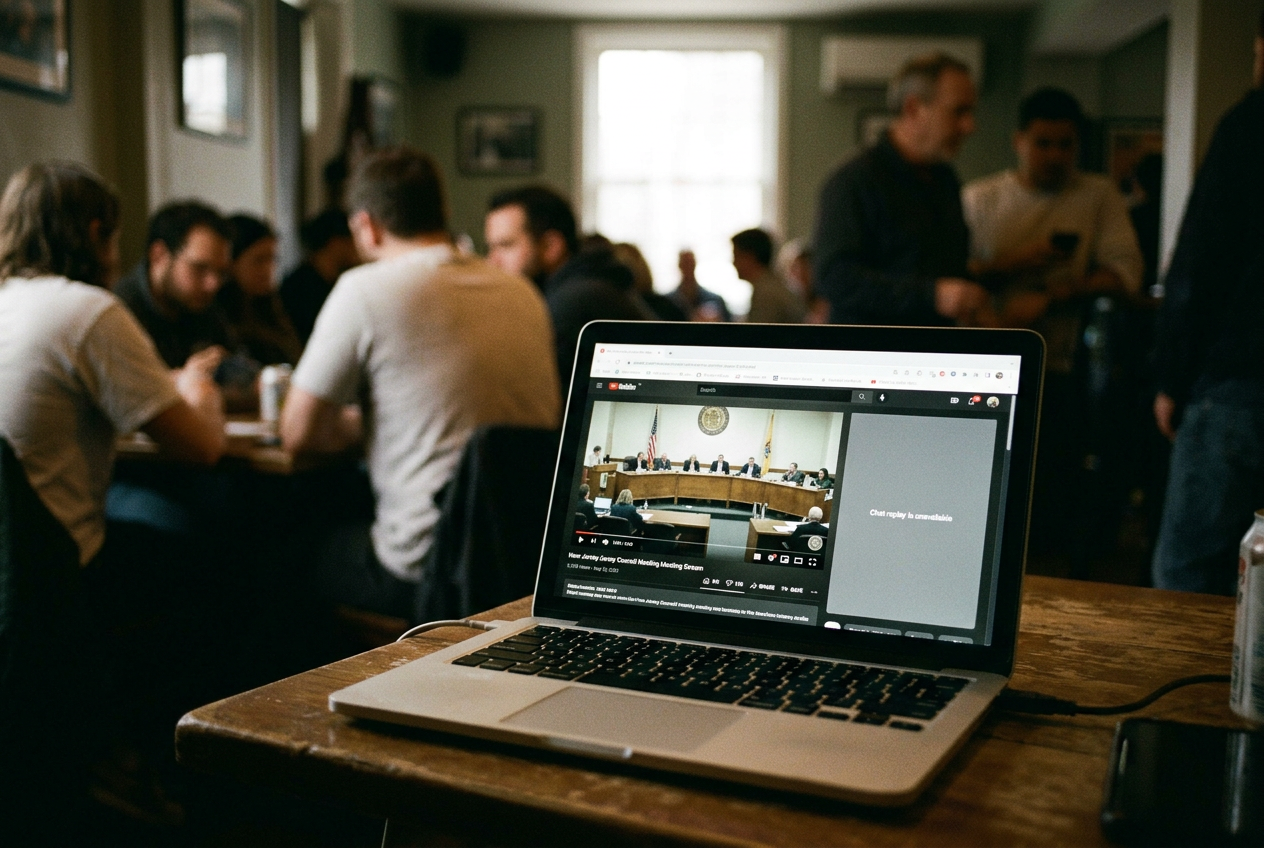
The useful document in Montclair is not a map of camera poles. It is the council resolution authorizing a subscription with Flock Safety, the private company whose automated license plate readers, cameras that record plates with time and location data, have become common municipal purchases.
Read as procurement, the resolution is ordinary. A police department gets cameras, cloud storage, search software and maintenance under a recurring agreement. Read as surveillance architecture, it is more consequential. The town is authorizing a database account whose value rises when other departments can query it, because a plate observed in Montclair may matter to an officer in another county or another state.
That distinction became harder to ignore in June 2025, after 404 Media reported that a Texas sheriff’s office used Flock’s nationwide system while looking for a woman connected to a reported self-administered abortion. The search reached cameras across the country. New Jersey Attorney General Matthew Platkin then directed departments to suspend sharing license-plate reader data with out-of-state agencies through the network while the state reviewed its safeguards.
The order addressed the most visible breach in the boundary. It did not make the system local again.
The municipal purchase is an access decision
Montclair’s Flock resolution is the anchor because it shows how a regional surveillance network arrives disguised as a local equipment purchase. The public meeting concerns a vendor agreement. The sales case concerns stolen cars, wanted vehicles and alerts generated when a plate matches a police list. Neither description captures the full permission structure.
Flock cameras photograph passing vehicles and convert visible plate characters into searchable text. The record typically includes the image, date, time, camera location and descriptive details about the vehicle. A department can search for a known plate, review detections associated with an investigation or receive an alert when a listed vehicle passes a camera.
The camera does not need to identify the driver to produce a useful movement record. Registration databases, investigative files and ordinary police contact can connect a plate to a person later. Even a failed character read may leave an image that an officer can inspect.
Flock sells this as a subscription rather than a town-owned box with an isolated hard drive. That matters. The product is cloud-hosted, meaning records are stored and searched on remote vendor systems, while agency administrators decide which users and partner departments receive access. The recurring fee buys the search layer as much as the roadside hardware.
A council can therefore approve cameras within municipal limits while also acquiring the ability to search records collected elsewhere, subject to the settings and agreements governing participating agencies. The network expands one contract at a time. No legislature has to vote for a single statewide map, and no county has to build a central database from scratch.
Return to the Montclair agenda line. It names one town and one vendor. It does not show every department whose officers may be able to send a query through the resulting system, nor every camera Montclair officers may search in return. The political unit approving the purchase is smaller than the technical unit created by it.
Data sharing can happen without sending a file
Public discussion often treats sharing as an export: one police department emails a spreadsheet to another. Networked plate readers make that model obsolete.
An outside agency may receive permission to run a query against records held in the platform, with results returned through the same interface. The local department does not need to download its entire database or handle each request manually. Access can be organized through direct agency relationships or broader regional and nationwide participation, depending on the platform configuration and governing rules.
This is why the Texas search mattered in New Jersey. It exposed a gap between the purpose presented at a municipal meeting and the possible purpose of a later query. A town may buy cameras to investigate vehicle theft. An outside officer can approach the network with a different case, a different legal environment and a different understanding of conduct that New Jersey protects.
The vendor records searches and agencies can audit user activity. Those controls are useful after misuse, but an audit log is not prior approval. A field requiring an officer to enter a reason also does not establish that the reason is accurate, legally sufficient or consistent with the collecting town’s policy. It establishes that text was entered.
New Jersey’s attorney general sets statewide rules for law-enforcement use of license-plate reader data, including authorized purposes, access controls and review. Local policies can add restrictions. Vendor settings can narrow sharing further. The weakness lies in the seams: the state writes one rule, a municipality signs another document, the vendor configures access, and a recipient agency applies its own practices once information reaches a case file.
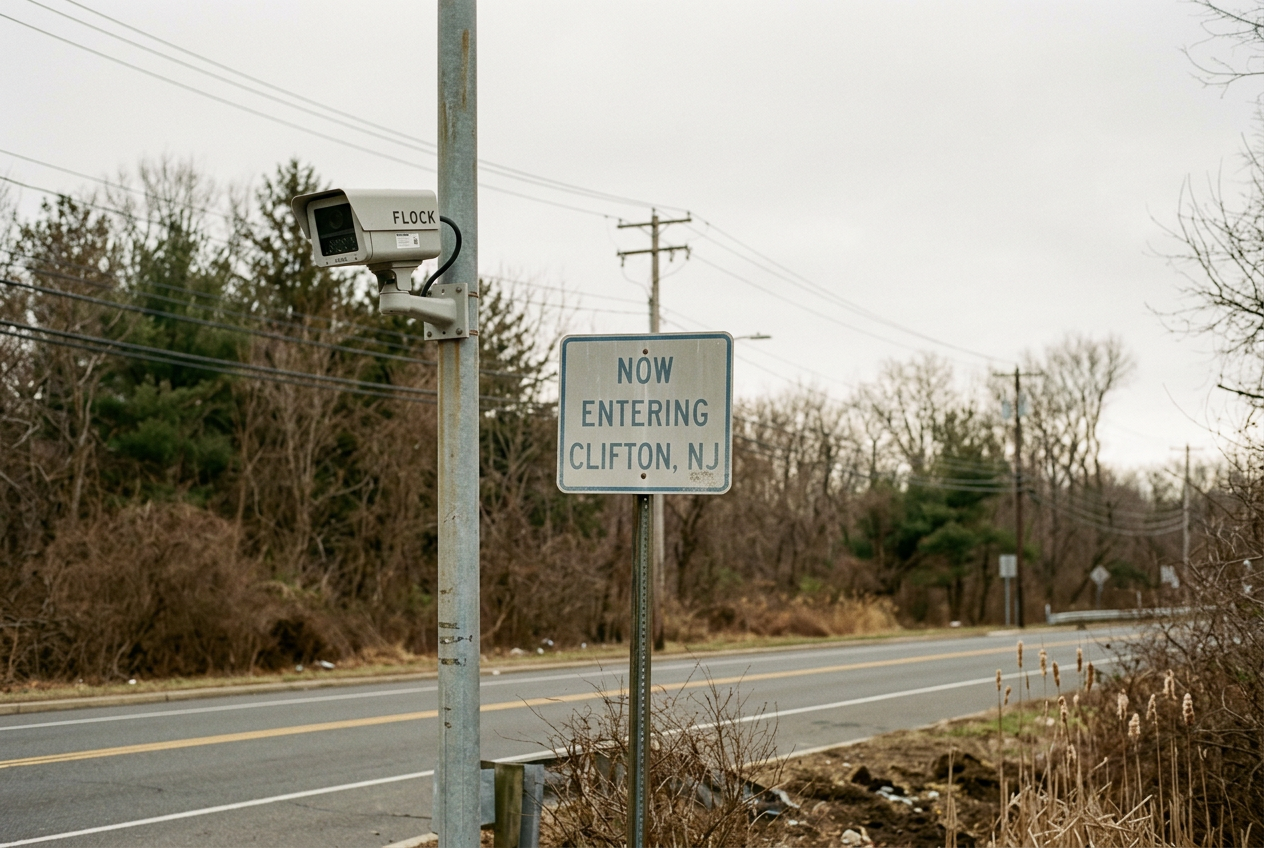
The town-line sign says a camera is present. It does not disclose that chain.
Deletion is not one event
Flock has publicly described a standard retention period measured in weeks for data held on its platform, unless a customer’s agreement or legal requirements provide otherwise. A short vendor window sounds like a hard limit. It is better understood as the first deletion clock.
An officer can preserve a detection for an investigation, download an image, attach a result to a report or disclose it to another authorized agency. Once copied into a records-management or evidence system, the material may follow a different retention schedule. The original platform record can expire while the derived record remains.
That is the part municipal approvals rarely make legible. A contract may specify how long routine detections stay searchable in the vendor cloud, while police records law, evidence rules, litigation holds and recipient policy determine what happens after a result is used. Deletion from the camera platform does not recall a screenshot, erase an alert from an investigative file or force another agency to destroy its copy.
Retention also changes the character of the search. A real-time alert asks whether a listed vehicle has just passed a camera. Historical searching asks where a plate appeared across a period, which can reveal repeated visits to a home, clinic, workplace, religious institution or political gathering. The same roadside unit supports both functions.
Time turns detection into pattern.
Back at the Montclair resolution, the recurring subscription sets the first clock and funds the interface. It does not settle the life of every record created after an officer clicks a result. The most consequential retention policy may belong to an agency that never appeared on Montclair’s agenda.
The pause is narrower than the network
Platkin’s intervention showed that the state can order New Jersey departments to change sharing behavior. It also showed when that leverage tends to appear: after reporting reveals a search that residents were never asked to imagine during procurement.
Suspending out-of-state sharing reduces exposure to jurisdictions whose laws conflict sharply with New Jersey policy. It does not answer how many in-state agencies can search one another’s records, how permissions are reviewed when personnel change, whether every historical search receives meaningful supervision or how exported results are deleted. Those are governance decisions, not camera features.
A serious municipal approval would publish the proposed partner list, distinguish real-time alerts from historical searches, state the retention period for routine detections and preserved results, and require public reporting on searches, denials and policy violations without exposing active investigations. Contracts could prohibit nationwide access by default and require a recorded approval before adding an agency. Audits could examine the stated justification against the underlying case, rather than confirming that a justification field contains words.
Those controls cost staff time and reduce convenience. That is the point. Friction is what separates a camera deployed for a defined local purpose from a database available to whoever has credentials and a plausible entry in a search box.
The Montclair agenda line will still look small. The appropriate attachment is not another product sheet. It is a current list of everyone standing on the other side of the search permission.
Questions people ask
How does a New Jersey license-plate reader work?
The camera records a passing vehicle’s plate, image, time and location, then stores the detection in searchable software. Police can compare plates against alert lists or search past detections, while vehicle details and other government records may later connect the plate to a person.
Can police outside the town search the data?
They may be able to if the collecting department enables interagency sharing or participates in a broader network. New Jersey’s 2025 pause restricted out-of-state sharing through Flock during a state review, but local and in-state access still depends on attorney-general rules, municipal policy and platform permissions.
Does
Flock delete license-plate data after 30 days?
Flock has described 30 days as its standard platform retention period, subject to customer agreements and legal requirements. A result preserved as evidence, downloaded into a report or shared with another agency can remain under a separate records schedule after the routine platform copy disappears.
What should a town disclose before approving these cameras?
The public record should identify retention periods, permitted search purposes, participating agencies, approval requirements for new partners and the treatment of exported records. It should also distinguish an alert for a currently wanted vehicle from a historical search capable of reconstructing someone’s movements.
One update a day
Today's story, in your inbox
One story each morning — no hype, no filler, no algorithm deciding for you.