New Jersey Schools Can Watch a Draft Become Evidence
Districts are licensing screen monitoring and AI-writing detection while leaving retention, access and appeals scattered across vendor terms and ordinary discipline codes.
August 11, 2026 · 8 min read
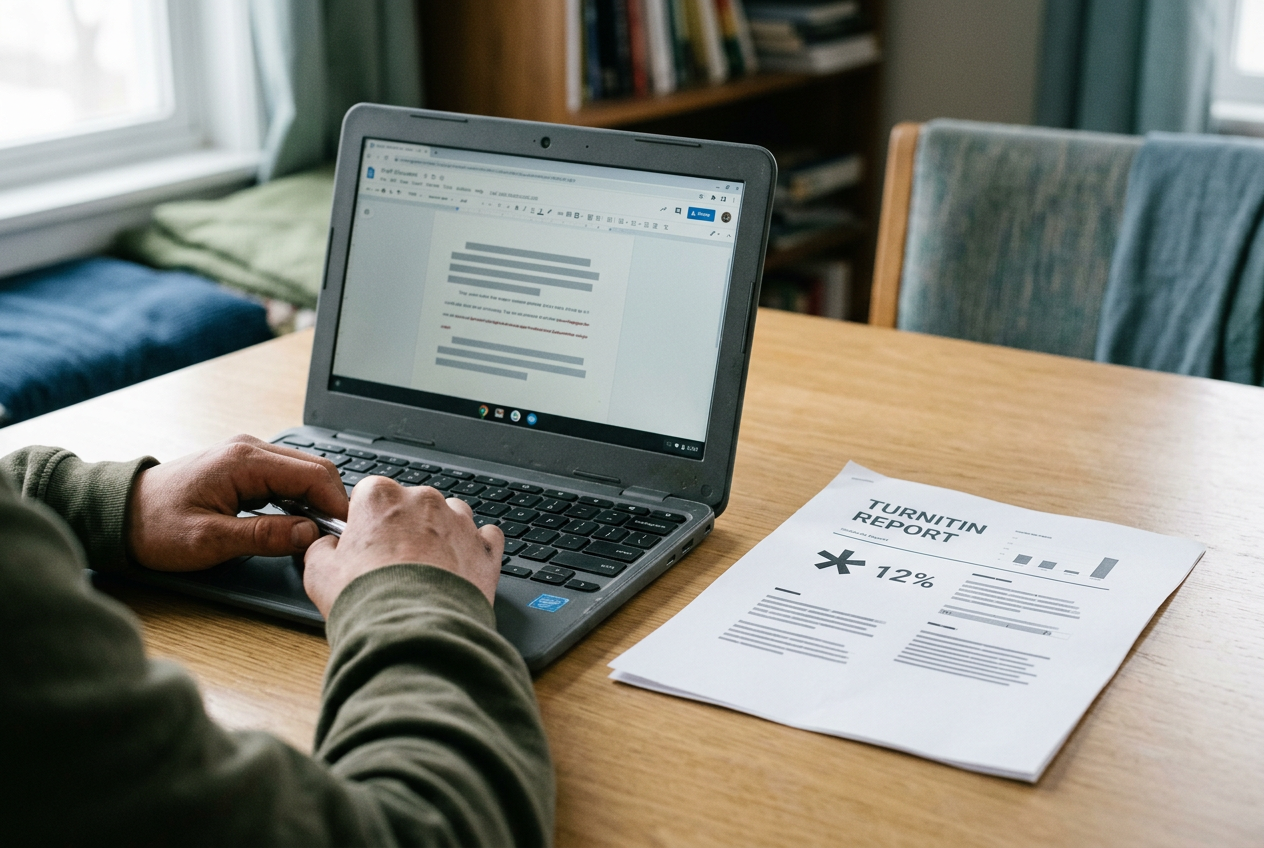
The most consequential mark in Turnitin’s AI-writing report can be an asterisk.
Turnitin, the plagiarism-detection company already embedded in many schools, uses an AI-writing indicator to estimate how much qualifying prose may have been generated by an artificial-intelligence system. For results below 20 percent, the company no longer shows instructors a precise number, displaying an asterisk instead because low scores carry a greater risk of false positives. The warning is responsible as far as it goes. It also reveals the arrangement: the software produces suspicion, the vendor qualifies it, and a teacher or administrator decides what happens to the student.
That asterisk is not a finding. It can still become a meeting, a rewritten assignment, a lowered grade or a disciplinary referral.
Across New Jersey, public board agendas, district technology pages and student handbooks show schools assembling this system from familiar products. Princeton Public Schools and West Windsor-Plainsboro Regional School District have publicly referenced Turnitin in instructional or academic-integrity materials. Cherry Hill Public Schools and Livingston Public Schools have published information about GoGuardian, a classroom-management product that can let authorized staff view student screens, inspect open tabs and restrict browsing on managed devices.
These products do different jobs. Turnitin evaluates submitted text and compares it with repositories while offering an AI-writing signal. GoGuardian supplies live or retrospective visibility into activity on school-managed accounts and devices. Put them together institutionally, even when no technical integration exists, and they form a record of how a student reached the page and a score suggesting whether the page belongs to them.
The district buys visibility. The student inherits the burden of explanation.
The purchase is easier than the policy
School software usually enters through an annual license approved among many other payments on a board agenda. The public record may name the vendor, the service period and a spending authorization. It rarely explains which settings administrators will enable, whether teachers can inspect activity outside class or how an AI indicator may affect a grade.
That gap matters because procurement treats the product as a service, while students encounter it as authority. The invoice pays for accounts, storage, support and access to a dashboard. It does not settle what evidence means.
Turnitin tells educators that its AI-writing indicator should not be the sole basis for adverse action. GoGuardian describes monitoring controls rather than adjudicating misconduct. Both positions push the decisive act back onto the school, where academic-integrity language is often broad enough to cover unauthorized assistance but too general to govern probabilistic software.
A conventional plagiarism match can point to text in another document. An AI-writing score cannot identify a source or reconstruct who pressed each key. It classifies patterns in prose, which means the product has to operationalize suspicious writing: passages that resemble the statistical regularities its model associates with machine-generated language. That judgment can be useful as a prompt to look closer.
It is weak evidence of authorship by itself.
The asterisk admits as much. Yet the report still arrives inside the same interface that teachers have long used to find copied passages, borrowing institutional credibility from a different kind of detection.
Watching the route to the sentence
Screen-monitoring software changes the evidentiary problem rather than solving it. A teacher who sees a student move between Google Docs, a search result and an AI chatbot may gain context. The same record can flatten ordinary research into suspicious behavior because tabs do not disclose intent, and a screenshot cannot distinguish asking for a definition from asking for a finished paragraph.
On a school-managed Chromebook, monitoring can reach beyond the classroom period if district settings, account rules and staff permissions allow it. GoGuardian offers schools controls over sessions and off-hours access, but the vendor does not choose the local boundary. District administrators do. Families often learn the practical limit from a technology notice, acceptable-use policy or parent application, documents written separately from the classroom rule that prohibits cheating.
This is how a writing assignment becomes a surveillance object. The final text is scanned. The route to it may be logged. Revision history can be demanded as corroboration, turning the normal debris of drafting into a defensive file a student is expected to preserve.
A student who writes in one sustained burst may look unlike a student who revises sentence by sentence. A multilingual writer may use translation software. A disabled student may dictate, rely on predictive text or move passages between tools as part of an accommodation. None of those actions proves misconduct.
A system organized around anomaly still makes deviation expensive, because the student must translate a legitimate writing practice into terms the institution will accept.
The software therefore defines suspicious writing twice. It scores features of the prose, then encourages adults to treat an unfamiliar process as supporting evidence.
Retention hides in the settings
New Jersey’s Student Online Personal Protection Act restricts how operators of school services may use student information, including limits around targeted advertising and sale. The federal Family Educational Rights and Privacy Act governs education records and permits schools to share information with contractors acting as school officials under specified conditions. Neither law gives a student a clean, immediate answer about how long a particular draft, similarity submission, browsing record or screenshot will remain available.
Turnitin’s repository settings illustrate the problem. Depending on how an assignment is configured, a paper may be stored so future submissions can be compared against it, stored in an institutional repository or excluded from a repository. Deletion generally runs through the institution rather than a button controlled by the student. The school selects the setting; the student supplies the work.
GoGuardian’s data practices likewise sit across contracts, privacy documentation and district configuration. Retention may depend on the service, the school’s account and legal or operational requirements. A parent reading a district’s short product notice cannot reliably infer which staff members can retrieve an old browsing event, how long it remains in the interface or whether an exported screenshot has moved into a separate disciplinary record.
The paper trail becomes fragmented at the point where precision matters. Board minutes establish that a relationship exists. Vendor terms describe a range of possible practices. District policies assign general responsibility.
The operative setting lives in an administrative console the public cannot see.
That is the concrete failure underneath the purchase. A district can approve the license without publicly approving the surveillance configuration.
There is rarely an appeal from the machine
In the New Jersey district materials reviewed for this piece, academic-integrity procedures generally provide familiar routes: a student speaks with the teacher, a family contacts an administrator, and an existing grade or discipline process may follow. The materials do not consistently create a separate procedure for challenging an AI-writing indicator or screen-monitoring inference.
That omission shifts the contest onto uneven ground. The school holds the report and may hold the activity history. The student has memory, drafts that happen to remain available and whatever explanation can be assembled after suspicion has already attached. Turnitin cannot determine innocence, and it does not hear appeals.
GoGuardian can show activity, but it cannot establish why the activity occurred. The institution makes both judgments.
A credible policy would require a human review before punishment, disclose the relevant report and underlying evidence, preserve accommodation and language-access considerations, and give the student a route to correct the record. It would also state that an AI score alone cannot establish misconduct. Those are not technical upgrades. They are restraints on institutional use.
Schools do have a real problem. Generative AI can produce passable homework quickly, and teachers cannot grade learning they cannot attribute to a student. Buying a detector offers speed, consistency and a document that looks more formal than intuition. It also lets an overworked institution convert uncertainty into a workflow.
That workflow is what vendors sell.
The alternative costs staff time. Teachers can require staged notes, discuss a student’s argument, assess work produced in class and design assignments around local material or oral explanation. None is foolproof. Each produces richer evidence than a percentage, and each requires schools to fund teaching rather than purchase a suspicion layer around it.
The asterisk remains the honest part of the system. It says the tool cannot safely be as precise as the interface once implied. New Jersey districts should have to place the same warning in their contracts, retention schedules and appeal rules before the mark reaches a student’s file.
Questions people ask
Can
New Jersey schools monitor student Chromebooks?
Schools can monitor activity on district-managed devices and accounts under their technology and acceptable-use rules, subject to law, contracts and local settings. The practical reach varies by district, including which staff can view sessions, whether monitoring continues outside class and how long records remain accessible.
Does a
Turnitin AI score prove that a student cheated?
No. Turnitin describes its AI indicator as one piece of information rather than proof, and it suppresses precise scores below 20 percent because false positives are more likely in that range. A school still decides whether the report supports any academic or disciplinary action.
How can a student challenge an AI-writing accusation?
The available route usually runs through the teacher, administrator and the district’s existing grade or discipline procedures. Public policies do not consistently offer a dedicated appeal for AI detection, so students may need access to the report, their drafts and any monitoring records to understand the allegation.
Who controls how long the writing data is kept?
Control is divided. Districts choose assignment and account settings, vendors maintain systems under their contracts, and schools may export material into education or disciplinary records. A student generally cannot assume that deleting a local draft also removes a Turnitin submission, browsing event or screenshot held elsewhere.
One update a day
Today's story, in your inbox
One story each morning — no hype, no filler, no algorithm deciding for you.