One Line on a Drug-Checking Strip Is Not a Chemical Profile
A drug-checking strip can flag one target in one sample. Sampling errors, interference and damaged strips mean the result belongs inside a harm-reduction plan, not above it.
August 11, 2026 · 8 min read
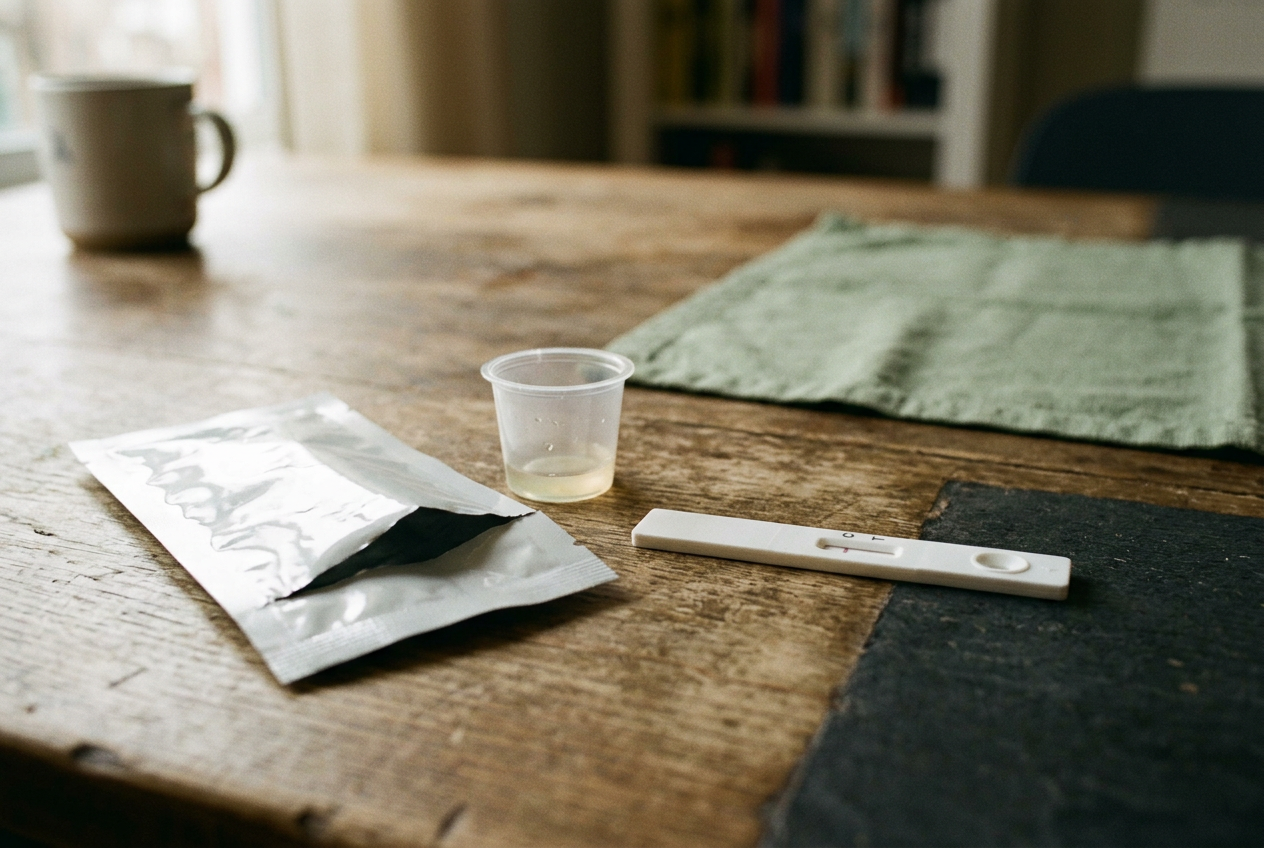
The object on the table is unremarkable: one white fentanyl test strip beside a clear cup, with a dark control line and no second line in the test area. On many competitive fentanyl strips, that pattern means a presumptive positive. The strip has answered one narrow question about one portion of material. It has not produced a chemical profile.
That distinction gets lost because the result looks decisive. Color appeared. A line disappeared. The format comes from familiar home tests, and the package may fit in a pocket, which makes a complicated analytical problem feel settled in minutes.
The convenience is real. So is the temptation to ask the strip for more certainty than its chemistry can provide.
This is reporting about harm reduction, not professional medical advice. Instructions differ by product, target substance and local drug supply, so the manufacturer’s directions and guidance from a local drug-checking service matter.
The line answers a narrow question
Most fentanyl and xylazine strips use lateral-flow immunoassays, tests in which liquid moves along a membrane and encounters antibodies designed to bind a particular molecular structure. The strip does not inspect a sample molecule by molecule. It looks for binding that crosses the product’s detection threshold.
Many fentanyl strips use a competitive format. The control line shows that liquid traveled through the device and the test functioned; the test line can fade or disappear when enough target material occupies the available binding sites. That is why one line may mean presumptive positive while two lines may mean negative, an arrangement capable of confounding anyone carrying assumptions from a pregnancy test. Other products may work differently.
Read that package, not a memory of another strip.
A faint line is still color, but color intensity is not a reliable potency meter. On many products, any visible test line within the stated reading window counts as negative, even if pale. The instructions control here. Reading too soon, waiting too long or interpreting a dried strip can produce a result the manufacturer never validated.
Return to the strip on the table. Its missing test line does not say how much fentanyl is present, whether the fentanyl is evenly distributed, or what else shares the cup. It cannot distinguish a trace from a concentration likely to create a different level of risk. “Detected” is the useful claim.
Everything beyond it is inference.
Sampling is where confidence usually breaks
A test result describes the liquid that reached the membrane. That sounds obvious until the material being checked is a pressed pill, a bag of powder or residue from packaging, where different particles may contain different compounds and concentrations.
This uneven distribution is often called the chocolate-chip effect: a small amount of a potent substance can sit in pockets rather than spreading uniformly through a batch. The term is imperfect, but the mechanism matters. A scraping from one corner can test negative while another portion contains the target. Crushing a pill and mixing the powder can improve representativeness, though it cannot guarantee uniformity.
Public harm-reduction guidance often treats dissolving the entire intended amount as the strongest available sampling method, provided the product instructions support that method. Testing a portion of that mixed liquid gives the strip a better chance of seeing material from across the sample. If someone cannot test the whole amount, combining tiny scrapings from several areas is more informative than trusting one visible grain, although the result remains limited.
Concentration also matters. Lateral-flow strips are calibrated for a specified dilution, meaning a stated relationship between sample and water. A mixture that is too concentrated can interfere with the assay and produce misleading results; excess dilution can push a target below the strip’s detection threshold. Improvising a splash of water in a bottle cap may feel practical, but it discards the condition under which the result is meant to mean anything.
The cup beside the white strip therefore matters as much as the colored line. What entered it, how thoroughly it was mixed and whether the instructions’ dilution was followed determine what question the strip was allowed to answer.
Cross-reactivity makes some positives complicated
Antibodies recognize shapes, not street names. Cross-reactivity occurs when a substance other than the intended target binds strongly enough to affect the test. Some fentanyl strips have produced presumptive positives when certain drugs or cutting agents were present at high concentrations, particularly when users tested mixtures that were much more concentrated than instructed.
Manufacturers have changed some products to reduce known interference, but “fentanyl test strip” is a category, not a single standardized object. Different strips can use different antibodies, thresholds and validation methods. A dilution recommended for one product should not be copied onto another because the packaging looks similar.
Cross-reactivity does not make a positive result worthless. It makes the word “presumptive” important. A laboratory method such as gas chromatography-mass spectrometry, which separates a mixture and identifies compounds by molecular patterns, can offer confirmation unavailable from a strip. Community drug-checking programs may use spectroscopy or laboratory analysis, though access, turnaround time and the range of detectable compounds vary.
A negative has its own blind spots. A fentanyl strip does not generally test for xylazine, nitazenes or every fentanyl analog, and a xylazine strip does not screen for fentanyl. Detection can vary across related compounds. Running one targeted assay and calling the sample clean is the chemical equivalent of checking one name against a guest list and declaring the building empty.
Heat, moisture and time reach the strip first
The white strip is a small chemical device, not inert paper. Heat and moisture can damage its reagents before anyone opens the wrapper. Storage instructions commonly call for a dry place within a stated temperature range, away from direct sunlight; exact limits belong to the specific manufacturer.
A sealed pouch that is torn, wet or past its expiration date deserves no confidence. Neither does a loose strip carried for months in a humid pocket or left in a hot car. Desiccant packets help control moisture inside some packaging, but they do not repair prolonged exposure or make an expired product current.
The control line is the immediate check. If it does not appear within the instructed window, the test is invalid, not negative. Too little liquid, excessive immersion, damage or poor storage can all prevent proper flow. Repeating the test with a new strip is more useful than trying to extract meaning from an empty rectangle.
Build a response that survives a wrong result
Drug checking works best as one layer. A negative result can reduce uncertainty about the target under the conditions tested, but it cannot remove overdose risk, identify dose or account for another substance the strip does not recognize. A positive result adds information without dictating what someone must do next.
The durable precautions are the ones that still matter if the strip was wrong or the sample was uneven. Public health guidance includes keeping naloxone available where opioid exposure is possible, avoiding solitary use, using less at first and allowing time before taking more, and avoiding combinations of depressants, which can compound breathing suppression. Local overdose-prevention programs can provide current advice about the regional supply and explain how their specific strips should be used.
Naloxone can reverse an opioid overdose, including one involving fentanyl, but it does not reverse xylazine or other non-opioid sedatives. It should still be given when opioid overdose is suspected, while emergency help and rescue breathing may also be needed. Someone who cannot be awakened, has slow or absent breathing, makes choking or gurgling sounds, or shows blue, gray or pale skin needs an emergency response.
That control-only strip remains useful. It may change whether someone discards a substance, seeks confirmatory checking or takes additional precautions. The failure begins when a narrow screening result gets promoted into a certificate of composition, potency and safety. No strip manufacturer has earned that authority from two pieces of colored ink.
Questions people ask
Does a darker line mean there is more or less fentanyl?
No reliable quantity can be read from line darkness. On many competitive fentanyl strips, a visible test line indicates a negative result within the product’s threshold, while an absent test line indicates a presumptive positive. Follow the specific instructions and reading window rather than comparing shades.
Can one negative strip prove a pill or bag contains no fentanyl?
No. The tested portion may not represent the whole amount, the concentration may fall below the detection threshold, or the strip may not detect a particular related compound. Better mixing improves the sample, but a negative result should remain one layer of information rather than a safety guarantee.
Why would a fentanyl strip show a false positive?
A highly concentrated mixture can interfere with some assays, and certain non-target compounds may cross-react with the strip’s antibodies. Using the manufacturer’s stated dilution reduces avoidable interference. Confirmation requires a more specific drug-checking or laboratory method, where available.
Can fentanyl and xylazine be checked with the same strip?
Generally, no. Fentanyl and xylazine strips target different chemical structures, so checking for both requires separate products and separate interpretation of their instructions. Neither result identifies every other compound in the sample, and neither measures the amount present.
One update a day
Today's story, in your inbox
One story each morning — no hype, no filler, no algorithm deciding for you.