Ring Ended the Police Shortcut, Not Access to Your Videos
The Request for Assistance button is gone. Police can still obtain Ring footage from willing owners, public posts, warrants and narrowly defined emergency disclosures.
August 28, 2026 · 8 min read
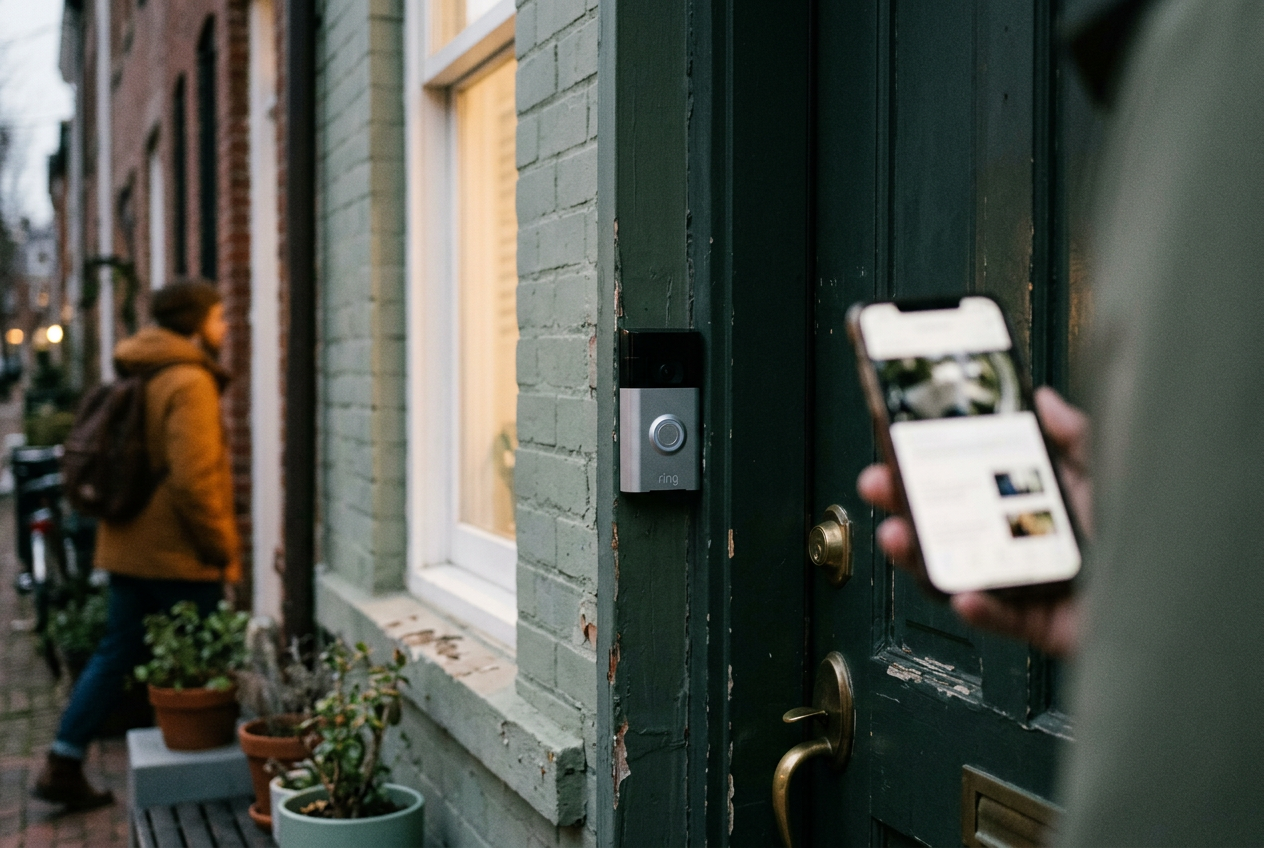
The thing that disappeared was a tile in the Neighbors feed. A police agency could publish a Request for Assistance tied to an investigation and a geographic area, asking Ring owners nearby to volunteer their recordings. In January 2024, Ring said it would stop letting public-safety agencies use that feature.
That was a meaningful retreat. It was not a lock on the camera.
The distinction matters because Ring’s announcement was widely compressed into a cleaner story: the company had stopped police from requesting doorbell footage. What it stopped was one company-built route for making those requests at neighborhood scale, inside the same app owners use to watch clips and receive alerts. The warrant remained. So did the officer at the door, the public post, the owner’s share button and the emergency request sent to Amazon.
Ring removed frictionless access. It did not end access itself.
The button did institutional work
The Request for Assistance tile looked modest. Its power came from placement.
Before the change, an agency did not need to identify every camera, find every owner and make a separate approach. Ring had already mapped its customers into a network, while the Neighbors app supplied the audience and the delivery system. Police could ask across an area; owners could decide whether to respond. Ring described the exchange as voluntary, which it was in the narrow legal sense.
The company had still designed the room, invited both sides and put the request in front of the people holding the recordings.
Removing that tile makes broad canvassing slower. An investigator may have to walk the block, leave contact details, locate a property owner through ordinary records or ask residents to publicize the search. Those steps cost labor and expose the scope of the request. They may also produce fewer clips, especially from owners who would tap an in-app prompt but ignore a stranger at the door.
Friction is not a technical defect here. It is a restraint.
Ring’s earlier police partnerships treated privately purchased cameras as pieces of a ready-made investigative network, even though the people passing through their fields of view had bought nothing and agreed to nothing. Customers paid for the hardware and, where applicable, cloud storage. Police received a convenient path into the resulting archive. Ring did not have to charge per clip for the arrangement to support its business; the promise of neighborhood security helped make more cameras, alerts and subscriptions feel necessary.
Ending the in-app request feature reduced that institutional subsidy. It also reduced a source of reputational damage for Amazon, which owns Ring. Neither effect rewrote evidence law.
An owner can still hand over a clip
The most ordinary route now sits outside Ring’s former police interface. An officer asks a camera owner directly, and the owner shares the recording.
That request might arrive during a door-to-door canvass, by phone, through an agency’s social account or in a public appeal. If the owner has access to a stored clip, the Ring app allows video to be downloaded and shared. Police do not need a warrant when the person controlling the account voluntarily supplies it.
The owner can generally decline a voluntary request. That choice belongs to the account holder, not to the delivery driver, neighbor, tenant’s guest or teenager recorded on the sidewalk. Doorbell surveillance has always distributed power unevenly: one person chooses the camera and retention plan, while many other people become searchable movement inside the frame.
The missing Request for Assistance tile changes how efficiently police can locate willing owners. It does not change an owner’s ability to become a source.
Public posting creates another route. Ring still permits public-safety agencies to use Neighbors for certain public communications, such as safety information and community updates, even though agencies can no longer publish Request for Assistance posts. Footage that users themselves place in a publicly viewable part of the service may be seen like other public material. Once a clip has been posted openly or sent elsewhere, Ring’s private-sharing policy cannot pull every copy back.
This is the first practical limit of the policy change. The platform closed its purpose-built intake lane, while the social layer around the camera kept moving.
Legal process is slower because it is binding
If an owner refuses, cannot be found or does not control the relevant account, police may seek records from Amazon through legal process. The kind of process matters.
Amazon’s law-enforcement guidelines say US authorities generally need a search warrant for stored video content. A warrant is a court order based on probable cause, meaning a judge has approved the government’s claim that specified evidence is likely to be found in the place or account to be searched. It is binding on the recipient unless successfully challenged, and it is categorically different from a voluntary request in an app.
A subpoena, a formal demand issued under legal authority, can compel certain account and transactional records but does not carry the same probable-cause finding. Under the federal Stored Communications Act, which governs when service providers may disclose stored communications and related records, video content receives more protection than basic subscriber information. Amazon says subpoenas may reach records such as identifying account details, while stored Ring video requires a warrant in the United States.
That division is easy to lose in a headline saying police can subpoena Ring footage. The word subpoena often gets used as shorthand for any legal demand. The underlying document controls what Amazon must produce.
A warrant also has boundaries. It should identify the account, place, period or evidence sought with enough particularity to limit the search. Amazon can reject defective demands or ask authorities to narrow them, while courts can resolve disputes. A valid warrant does not guarantee useful footage exists: the camera may not have recorded the event, the owner may lack a storage plan, the retention period may have expired or the clip may have been deleted before preservation took effect.
Police can also serve legal process on an owner or seek authority to search or seize a device, depending on the investigation and jurisdiction. The exact route changes with where the video is stored and who controls it. Ring’s product policy does not cancel those powers.
This is why the vanished tile is worth returning to. A request post depended on convenience and consent. A warrant depends on judicial authorization and compulsion. Ending the first route does not weaken the second, but it forces police to state what they seek and, at least on paper, justify the intrusion.
Emergency disclosure remains an exception
Amazon also accepts emergency requests. Federal law permits a provider to disclose information without ordinary legal process when it has a good-faith belief that an emergency involving danger of death or serious physical injury requires disclosure without delay.
This route is discretionary. Police submit the circumstances, and Amazon decides whether the request meets the emergency standard; the existence of an emergency form does not make every urgent investigation eligible. The company’s review still happens without the camera owner making the disclosure and, in qualifying cases, without a warrant arriving first.
Emergency access attracts attention because it bypasses the normal sequence, but it should not be confused with the old Request for Assistance tile. The tile broadcast a voluntary appeal to users in an area. An emergency request goes to the provider and asks the company itself to disclose data under a statutory exception. One was a product feature.
The other is embedded in communications law.
Amazon publishes transparency reporting about government demands and emergency requests, though aggregate categories cannot show a person standing in front of a particular door whether their image was disclosed. Company policy supplies procedures around the exception. The legal permission comes from Congress.
The change moved the checkpoint
Ring’s decision matters most at the beginning of an investigation, when officers want to discover which private cameras captured something and collect clips before they disappear. The company no longer turns that search into a feed prompt delivered to nearby customers. Police must do more of the finding and asking themselves.
That extra work may narrow requests. It may also shift them into less visible channels, where residents receive a knock or a message that leaves no standardized public post behind. Ring’s old tile made police access easy, but it also made the request legible inside the app. Removing it trades a centralized, scalable mechanism for a patchwork of direct approaches and compulsory orders.
The binding checkpoint now appears later. Owners decide whether to cooperate with an ordinary request. Judges authorize warrants. Amazon evaluates the demand it receives and may disclose data when the law requires or permits it.
Those are separate decisions made by actors with different incentives, and folding them into the phrase Ring stopped sharing footage gives the company more credit than the policy deserves.
A missing button is a product decision. A warrant is state power.
Questions people ask
Can police still get Ring footage without a warrant?
Yes. An owner can voluntarily download and share a clip, and police can view footage the owner has posted publicly. Amazon may also disclose information during a qualifying emergency involving danger of death or serious physical injury. Those routes do not mean police have general, automatic access to every Ring camera.
Can a Ring owner refuse a police request?
An owner can generally refuse an ordinary voluntary request from an officer or public appeal. A valid court order served on the owner or Amazon is different because legal process can compel production. The rights and procedures around a specific demand depend on the document and jurisdiction.
Does a subpoena give police access to stored Ring video?
Not by itself under Amazon’s stated US practice. Amazon says stored video content generally requires a search warrant, while a subpoena may compel specified subscriber or transactional records. News reports often use subpoena loosely, but warrants and subpoenas carry different standards and reach different categories of information.
What did Ring’s policy change accomplish?
It removed a built-in way for police agencies to broadcast geographically targeted footage requests through Neighbors. That raises the time and labor required to canvass camera owners, but it leaves direct owner sharing, public footage, warrants and emergency disclosures in place. The shortcut ended. The evidence routes did not.
One update a day
Today's story, in your inbox
One story each morning — no hype, no filler, no algorithm deciding for you.