Ring Killed Police Requests. The Share Button Stayed.
Ring retired the police request feature inside Neighbors. It did not remove the cameras, public posts, user exports or legal routes that keep doorbell footage moving.
August 20, 2026 · 8 min read
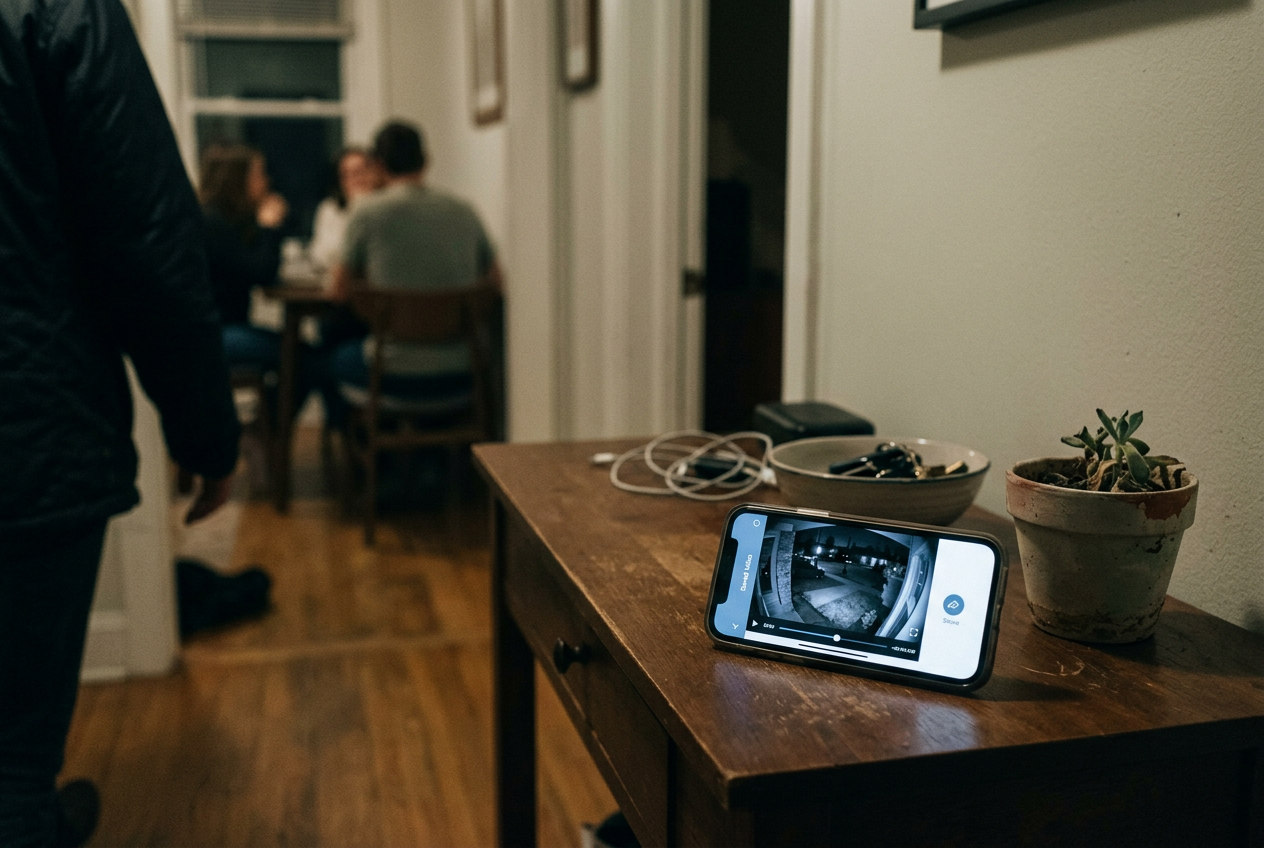
The important object is still sitting beneath a saved Ring recording: the Share icon.
Open an event in Ring’s Event History, select the recording and the app offers ways to send or download it. That control looks ordinary because it is ordinary. People forward clips to neighbors, relatives, building managers and police departments. They save files to a phone.
They post recordings elsewhere. Once a file leaves Ring, it becomes a portable piece of video rather than a permission contained inside one company’s app.
In January 2024, Ring announced that it would retire Request for Assistance, a Neighbors feature through which verified public safety agencies could ask people in a defined area to voluntarily submit relevant recordings. The company presented the change as an end to police requests for user footage inside Neighbors. That was accurate as far as the feature went.
The feature was one route through a much larger system. It was never the system itself.
What Ring retired
Request for Assistance gave participating agencies a structured request channel. An agency could describe an investigation, identify an area and time period, then publish the request to nearby Neighbors users. A resident who received it could decide whether to respond with footage. Ring described the arrangement as voluntary, and the request did not give an agency automatic access to a camera or account.
Retiring that workflow mattered. Police lost a company-built interface that turned a geographic investigation into a prompt delivered to camera owners, while Ring stopped hosting that particular exchange inside the same neighborhood feed it operates. Friction returned. An officer might now have to knock on doors, circulate contact information, use another request platform or ask a resident directly.
Friction is not nothing. It affects how many people are approached, how quickly footage arrives and how easy it is to make a broad request feel routine. A button placed in front of thousands of camera owners can normalize participation without requiring a warrant or an individualized visit.
Still, Ring did not disable the cameras involved in those requests. It did not delete existing recordings, remove the Share icon or prevent residents from exporting files. It did not promise that police would disappear from Neighbors. In its announcement, Ring said public safety agencies could continue using the app for safety information, updates and community events.
The retired object was the agency request form. The recording infrastructure remained in place.
The clip still has exits
Ring’s help documentation explains how an account holder can share a recording from Event History or download it to another device. The distinction matters. A shared link continues to depend on Ring’s delivery and the recording’s availability, while a downloaded video becomes a separate copy that can be attached to an email, uploaded to a case portal, placed in an evidence system or reposted to a neighborhood group.
The Share icon is therefore more consequential than it appears. It converts footage captured for one household into material that can travel among institutions with different rules, retention periods and access controls. Ring may govern the original account, but it does not govern every copy made from it.
Residents can also publish material to Neighbors, Ring’s community feed. A public post is different from privately stored Event History footage because the account holder has chosen distribution inside a wider audience. Agency users and other people with access to that feed can encounter the post without sending a Request for Assistance. Removing the request tool did not make those posts private.
Nor does hiding a home address in a neighborhood interface guarantee anonymity. A camera angle can show a doorway, street number, vehicle plate, distinctive yard or person’s routine. The content supplies location clues even when the account field does not. Video is promiscuous that way, although Ring’s interface prefers the cleaner language of sharing.
Account permissions create another route. Ring allows owners to grant other people access as Shared Users, with permissions determined by the owner and product. A household member, property manager or other authorized user may be able to view recordings and operate parts of the system. Each additional login expands the group capable of moving a clip beyond the original account.
None of these routes replicates the exact convenience of a police request appearing in Neighbors. Together, they explain why the network survived its removal.
Police access has more than one door
A resident can provide footage directly to an officer. That exchange may begin with a doorstep conversation, an agency social post, a phone call or a link sent through an ordinary messaging service. Ring does not need to broker it. The resident selects the event, taps the same Share icon and chooses where the recording goes.
Police can also encounter footage already posted publicly. They can ask a person who uploaded it for an original file or additional recordings. Once a department receives a copy, the department’s evidence rules and local law shape what happens next, rather than Ring’s consumer-facing controls.
Then there is compelled access. Ring’s law-enforcement guidelines describe how authorities may seek account information and content through legal process, a general term covering demands such as subpoenas, court orders and search warrants, depending on the data requested and the governing law. The company says it reviews demands and may object when it considers them legally deficient or overbroad. That is a corporate review policy, not a technical barrier that makes disclosure impossible.
Ring’s documentation also describes emergency requests involving danger of death or serious physical injury. In those circumstances, the company may disclose information without the ordinary legal process if it determines that the request meets its standard. This route is separate from Request for Assistance because the resident is not being prompted to volunteer a clip through Neighbors. The request goes to the company.
The company says law enforcement does not receive direct, continuous access to users’ cameras merely by participating in Neighbors. That limitation should not be blurred. A police department browsing every live Ring feed would represent a different and more invasive system.
But direct live access is not the only meaningful form of surveillance. Stored footage can reconstruct movement after the fact, identify visitors, extend an investigation beyond its initial target or place people in a police file without their knowledge. A porch camera bought by one household records whoever crosses its frame, including workers, tenants, children, protesters and the neighbor who never agreed to join anything.
A distributed network survives feature changes
Ring’s underlying advantage is distribution. Households buy the hardware, point it toward thresholds and streets, connect it to an account, and often pay for services that preserve recordings beyond a live notification. The company supplies the cameras, cloud functions and interface. Residents supply the locations, electricity, internet connection and social permission.
That arrangement gives Ring a surveillance network without installing municipal poles or employing camera operators. It also diffuses responsibility. Each owner can describe a disclosure as a personal choice, each agency can describe a clip as voluntarily received, and Ring can describe itself as the platform that provided controls. The resulting collection is larger than any one decision.
Request for Assistance made that distributed network easier for police to query. Its removal changed the query layer, meaning the interface used to ask many camera owners for material. It did not change the collection layer beneath it. Cameras still detect events.
Accounts still retain available recordings. Owners still decide whether to publish, export or grant access.
Third-party systems enter after export. A downloaded file can move into police evidence software, a landlord’s storage account, a private security archive, a neighborhood chat or a social platform whose moderation and retention rules differ from Ring’s. The original owner may delete the Ring recording later and still have no practical way to recall those copies.
Return to the Share icon. It requires an affirmative tap, which distinguishes it from automatic police access, yet that small consent event can authorize circulation far beyond what the interface shows. The app can display destinations. It cannot display every later recipient, duplicate or inference drawn from the video.
What dismantling would require
Dismantling a surveillance network would reach deeper than retiring one agency-facing tool. It would reduce how much footage exists, how long it remains available, how many accounts can reach it and how easily files leave the system. It would also require clear records of company disclosures and meaningful limits on emergency access, rather than treating every export as the end of the platform’s responsibility.
Ring gives users controls over recording, retention and sharing, although the available settings depend on the device, service and account configuration. Those controls put work on the camera owner. The passerby in frame does not choose the retention period, receive the police request or see where an exported clip lands.
That asymmetry is the mechanism. One person purchases convenience and gains authority over images of other people. Ring converts that authority into a manageable interface. Police, landlords and private recipients can obtain the resulting footage through routes that do not depend on the retired request feature.
The January 2024 announcement narrowed one relationship between Ring and law enforcement. It did not sever the relationship between privately owned cameras and institutional demand. The clearest evidence remains the control beneath every eligible recording, ready to turn a domestic security event into a file someone else can keep.
Questions people ask
Did
Ring stop police from requesting doorbell footage?
Ring stopped verified public safety agencies from using Request for Assistance inside Neighbors in January 2024. Police can still ask residents directly, seek clips already posted publicly or pursue account data through appropriate legal process. The retired feature was a standardized request channel, not a ban on police receiving Ring video.
Can
Ring give footage to police without the owner sharing it?
Ring’s law-enforcement guidelines allow disclosures in response to valid legal demands and describe a separate process for qualifying emergencies involving danger of death or serious physical injury. The company says it reviews requests. Those company-level disclosures do not require the owner to press Share inside the app.
Can residents still send Ring clips to police?
Yes. An account holder can share an available recording or download a copy, then provide it through email, messaging, an upload portal or another channel. Ring’s removal of Request for Assistance did not disable resident-controlled sharing or prevent police from approaching camera owners outside Neighbors.
What happens after someone downloads a Ring video?
The downloaded file can be copied into other storage, evidence and social systems. Deleting the original from Ring does not recall those duplicates. Future access depends on the recipient’s policies and the law governing that recipient, not on the controls attached to the original Ring account.
One update a day
Today's story, in your inbox
One story each morning — no hype, no filler, no algorithm deciding for you.