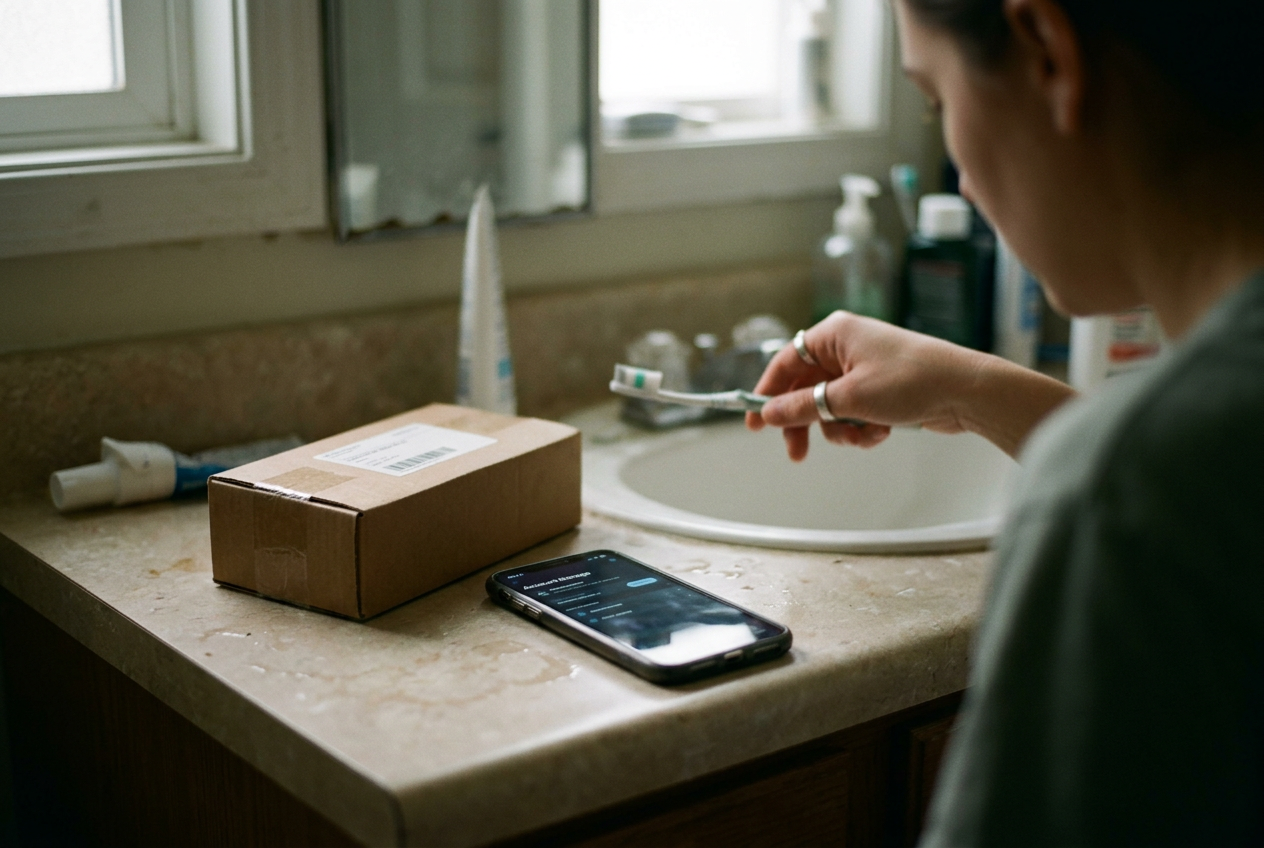
STI Mail-In Kits Reach a Lab. The Care Handoff Varies.
LetsGetChecked, Everlywell, myLAB Box and Nurx can all move a sample from bathroom to laboratory. What happens after a positive result is where their models stop looking alike.
August 17, 2026 · 8 min read
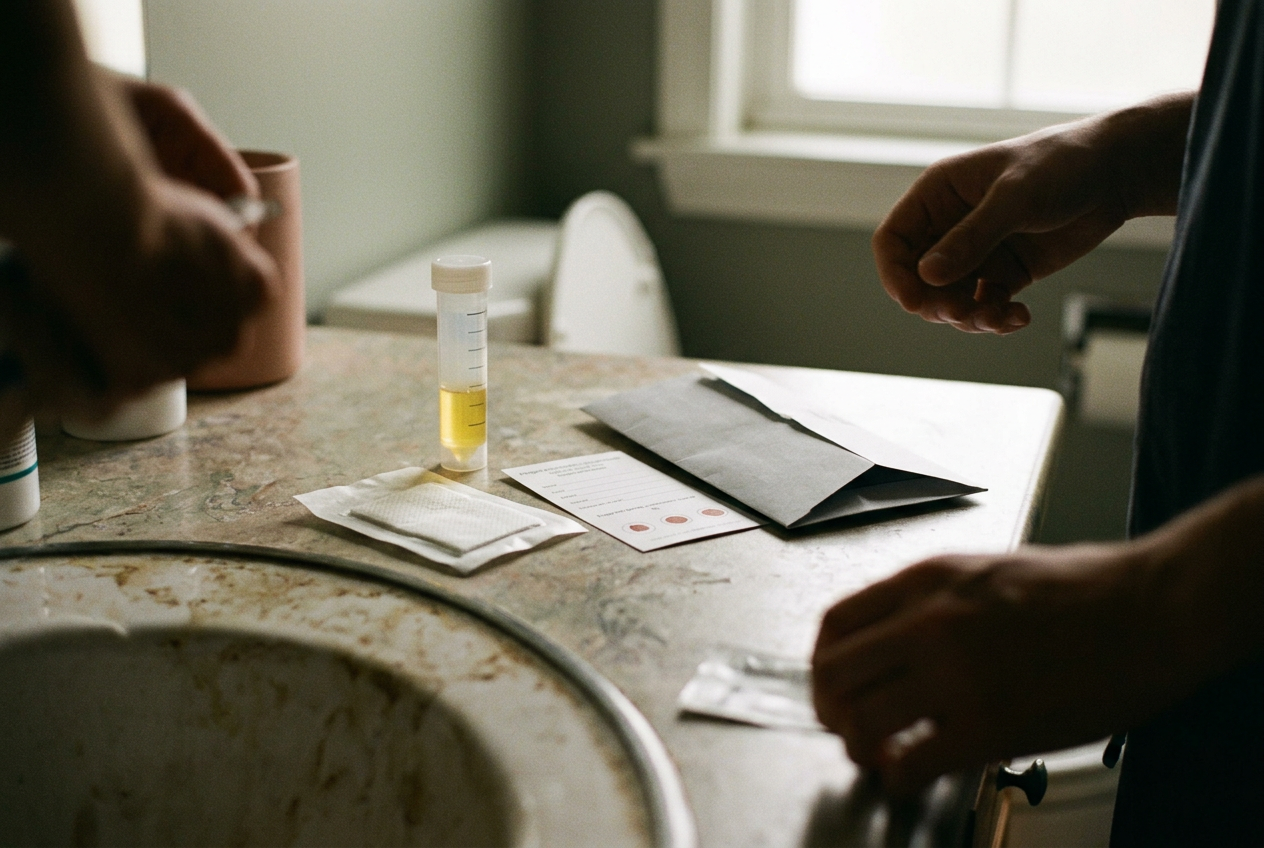
Take the narrow urine tube in a LetsGetChecked Standard 5 kit. It has a fill line, a screw cap and one job that appears modest enough to complete before breakfast. The kit pairs it with a finger-prick blood sample, then asks the user to seal both according to the insert, attach the prepaid return label and send the package within the specified collection window.
The bathroom is where the advertising lingers: discreet box, private collection, no waiting room. The more consequential machinery begins after the cap tightens. A carrier has to accept the parcel. A receiving laboratory has to match it to an order, decide whether the sample survived and run different testing methods on urine and blood.
Someone then has to release the findings, explain any ambiguity and decide whether the service can treat what it found.
LetsGetChecked, Everlywell, myLAB Box and Nurx all sell versions of this journey. Their public documents describe a broadly similar laboratory backbone and sharply different clinical edges. Convenience is real. Continuity of care is the variable being packaged as a feature.
The mailer is part of the test
A return envelope does not preserve a sample through optimism. Home kits use specimen packaging built around a sealed collection container, absorbent material, a secondary pouch and an outer mailer approved for the carrier named in the instructions. The configuration limits leaks and keeps the paperwork or identifying code separate from the fluid.
Each brand tells customers to follow the timing printed for the specific kit, often collecting on a weekday and mailing promptly so a package does not spend a weekend stationary. LetsGetChecked instructs users to return samples on the day of collection and places collection-day limits around shipping. Everlywell likewise directs customers to use the enclosed materials and prepaid label, with timing that depends on the test. myLAB Box and Nurx supply kit-specific return instructions rather than one universal rule across every specimen type.
That distinction matters. Urine, dried blood, vaginal swabs, throat swabs and rectal swabs do not share one stability profile. Stability means the period and conditions under which a laboratory has validated that a sample can still produce a reliable result. The kit maker and laboratory design the transport method around those limits, which is why substituting a kitchen container, refrigerating a tube without being told to or leaving the mailer in a hot car can turn convenience into a rejected sample.
The LetsGetChecked tube keeps returning here. Its fill line is clinical infrastructure in miniature. Too little urine may leave the laboratory without enough material to test; leakage can contaminate the package; a code that was never registered can strand a technically usable specimen without a confirmed owner. The laboratory does not know how awkward the finger prick felt.
It sees volume, condition, timing and identifiers.
The first lab result may be a rejection
When the parcel arrives, staff accession it, meaning they log the specimen, connect its barcode to the electronic order and check whether it meets acceptance criteria. A sample can fail before any STI assay begins. Common reasons described across home-testing documentation include insufficient quantity, leakage, damage, missing registration and collection or transport errors.
Accepted urine and swab samples are commonly analyzed with a nucleic acid amplification test, or NAAT, which detects and multiplies small amounts of a pathogen’s genetic material so the instrument can identify it. Blood-based screening for infections such as HIV or syphilis uses antigen or antibody methods, depending on the panel and laboratory. Internal controls tell the lab whether the run behaved as expected; qualified personnel review the output before releasing it.
The brands emphasize that they work with CLIA-certified laboratories. CLIA is the federal framework that sets quality standards for US clinical laboratory testing. Certification matters, but it does not mean a federal agency has endorsed every panel, collection choice or promise wrapped around it. Some partner laboratories also carry accreditation from organizations such as the College of American Pathologists, which adds external inspection against laboratory standards.
The consumer brand may never touch the analyzer. It can operate as the storefront, logistics coordinator and results interface while a partner laboratory performs the test and an affiliated or contracted clinician authorizes the order. That division makes national scale possible. It also explains why a sleek app can coexist with state restrictions, different treatment availability and a follow-up system that feels much thinner than the purchase page.
A negative result has borders
LetsGetChecked and Everlywell generally post completed results to password-protected accounts after clinical or laboratory review. myLAB Box uses an online portal. Nurx places testing inside a broader care platform, with results and messages routed through the account used for the medical intake. Turnaround estimates start to matter only after the laboratory receives an acceptable sample, not when the customer lowers the mailbox flag.
A portal can display “negative” with impressive finality. The word covers only the infections ordered, the anatomical sites sampled and the period in which the test can detect an infection. A urine sample does not automatically evaluate a throat or rectal exposure. A blood screen taken during an infection’s window period, the interval before a marker becomes detectable, may need to be repeated later.
Panel design therefore carries more weight than the number printed on the box. Some services offer anatomy-specific swabs or use an intake to match collection sites to exposure; others center urine, vaginal sampling and finger-prick blood. More organisms on a panel do not repair the omission of the site that was exposed. The Standard 5 urine tube can be collected perfectly and still answer a narrower question than its owner thought they purchased.
Reactive screening results can also require confirmation through another test or an in-person service. A screening assay is designed to identify samples that may contain evidence of infection; confirmation uses an additional method or specimen to settle what the first result means. The clinical handoff is where a mail-in company either becomes health care or hands the customer a referral.
Four brands, four versions of follow-up
LetsGetChecked says its nursing team contacts customers about abnormal results and discusses next steps. Its documentation describes clinician support around results, while treatment availability depends on the infection, medical appropriateness and location. The model offers a human interpreter, but the box should not be read as a guarantee that every positive finding ends with medication shipped from the same system.
Everlywell routes results through physician review and describes telehealth support for certain positive STI findings. The qualifying language matters. Some infections can be treated after a remote assessment; others call for confirmatory testing, an injection, an examination or coordination with a local clinic. A reviewed result is valuable.
It remains different from an established clinician who already knows the patient’s medications, pregnancy status and recent exposures.
myLAB Box advertises complimentary physician consultations after positive results on eligible tests, with prescriptions available when clinically appropriate. Its public material also directs customers toward outside care when remote treatment does not fit. The consultation is the bridge, although the strength of that bridge depends on which infection was detected and where the customer lives.
Nurx begins closer to a telehealth clinic. A customer completes a medical intake, receives a kit selected through that care pathway and communicates with the medical team through the platform. Its service can arrange treatment for infections manageable through telehealth and refer outward when the result requires confirmation or in-person treatment. That added continuity can mean more forms and clinician involvement before the kit ships.
Friction has uses.
These are not cosmetic differences. A direct-to-consumer testing company is paid when it sells and processes a kit. Follow-up care creates another set of obligations: licensed clinicians, state-by-state prescribing rules, pharmacy coordination, public-health reporting and responsibility for results that cannot be resolved through chat. Brands that build less of that layer can keep the encounter looking like ecommerce, but the customer then absorbs more of the work at the point of greatest anxiety.
Discreet packaging does not settle privacy
All four services promote discreet delivery. That tells a household member little about the contents of the box. It says almost nothing about the digital record created by ordering it.
A home STI order can generate an account profile, payment record, shipping address, medical intake, device information, laboratory order and communications with clinicians. The relevant privacy terms may be split among the consumer company, prescribing entity, laboratory and pharmacy. HIPAA, the US health privacy law, applies to covered health-care entities and their business associates; it does not automatically govern every piece of data held by every wellness or ecommerce operation.
The brands’ privacy notices describe sharing needed to operate the service, including laboratories, clinicians, payment processors, shipping vendors and technical providers. They also reserve disclosures required by law and provisions for corporate transactions. Separately, laboratories and clinicians may have to report certain diagnosed infections to public-health authorities. Private testing does not mean invisible testing.
The useful questions sit below the word “confidential”: which legal entity holds the record, whether advertising or analytics technologies operate on public pages, how deletion requests interact with medical-retention duties, and which notice governs the clinical result. A sealed mailer solves the roommate problem. It does not solve data governance.
The narrow tube finally disappears into a laboratory waste stream. The result does not. It may persist across a brand account, a laboratory system and a clinician’s medical record, each under different retention rules. That is the real exchange behind the bathroom convenience: less exposure in the waiting room, more reliance on a chain of companies whose responsibility becomes clearest only after something comes back positive.
Questions people ask
Can an STI sample go bad in the mail?
Yes. Each specimen has validated limits for time, temperature and packaging, and a laboratory may reject a tube or swab that leaks, arrives too late, lacks enough material or cannot be matched to a registered order. Use the supplied packaging and the collection and shipping schedule printed for that specific kit.
Does a positive mail-in STI result include treatment?
Sometimes. LetsGetChecked, Everlywell and myLAB Box describe clinician or nursing support for eligible positive results, while Nurx places testing inside a broader telehealth service. Prescriptions depend on the infection, location and medical assessment; confirmation, injections or examinations can require a local clinic even when the first result appears online.
Are mail-in STI tests as private as they look?
The parcel can be discreet while the transaction creates records across the testing brand, laboratory, clinician, payment processor and possibly a pharmacy. HIPAA may protect clinical records held by covered entities, but each company’s privacy notice governs other data, and legally reportable infections can still be disclosed to public-health agencies.
What does a negative home STI test leave out?
It leaves out infections that were not ordered, anatomical sites that were not sampled and recent exposures still inside a test’s window period. A negative urine result cannot by itself clear every throat or rectal exposure, and the kit’s result page should identify the exact organisms and specimen types tested.
One update a day
Today's story, in your inbox
One story each morning — no hype, no filler, no algorithm deciding for you.