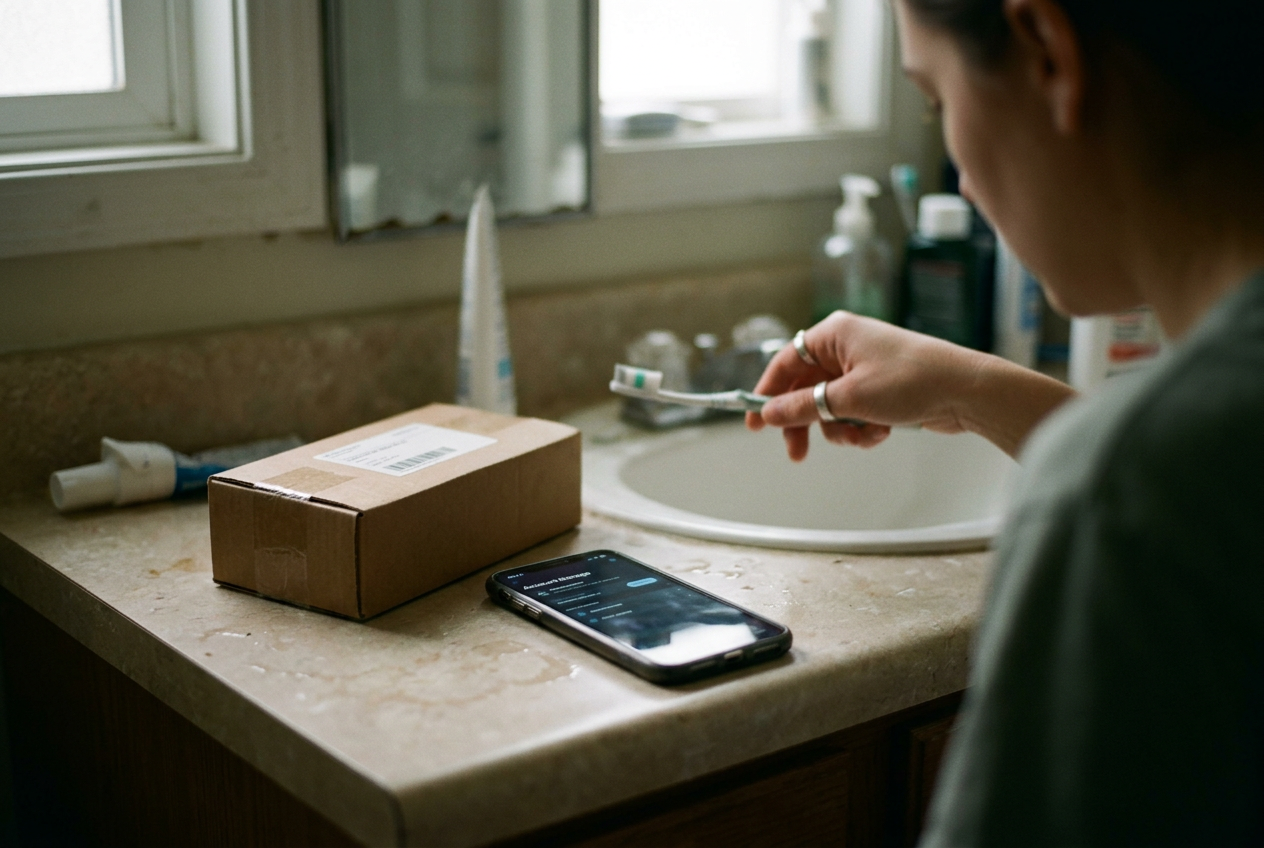
That Negative Fentanyl Strip Is Not a Green Light
Reagents and test strips answer narrow questions about one sample. The useful skill is knowing exactly which question was asked, and how much uncertainty remains.
August 11, 2026 · 8 min read
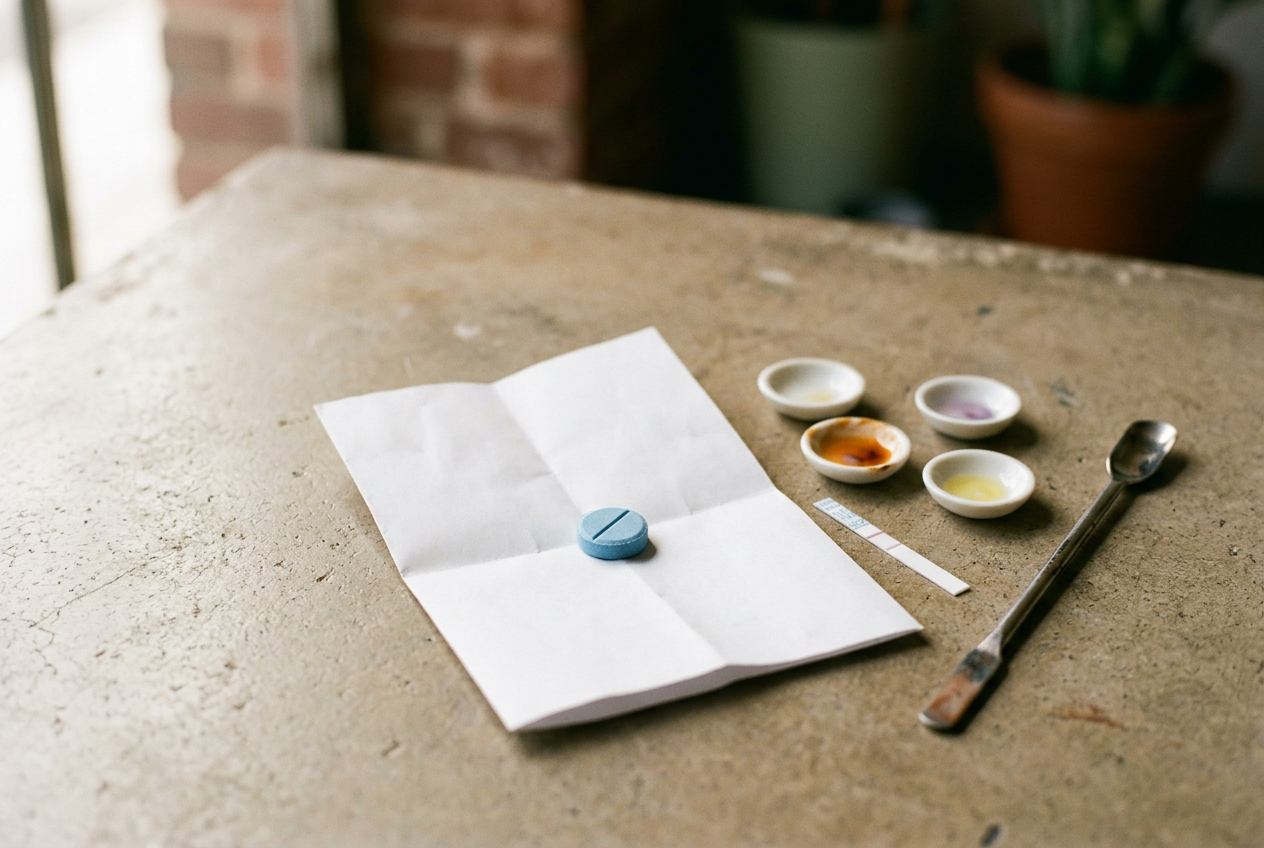
Put one blue pressed tablet on folded white paper. It has a score through the middle, darker flecks near one edge and no packaging worth believing. It was sold as MDMA. A shaving exposed to Marquis reagent turns dark purple, then black.
A fentanyl test strip dipped into a separate solution shows one line, the manufacturer’s indication of a negative result.
This is where people say the tablet tested clean. It did not.
The reagent produced a color consistent with an MDMA-like substance in one shaving. The strip did not detect fentanyl above its detection threshold in the solution it touched. Neither result establishes the tablet’s dose, rules out every adulterant or tells you that another tablet from the same bag matches this one.
Drug checking is valuable because those are still useful facts. The trouble starts when a narrow finding gets promoted into a verdict.
Start with the claim the test can support
A reagent test is a presumptive chemical test, meaning it produces a color reaction associated with certain drug families rather than confirming one substance beyond doubt. Marquis reagent, for example, can turn purple to black in the presence of MDMA and related compounds. That reaction may support what the seller claimed. It cannot distinguish every close relative, measure strength or certify purity.
Color charts encourage more confidence than the chemistry earns. Lighting changes what you see. Old reagents degrade. Too much sample can darken the reaction before its progression is visible, while dyes and fillers can obscure it from the start.
Timing matters because the relevant reading belongs within the manufacturer’s stated window, not after the drop has sat around changing color.
Use a clean white ceramic surface, a sample no larger than the instructions call for and one reagent on one separate scraping. Never combine reagents in the same spot. They are corrosive chemicals, so avoid skin contact, follow the disposal instructions and discard any drug material that touched them.
More than one reagent can narrow the possibilities because each reacts differently, but agreement between several colors still does not become laboratory confirmation. If Marquis, Mecke and Simon’s reagents all behave as expected, you have several compatible presumptive findings. You do not have a certificate for the tablet.
The fentanyl strip makes a different claim. It is an immunoassay, a test that uses antibodies to recognize a target molecule or related compounds. Depending on the product, it may detect fentanyl and some analogs. Coverage varies, and substances outside that target remain invisible.
A negative line therefore means the target was not detected above the strip’s threshold in that prepared solution. It does not mean there are no opioids, no dangerous adulterants or no fentanyl elsewhere in the tablet.
The sample is part of the result
Return to the blue tablet. The shaving came from the darker edge because that was easy to scrape. If the tablet was poorly mixed before pressing, that edge may not represent the center, the scored half or the next pill. The test has described the shaving with more confidence than it can describe the object.
This is the sampling problem. Powders and crushed material can separate during transport because particles differ in size and density. Pressed tablets may contain pockets created by uneven mixing. Fentanyl is active in small amounts, so a concentrated area can matter even when most of a batch contains little or none.
The most representative way to test one tablet is destructive: crush the whole tablet into a fine, uniform powder, mix it thoroughly, then take samples from that mixture. Dissolving the entire amount according to validated strip instructions can improve representativeness further because the test solution contains material from the whole unit. This costs the tablet’s intact form and may make storage or dosing harder. Convenience is one reason people test a corner instead.
Convenience does not repair the sampling error.
If you will not crush the entire unit, taking tiny scrapings from several parts is better than trusting one edge, though it still leaves uncertainty. With powder, mix the contents thoroughly using a clean tool and sample from more than one area. Clean the surface and tool first; residue from a previous sample can create a result that belongs to the equipment.
Batch claims deserve the same suspicion. Testing one pill from a bag says little about another if the pills came from different presses or the mixture was inconsistent. Matching color and logo prove appearance. Illicit manufacturers do not run reliable quality-control systems merely because they bought the same stamp.
Strip technique can manufacture confidence
Test strips need the dilution specified by their manufacturer or a trusted drug-checking service. The ratio matters. A solution that is too concentrated can produce false positives with some non-fentanyl drugs because the strip’s chemistry becomes less selective at high concentrations. Excessive dilution can push a small amount of fentanyl below the detection threshold.
Generic instructions copied from a social post are not enough. Products differ, and guidance may change according to the substance being tested. Check the strip’s expiration date, use the stated dip time and read it within the stated window. A faint test line generally counts according to the manufacturer’s directions, not according to whether it looks persuasive in a photograph.
The one-line result from our blue tablet remains meaningful. It lowers one specific concern if the sample was representative and the dilution correct. Its value is conditional, which is less emotionally satisfying than the word negative but more honest.
Strips also have blind spots built into their business model. A fentanyl strip is designed to find fentanyl-related targets, not to perform an open search for whatever happens to be present. Separate strips exist for compounds such as xylazine, but adding another target does not create a universal scanner. Each strip buys an answer to one bounded question.
Reagents identify patterns, not purity
A strong expected reagent reaction can coexist with an adulterant. In mixtures, the dominant drug may produce such a dark or fast color that a weaker reaction disappears underneath it. An inert filler produces no reassuring color at all, yet it may alter the dose. Some active compounds react similarly enough that a home kit cannot reliably separate them.
This is why purity is the wrong word. Purity asks what proportion of the material is the intended substance, which requires quantitative analysis. Most home reagent kits do not measure proportion. A tablet containing some MDMA may give the expected Marquis reaction whether the amount is low, high or accompanied by something the reaction fails to expose.
Potency remains unknown too. Two tablets can produce matching colors while containing very different amounts. Even confirmed identity cannot tell you how a particular body will respond, especially alongside alcohol, prescriptions, other drugs, heat, exertion or an underlying condition.
The result should be written down in literal terms: “Marquis reaction consistent with an MDMA-like compound; fentanyl strip negative in the tested solution.” Avoid “clean,” “pure” and “safe.” Those words erase the test’s boundaries precisely when you need to remember them.
Better testing changes the question
Community drug-checking services may use Fourier-transform infrared spectroscopy, or FTIR, which compares the sample’s infrared absorption pattern with reference spectra. It can identify major components quickly and without relying on human color judgment, though low-level ingredients and complicated mixtures can still be difficult to resolve.
Laboratory methods such as gas chromatography-mass spectrometry separate mixture components before identifying them by molecular pattern. They can reveal more than home tests, but access, turnaround time and reporting detail vary. A service only provides potency data when it performs a validated quantitative analysis; a sophisticated machine does not make every result quantitative by default.
If a reagent response is unexpected, a strip is positive or the colors cannot be read through a tablet’s dye, a checking service is the sensible next step. Retesting with the same limited method may reproduce the same uncertainty.
Turn the result into a decision
For the blue tablet, the correct conclusion is modest. There is presumptive evidence of an MDMA-like compound in the tested material, and fentanyl was not detected in one prepared sample. Unknown dose, uneven distribution and non-target adulterants remain on the table.
An unexpected result is information to stop. Do not try to explain it away because the purchase was expensive or the night has already started. A negative result permits a smaller update: one identified risk looks less likely under the conditions of that test.
If someone decides to use despite the remaining uncertainty, standard harm-reduction measures still matter. Avoid using alone, have naloxone available where opioid exposure is possible and make sure another person can recognize an overdose and call emergency services. A small initial amount may reduce exposure, but it cannot reveal every delayed effect or protect against a concentrated pocket in untested material.
The strip stays beside the folded paper. Keep the wording with it: negative for the target in this solution. That sentence is less convenient than a green light. It is also what the test said.
Questions people ask
Does a negative fentanyl strip mean the whole bag is fentanyl-free?
No. It means fentanyl-related targets were not detected above the strip’s threshold in the solution tested. Material elsewhere in the bag may differ, particularly if the powder was not mixed thoroughly or only one pill from a batch was sampled.
Can a reagent test confirm that a tablet is MDMA?
A reagent can produce a reaction consistent with MDMA or a related compound, but it cannot confirm identity, dose or purity. Several reagents may narrow the possibilities. Laboratory analysis offers stronger identification because it separates or measures chemical components rather than relying on color alone.
Should an entire pill be crushed before testing?
Crushing and thoroughly mixing the whole pill gives a more representative sample than shaving one edge, though it destroys the intact tablet. Sampling several areas is a compromise, not an equivalent method, because a small concentrated pocket may still escape every scraping.
What should
I do with an unexpected drug-checking result?
Do not treat the expected parts of the result as permission to ignore the unexpected one. Set the material aside, repeat the test with fresh equipment if user error is plausible, and use a community checking service when available. Drug material that contacted a chemical reagent should be discarded.
One update a day
Today's story, in your inbox
One story each morning — no hype, no filler, no algorithm deciding for you.