The AI Lemon Cake Looks Done. The Recipe Cannot Bake It.
A synthetic lemon loaf clip delivers a perfect slice by skipping the chemistry between batter and cake. That failure is built into how recipe videos are generated, ranked and monetized.
August 26, 2026 · 8 min read
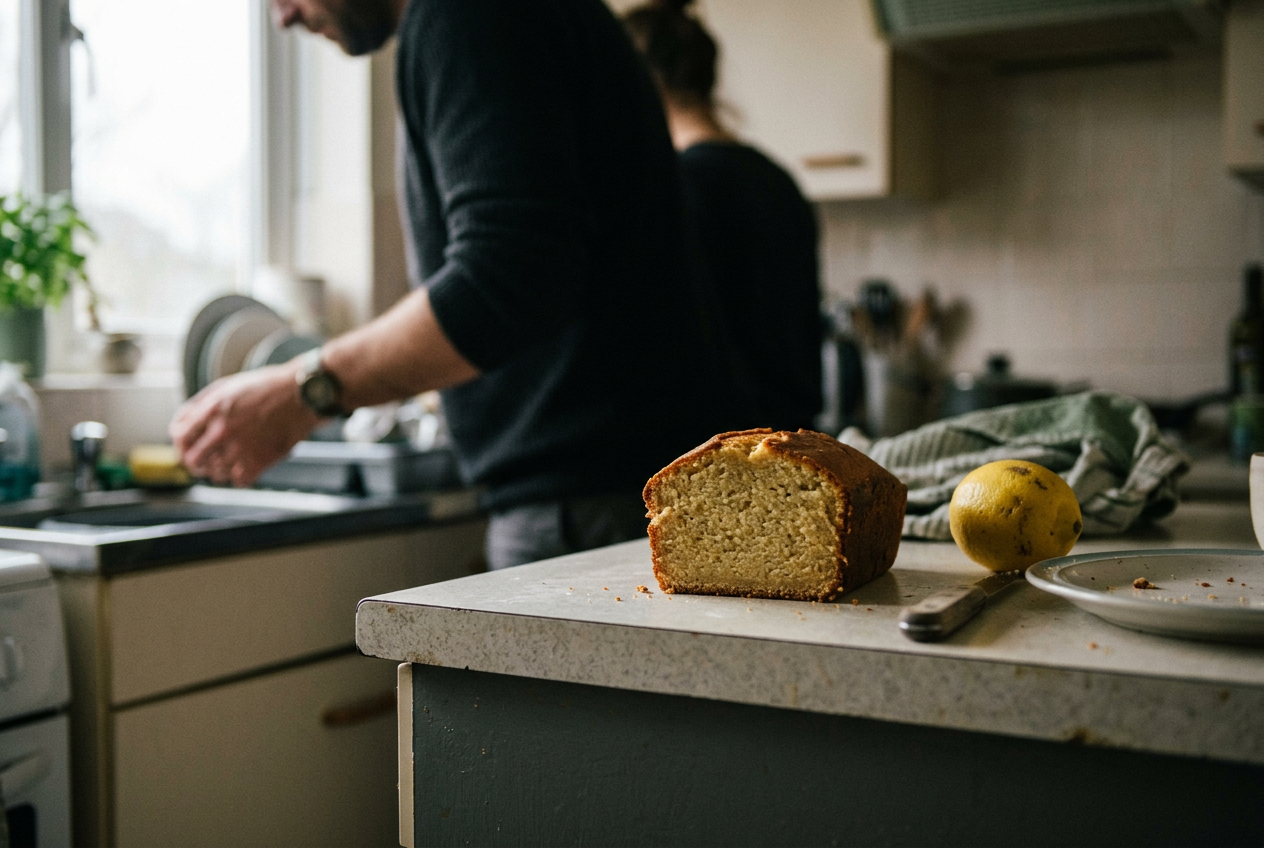
The lemon loaf arrived already sliced.
That was the first useful clue. In the short-form video, a whole lemon became a pale batter, the batter entered a loaf pan, and a browned cake emerged with a fine, even crumb. The transition was clean enough to register while scrolling. It was also where the recipe stopped describing a physical event.
The on-screen method called for one whole lemon, eggs, sugar and flour. There was no fat, no added liquid and no leavener, the ingredient that produces gas and helps a cake rise. The lemon went into the blender raw, peel and all. Twenty-five minutes later, according to the clip, the loaf was ready.
I followed those instructions rather than repairing them. The batter was thick and sharply bitter from the pith. After the stated baking time, the top had colored but the center had not set; keeping it in the oven made the edges firm while the middle remained heavy. It was food in the narrow sense.
It was not the loaf shown on screen.
The failure was not hidden in a difficult technique. It sat in the ingredient list. The video had generated the appearance of a recipe by connecting familiar food images, but no cook had been required to verify the bridge between them.
The missing step is reality
Synthetic cooking clips inherit the grammar of recipe video: overhead ingredients, frictionless transformation, close-up crumb shot. That grammar once implied a chain of events. Someone had mixed the batter. A camera had recorded the result.
Editing could compress time or conceal a messy counter, but the baked object still had to exist long enough to be filmed.
Generative video breaks that obligation. A model can synthesize plausible frames from patterns in its training material without maintaining what researchers call temporal consistency, meaning that objects and properties remain stable from one moment to the next. A lemon can lose its seeds between cuts. Batter can change volume without aeration.
A loaf can acquire the crumb structure of a different cake because the final shot only needs to resemble successful baking.
Watch the lemon loaf again at normal speed and the handoff feels smooth. Slow it down and the batter changes shade as it enters the pan. Its level rises despite no additional mixture being poured. The baked loaf has a straight-sided shape that does not match the rounded pan shown earlier.
These are small discontinuities, and short-form video is built to keep them small. The clip moves before scrutiny can settle.
This is why visual plausibility beats procedural accuracy. The viewer sees each moment locally: lemon, blender, batter, cake. The system does not need to prove that one state caused the next. It needs adjacent frames that the eye will accept before the swipe.
Cooking is unusually hostile to that shortcut. Recipes encode ratios, temperatures and transformations that are not fully visible. Flour hydration determines texture. Acid affects leavening.
Heat reaches the outside before the center. A browned surface may conceal raw batter, while a glossy sauce may have split seconds before the camera found its preferred frame. The generated clip can imitate every visual checkpoint without carrying the material constraints that connect them.
The recipe came from somewhere, in pieces
The lemon loaf was not random. Its nearest procedural relative is a family of whole-orange cakes in which citrus is often boiled to soften the peel and reduce bitterness, then combined with eggs, sugar and ground almonds or another structured dry mixture. Other blender cakes use oil, milk and baking powder. The synthetic version retained the striking instruction, put the whole fruit in, while dropping the supporting decisions that make the instruction work.
I searched the ingredient sequence and compared the clip’s key stages with conventional citrus loaf methods. No single recipe accounted for the video. The opening resembled whole-fruit blender cakes. The pour resembled a standard oil-based loaf batter.
The finished crumb looked closer to a conventional lemon pound cake, which depends on fat and deliberate mixing for its structure.
The likely source is therefore not one stolen recipe reproduced intact. It is a compressed average of several recognizable formats, with the visually distinctive parts preserved and the less photogenic constraints discarded. Boiling citrus takes time. Measuring baking powder adds no spectacle.
Explaining why almond flour behaves differently from wheat flour slows the clip and creates opportunities for viewers to leave.
The same pattern appeared across the other synthetic cooking clips I checked. A creamy pasta sequence borrowed the surface finish of an emulsified cheese sauce but never showed enough cooking water or mixing to produce one. A stuffed bread clip moved from raw dough to an airy interior without proofing, the rest period during which yeast generates gas and dough gains volume. Their instructions were legible.
Their causal chains were not.
That distinction matters. A garbled recipe copied from a human site may still contain remnants of testing: an oven temperature, a pan size, an awkward warning about moisture. A generated recipe can smooth those remnants away. Fluency becomes evidence against reliability because the system has removed the friction that often carries the useful information.
The lemon loaf’s perfect slice performed the same cleanup. It did not merely conceal the failed center I found in my pan. It supplied a different cake.
The feed rewards the reveal, not the method
Short-form ranking systems are proprietary and change often, but platforms commonly evaluate signals such as whether viewers finish, replay, share or quickly abandon a clip. A synthetic recipe is well suited to that environment because its producer can design backward from the reveal. Start with the glossy loaf. Add a whole lemon for novelty.
Keep the middle fast enough that nobody has time to audit the ratio.
Procedural accuracy has weak feedback. Most viewers will never cook the dish. Those who do may not find the original clip again, and a failed bake occurs far from the moment when the platform logged a completed view. The system receives immediate evidence that the video held attention, while evidence that the recipe failed stays in a private kitchen.
Even comments pointing out errors can become engagement. The correction remains attached to the same post, producing more activity around the clip rather than forcing its maker to test a second loaf. Platforms can moderate obvious safety violations, but a cake recipe that yields a dense, bitter slab occupies a softer category: bad information with no clean enforcement hook.
This arrangement works for accounts running high-volume production. Generative tools reduce the need for ingredients, kitchen space, shooting time and cleanup. One person can create variations without buying a lemon, and the content can lead viewers toward ad-supported recipe pages, affiliate links or whatever monetization a platform offers eligible accounts. Payment varies by service and account.
The cost advantage does not.
The viewer pays differently. A failed lemon loaf consumes groceries, oven time and confidence. Those costs are too dispersed to appear in a creator dashboard, which is one reason the dashboard can treat the clip as a success.
A recipe needs witnesses
Human recipe media has never guaranteed competence. Food styling cheats. Viral hacks fail. Publishers copy one another, and search-oriented recipe pages have long padded thin instructions with material written for machines.
Synthetic video enters an already compromised market.
It still changes the evidentiary standard. Conventional footage at least begins with a photographed object, even if that object was prepared off camera or swapped before the beauty shot. Fully generated footage can present a process that never occurred and a finished dish that never occupied the same room as its ingredients. There may be no original loaf to inspect.
A useful test is to read the method without the reveal. Check whether the ingredient ratios resemble the claimed dish, whether visible transformations have stated causes, and whether timing accounts for resting, heating or cooling. Reverse image search can sometimes locate reused photographs, though fully synthetic frames may produce no clean match. None of this should be required labor for somebody looking for dinner.
Platforms could place more weight on provenance, meaning information about where media came from and how it was made. Clear synthetic-media labels would help, particularly when a clip presents instructions rather than fantasy. Recipe publishers could attach tested written methods and identify who cooked them. Accounts posting generated food could stop calling visual prompts recipes.
The stronger fix is less glamorous. Somebody has to make the thing.
That person does not need a studio or a culinary degree. They need a kitchen, the stated ingredients and enough editorial authority to reject the clip when the center stays wet. In the lemon loaf’s production chain, that role had been eliminated because it added cost without improving the metric visible to the feed.
The synthetic cake looked finished. The system’s work was finished too.
Questions people ask
How can
I tell if a recipe video is AI-generated?
Look for ingredients that change shape or quantity between cuts, utensils that deform, mismatched pans and finished food whose structure does not follow from the method. Those clues are imperfect, so read the written recipe as a separate document rather than treating realistic footage as proof.
Why do
AI cooking videos leave out important steps?
Generation systems reproduce visual patterns, while short-form feeds reward fast completion and an appealing reveal. Resting, temperature checks and explanations of ingredient ratios take time without guaranteeing more views, so a high-volume production pipeline has an incentive to remove them.
Are AI-generated recipes safe to cook?
Some may be harmless, but visual realism does not establish safe temperature, accurate timing or workable ratios. Use a tested recipe from a source that identifies its method, especially for meat, eggs, preservation or ingredients that can cause harm when mishandled.
Who benefits when an impossible recipe goes viral?
The account can gain reach and may earn platform payments, advertising revenue or affiliate income, depending on where the clip leads. The platform gets attention and more material to recommend. The cook who buys a lemon and pulls a wet loaf from the oven absorbs the failure.
One update a day
Today's story, in your inbox
One story each morning — no hype, no filler, no algorithm deciding for you.