The Airport Face-Scan Opt-Out Is Hidden in One Sentence
A voluntary face scan is not a meaningful choice if the notice appears after a passenger reaches the camera. The real test is whether “Photo capture is voluntary” can be found in time.
August 25, 2026 · 7 min read
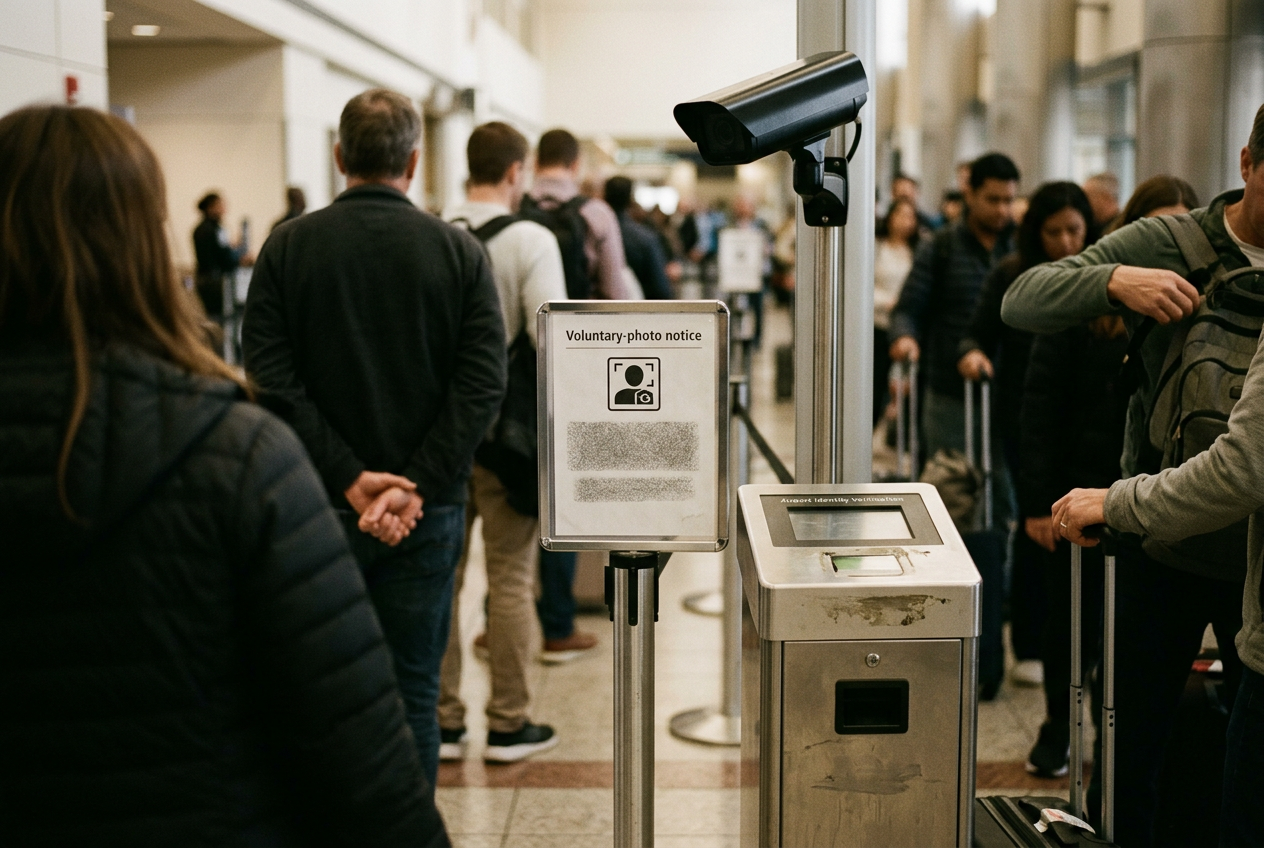
The sentence is short: “Photo capture is voluntary.”
That is the object to track through an airport checkpoint. Not the camera, which is easy to see once you know its shape. Not the agency language about modernization or identity verification. The sentence matters because it tells a passenger that the camera is optional before the passenger’s face enters its frame.
A face-scan opt-out can exist in policy and fail in the terminal. The failure does not require a broken machine or an employee refusing a direct request. It can happen earlier, through placement, timing and the ordinary pressure of a security line, where people copy the traveler ahead of them and treat every instruction as mandatory. By the time someone learns there was a choice, the image may already have been captured.
That makes signage part of the surveillance system, not decoration beside it. The government controls the words, the type size and the point at which a passenger encounters them. A choice built this way favors the institution even when every sentence on the sign is technically accurate.
The sentence has to arrive before the camera
At Transportation Security Administration checkpoints using facial matching, a camera takes a live image and compares it with the photograph attached to a passenger’s identity document. Facial matching means software estimates whether two images depict the same person; it does not establish identity from a face alone in some broader, cinematic sense.
TSA says participation in its facial recognition technology is voluntary and that travelers may decline without losing their place in line. Customs and Border Protection operates separate biometric systems in international travel, including facial comparison during some departure and arrival procedures, under different authorities and rules. An airport can therefore contain several face-scan encounters that look similar to a traveler but do not offer identical choices. “I opted out at security” does not settle what happens at an international gate or border inspection.
The checkpoint test must stay narrow. Can an ordinary passenger identify the voluntary step before reaching the capture position, decline it in normal language and proceed through the required identity check without being treated as a disruption?
The phrase “Photo capture is voluntary” is the anchor because it gives the traveler both the action and its status. A general privacy notice is not enough. A sign saying that facial recognition is in use describes the institution’s activity without explaining the passenger’s choice. A link or QR code that leads to a longer policy transfers the burden to the person moving through a controlled line, often with luggage in one hand and identification in the other.
The agency already knows the operative sentence. It can print it where the decision occurs.
Timing carries more weight than legalistic completeness. If the first readable opt-out notice stands beside the device, the passenger must absorb it while an officer is directing traffic and the people behind are waiting. If the notice sits beyond the place where documents are handed over, it may be functionally late. The relevant distance is not a measurement in feet.
It is whether the traveler has enough time to understand the choice and act before the camera receives an image.
A field test should reproduce an ordinary trip
A credible hands-on evaluation should not turn a checkpoint into a stage. It should use normal ticketed journeys through airports reachable from New Jersey, including the region’s large commercial airports when the itinerary permits, and record only what a passenger can observe without blocking a lane, photographing sensitive checkpoint operations or provoking repeated encounters for content.
The observation begins before the identity podium. The reporter notes where the first face-scan notice becomes visible, whether “voluntary” or equivalent language can be read from the moving line, whether another sign or piece of equipment obscures it, and whether the notice distinguishes the optional photograph from the mandatory identity check. Those details belong together because a perfectly worded sign can still fail when it faces away from the queue or becomes legible only after the officer has positioned the passenger.
The interaction itself should be plain. A passenger can say, “I would like to opt out of the photo,” before stepping into the camera position. The test is not whether staff can recite agency policy under interrogation. It is whether the request is recognized, whether the officer moves directly to an alternative identity check, and whether the traveler must defend the choice while the line watches.
Time matters, but it should be recorded as an observed burden rather than converted into a stunt. A brief manual check is different from being moved aside without explanation. A repeated instruction to face the camera after an opt-out is different from a staff member needing a moment to switch procedures. The reporting has to preserve those distinctions; otherwise an evaluation of coercive design becomes another piece of airport theater.
No airport should receive a definitive score from one checkpoint encounter. Terminals change, signs move and staff practices vary by shift. A useful account identifies the lane, terminal context, kind of biometric system and sequence of events without pretending one passage represents an entire airport. The purpose is to test the passenger-facing mechanism, then compare it with the agency’s stated policy.
This draft does not claim completed site results because no field notes were supplied. That boundary matters. Inventing a hidden sign at Newark Liberty International Airport, a smooth refusal at Philadelphia International Airport or a confused exchange at a New York airport would reproduce the institutional habit under examination: announcing that a procedure worked without showing the record.
Voluntary systems benefit from automatic compliance
The airport does not need every passenger to believe facial matching is mandatory. It needs the default path to feel mandatory enough.
Security lines train compliance through repetition. Shoes, bags, documents and bodies move according to instructions that may change between lanes. Travelers learn that hesitation costs time and attracts attention. Inside that setting, an optional camera presented in the same visual language as mandatory screening inherits authority from everything around it, even if a small notice uses the correct word.
This is a dark pattern, meaning an interface arranged to steer people toward the operator’s preferred choice. The interface happens to be physical: queue barriers, signs, floor marks, a camera and an officer’s gestures. There may be no deceptive button and no false statement. The steering comes from making one route obvious and the other route discoverable only by people who arrived knowing the sentence.
The institutional incentive is straightforward. Biometric identity checks promise faster processing, less handling of documents and a standardized transaction that can be measured across large numbers of passengers. Vendors supply parts of the technical infrastructure, while federal agencies set operational requirements and present expansion as efficiency or security. The passenger pays through attention and through the disclosure of a biometric image, even when the agency limits how that image is retained or used.
The opt-out complicates throughput. An officer may need to change modes and inspect identification without facial matching. None of that makes refusal improper. It explains why a nominally voluntary system can be designed around near-universal participation without anyone issuing an explicit command.
“Photo capture is voluntary” works against that default only if the sentence is given comparable authority. It should be visible from the queue, written in plain language and placed before any prompt to stand on a mark or look toward a lens. Staff should not have to wait for a passenger to produce specialized vocabulary. “No photo” should be enough.
The alternative is not an escape from airport surveillance
Declining facial matching does not remove a passenger from security screening, identity verification, airline records or cameras elsewhere in the terminal. The alternative usually changes one transaction: an officer checks the traveler’s identification without using the optional live facial comparison. That limitation should be stated plainly, since overstating the opt-out turns a specific procedural choice into a false promise of anonymity.
The narrower choice still matters. Biometric systems convert the body into a reusable credential, and their routine use makes later expansion easier to present as administrative housekeeping. Consent at scale is often inferred from participation rates, although those rates say little about whether passengers saw the notice, understood it or felt able to interrupt the line.
A field test can expose that gap without speculating about hidden motives. Record the first point where refusal becomes knowable. Record what the passenger has already handed over by then. Record whether the officer accepts an ordinary refusal and what additional time or attention follows.
Return to the sentence.
If “Photo capture is voluntary” cannot be found before the camera, the airport has preserved an opt-out on paper while designing the trip around surrender.
Questions people ask
Can
I decline a TSA face scan at the airport?
TSA states that participation in its facial recognition technology is voluntary and that a traveler may request an alternative identity check. Decline before moving into the camera position. This does not exempt anyone from required security screening, and procedures may differ during international border processing.
Will opting out make me lose my place in line?
TSA says declining the photograph should not cost a traveler their place. A manual identity check may change the interaction or add some time, which is why field reporting should document the practical burden without treating every delay as retaliation or every smooth exchange as proof that the system works everywhere.
Is the face scan at an international gate the same as the TSA scan?
No. TSA checkpoint facial matching and CBP biometric entry or exit systems are operated for different purposes and may follow different rules. Travelers should read the notice at each encounter rather than assume that an earlier refusal applies throughout the airport.
What should airport face-scan signage say?
The notice should identify the photograph as optional, explain the alternative in plain language and appear early enough for a passenger to decide before entering the camera’s capture area. “Photo capture is voluntary” is useful only when a traveler can see it in time.
One update a day
Today's story, in your inbox
One story each morning — no hype, no filler, no algorithm deciding for you.