The Body-Camera Clip May Start Where Police Chose to Start It
A released body-camera video is usually a constructed public record, not an untouched window. Activation rules, silent buffers and edits determine what appears to be the beginning.
August 11, 2026 · 8 min read
In 2023, the Los Angeles Police Department released a critical-incident briefing about officers’ encounter with Keenan Anderson, who died after police repeatedly used a Taser and restrained him. Like other LAPD briefings, the package moved through department narration, maps and selected records before cutting into body-worn video.
Keep that cut in mind. It looks like entry into the event. It is only entry into the department’s presentation of the event.
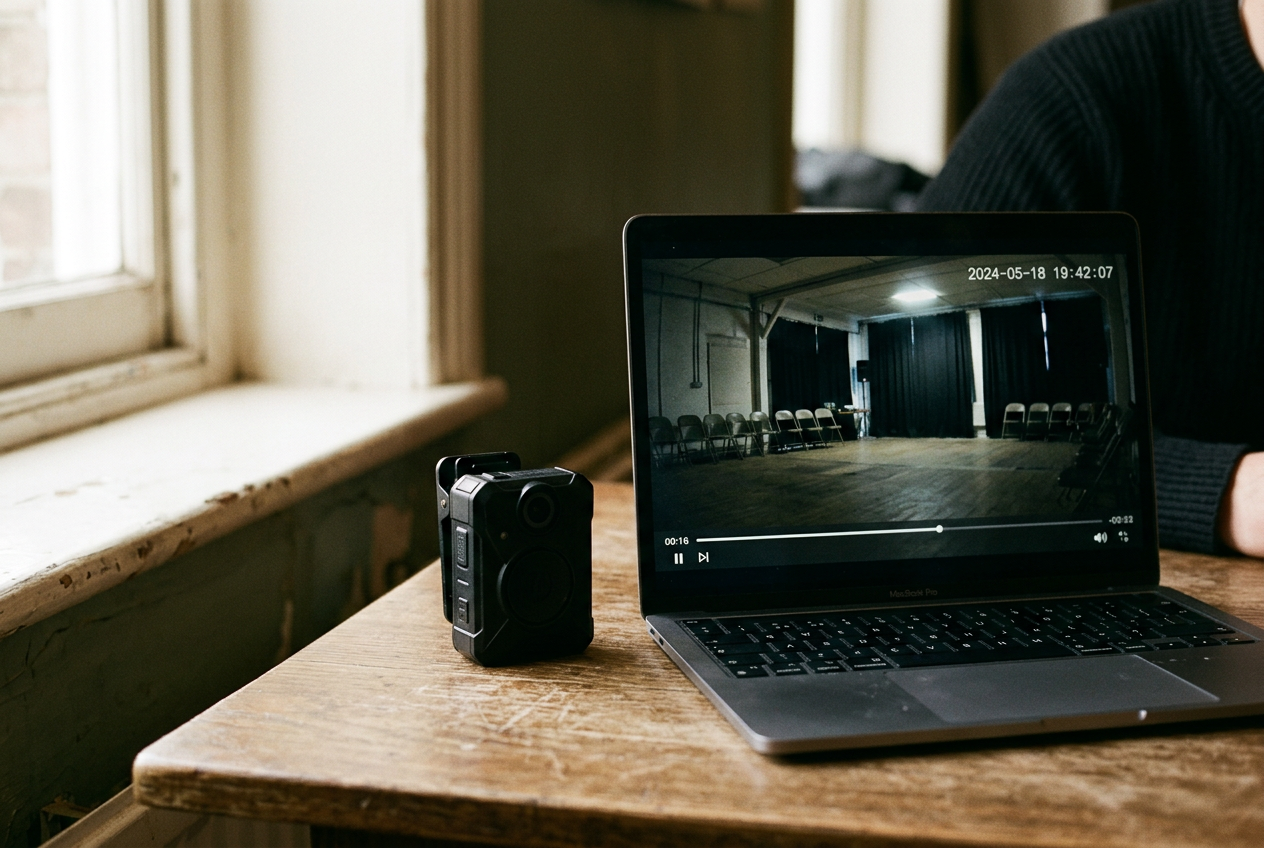
A body camera may have captured images before an officer deliberately activated it. The released package may begin after those images, replace them with narration or arrange several cameras into a sequence that no person experienced. Redaction can remove sound, obscure a screen or eliminate a passage altogether. A viewer encounters one clean play button where the underlying record may contain several clocks, files and editorial decisions.
That does not make every release deceptive. It makes the release a produced object, with a starting point chosen under rules that differ by department, camera configuration and state disclosure law. The polished briefing works for police because it collapses those choices into a familiar video grammar: introduction, incident, response. The institution gets to establish sequence before the evidence appears.
Recording starts more than once
Body cameras have at least three relevant beginnings. There is the beginning of the encounter, the beginning of what the device held in its temporary memory and the moment the officer pressed record. A fourth beginning appears when the department exports or edits footage for release.
Many cameras maintain a pre-event buffer, a short rolling loop of images that can be saved when the officer activates recording. Think of it as temporary memory constantly overwriting itself. Once activated, the device attaches some of the preceding video to the recorded file.
The length and contents of that buffer depend on the device and agency settings. Axon documentation describes configurable pre-event buffering across its camera systems. LAPD policy has provided for a two-minute pre-event video buffer without audio. That means an LAPD file can show an officer moving through a scene before the first audible exchange, even though the officer had not yet activated a full audio-and-video recording.
Silence at the front of such a file does not prove nobody spoke. It may identify the buffered interval. Nor does the first audible sentence establish the encounter’s first sentence. It often establishes when activation added audio.
The cut in the Anderson briefing therefore cannot be read by sight alone. You need the camera policy and the file’s timing information to distinguish the department’s edit from the device’s buffer and the officer’s activation. Without them, the apparent opening remains an assertion.
Policy says when officers should press record
Activation policy tells officers when recording is required. It may cover calls for service, vehicle stops, searches, arrests, pursuits and adversarial contacts. Some policies require activation before arrival when feasible; others tie it to the start of enforcement activity. Exceptions often address sensitive conversations, hospitals, confidential sources or moments when activation is unsafe or impractical.
These words matter, but their legal weight needs sorting. A department policy generally binds employees through workplace discipline. It is not automatically a statute, and violating it does not automatically make footage inadmissible in court or create a successful civil claim. State law, union rules, court precedent and the facts of a case can change the consequence.
A policy can be mandatory inside the department while offering the person recorded little direct remedy outside it.
Watch for phrases such as “when safe,” “when practical” and “as soon as feasible.” They recognize real constraints, but they also create space for after-the-fact explanations. If recording begins during handcuffing rather than during the approach, the file may document force while omitting the decisions that produced it.
Late activation is evidence about the recording, not automatic proof of misconduct. The useful comparison is chronological: identify the first known police contact from dispatch audio, surveillance video, witness footage or reports, then compare it with the activation point required by policy. The gap is the issue. Police narration about the gap is not the gap itself.
A public release is rarely the native file
Departments often publish critical-incident videos rather than raw camera files. These packages can combine 911 audio, dispatch traffic, surveillance images, body-camera excerpts, captions, freeze frames and narration. They are designed to explain. Explanation is editorial power.
The native file, meaning the direct exported recording in its original system format, can carry metadata, or information stored with a file about timing, device identity and handling. A social-platform upload usually strips some of that context. A screen recording strips more. A television segment or viral repost may crop the timestamp and remove the department’s disclosure that footage was shortened.
Redaction adds another layer. Agencies may blur uninvolved people, mute private information, conceal a home interior or withhold material they say could affect an investigation. Public-records law varies by state, and courts sometimes decide whether a claimed exemption applies. A department’s decision to redact is not the same thing as a judicial ruling that the material must remain hidden.
Redaction can be legitimate and still alter comprehension. Muting a name is different from removing an interval. Blurring a child is different from obscuring where an officer’s hands moved. A responsible release should make those interventions visible through labels, edit notices or accompanying documentation, rather than asking the audience to mistake smoothness for completeness.
Return to the Anderson package’s cut from institutional narration into body-camera footage. The narration supplies a frame before the camera supplies an image. If the release then moves among officers, the viewer receives a reconstructed sequence assembled after the event, not one continuous point of view. That distinction should travel with every excerpt, including the version detached from its source and posted to a feed.
Read the opening as a claim
Start with the earliest frame available. Look for a timestamp, device label, muted-audio notice or abrupt change in image quality. A silent opening may be a buffer. A black screen may reflect redaction or a camera covered by clothing.
Neither interpretation should be guessed when the release materials can answer it.
Next, locate the governing policy in effect at the time, not the department’s current promotional page. Find the activation rule, buffer duration, audio setting, deactivation rule and any permission for supervisors or officers to review footage before writing reports. Product capability does not settle agency practice. A camera may support a feature that the department disabled or configured differently.
Then identify the release type. A critical-incident briefing, press conference clip or YouTube compilation is an edited publication. A records response may still contain redactions or converted files. Court exhibits can also be excerpts.
The word “footage” tells you almost nothing about how many transformations sit between the camera and your screen.
Compare clocks where other records exist. Dispatch logs can place the assignment of a call. Fixed surveillance video can establish an arrival. Bystander footage may preserve words absent from a silent buffer.
These sources have their own limits, but disagreement among them can reveal an activation delay, clock offset or editorial cut that a standalone body-camera clip hides.
Finally, separate what the opening shows from what it cannot establish. It can show that a camera preserved particular images from a particular point. Without the surrounding records, it cannot prove that no earlier contact occurred, that no words were exchanged during a silent buffer or that the released sequence contains every available camera.
The checklist is less satisfying than instant certainty. That is precisely why it matters. Police video arrives with the authority of machinery and the pacing of television, while the consequential choices often happened in camera settings, policy language and an editing suite before the public saw a frame.
What to request when the first minute matters
A fuller records request can seek every body-camera file associated with the incident, including pre-event footage, along with dispatch audio, computer-aided dispatch records and the policy version effective at the time. Requesting the longest available export may reduce the chance of receiving only the excerpt used in a briefing, although disclosure rules and exemptions will still control what the agency produces.
It can also help to seek metadata, redaction logs and documentation identifying edits or time corrections. Agencies may withhold some of this material, say it does not exist or charge permitted processing fees. Those responses remain informative. They show which parts of the sequence the public can verify and which parts still depend on the department’s account.
Do not let the department-hosted video become the endpoint merely because it is easy to embed. The same applies to the repost that removes the LAPD briefing around Anderson and begins directly on an officer’s camera. Cutting away police narration can remove institutional framing, but it can also erase the notice that the viewer is watching an excerpt.
Questions people ask
Does a body camera record before an officer presses the button?
Many models can retain a configurable pre-event video buffer, which is saved when recording activates. The buffer may lack audio, as under LAPD’s published setup, and its duration varies. Camera capability alone does not prove what a particular department enabled or what survived in the released file.
Does late activation make the footage unusable in court?
Not automatically. Courts apply evidentiary rules, statutes and precedent, while departments handle policy violations through their own disciplinary systems. Late activation can still affect how complete or persuasive a recording is, particularly when another source establishes that police contact began earlier.
Can police edit body-camera video before releasing it?
Departments commonly redact legally protected material and produce edited critical-incident presentations. Whether a specific deletion is permitted depends on applicable disclosure law and, sometimes, a court ruling. A release should identify edits clearly, but a smooth transition on screen does not guarantee that every available interval was included.
What does the first frame of a body-camera clip prove?
It proves that the released video begins there. By itself, it does not establish when the encounter began, when the device started buffering, when audio activated or whether earlier footage exists. The policy, native-file information and records from other cameras are what turn an opening image into a defensible timeline.
One update a day
Today's story, in your inbox
One story each morning — no hype, no filler, no algorithm deciding for you.