The Community Note Came After the Screenshot Got Away
Crowd-sourced context can correct a post without catching its copies. By the time consensus arrives, the feed has often turned one claim into screenshots, clips and reaction videos.
August 21, 2026 · 8 min read
In November 2022, the White House deleted a tweet taking credit for a large Social Security cost-of-living increase after Twitter attached reader-written context explaining that the adjustment followed an inflation-linked formula created by law.
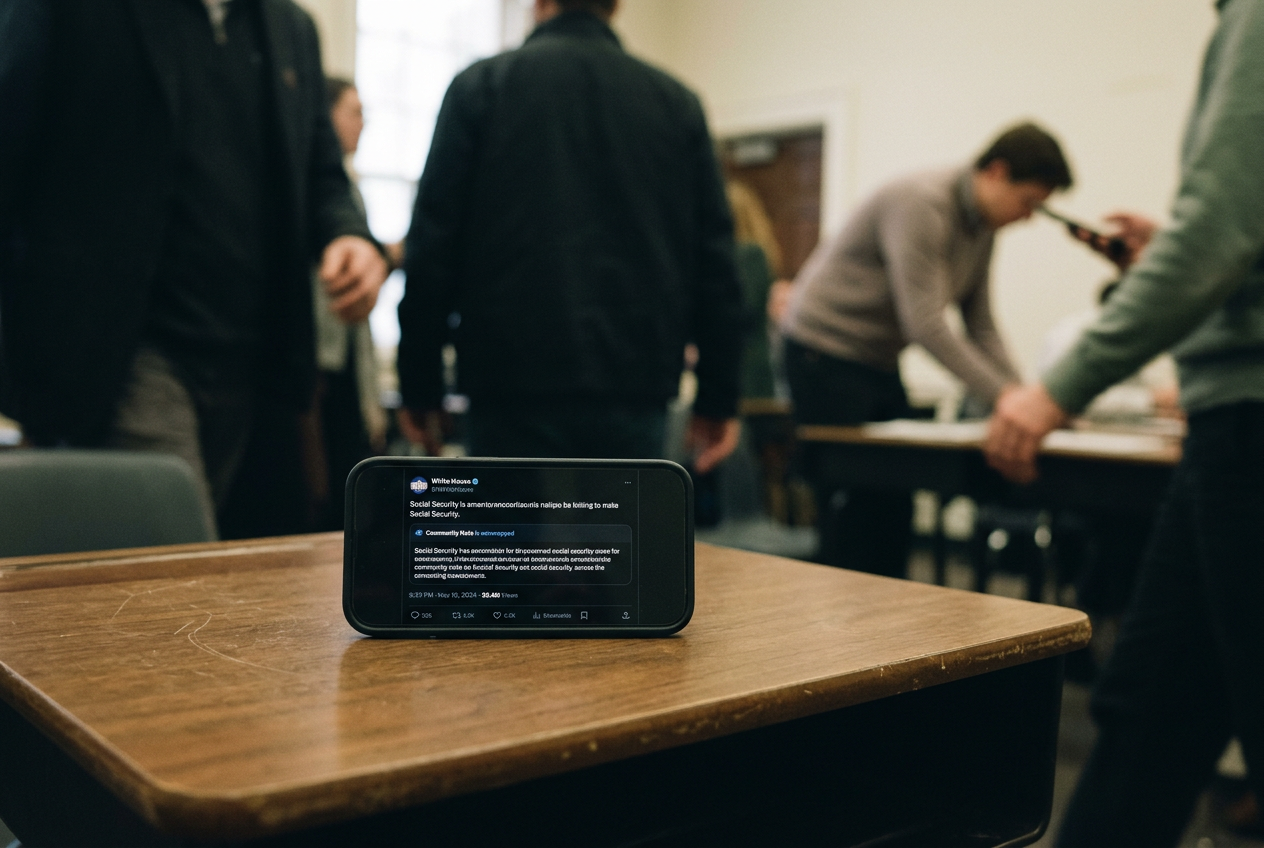
The deleted tweet was ordinary political feed material: a short claim, a statistic presented as an achievement and a White House account lending it institutional weight. The note was more precise. The deletion then produced the object that mattered most, a dark-mode screenshot showing the government’s claim with the correction directly underneath it.
That screenshot still circulates whenever someone wants to prove that Community Notes works, that the White House lies, that Twitter once had standards, or that inflation made seniors poorer despite the nominal increase. One image, several arguments. The original post is gone.
Keep that screenshot in view. It contains the central problem with crowd-sourced context: the correction is attached to a post, while the meaning escapes as media.
The original gets corrected. The copies become new posts.
A community note is usually bound to a platform object, meaning the specific post, video or image entry stored under one account and one identifier. Contributors submit context and other contributors rate whether it is helpful. On X, the system looks for agreement among raters who have disagreed on previous notes, an approach intended to stop one political camp from publishing context by force of numbers alone.
That takes time. A claim does not.
The White House tweet could be read, quoted, captured and pushed into other feeds before enough contributors had written and rated a note. Once deleted, its screenshot no longer behaved like a corrected political statement. It became an image file. Upload that file to Instagram and Meta sees a new post.
Put it behind a talking head on TikTok and the claim becomes part of a video. Crop out the bottom and the Community Note disappears with a thumb movement.
Recommendation systems, which rank posts by predicting what will hold attention or produce interaction, do not pause while a correction gathers consensus. They test the claim immediately. Early engagement widens distribution, widening distribution generates more responses, and those responses create fresh objects that can rank on their own. The note enters after the system has already financed the claim with attention.
This is why the familiar before-and-after view is misleading. A platform shows the post before its note, then the same post after its note, as though the second state replaced the first. It did not. The first state generated descendants.
The correction has to win several races
The first race is against the original post’s distribution. Public reporting on X’s Community Notes has repeatedly found notes appearing after misleading posts had already accumulated substantial visibility, particularly during elections and breaking news. Some notes never reach public status because contributors cannot produce the required cross-group agreement, even when outside reporting has established the underlying facts.
The second race is against mutation. In May 2023, an AI-generated image purporting to show an explosion near the Pentagon spread through verified and imitation news accounts on X. Some copies were deleted, labeled or corrected as officials and reporters established that no explosion had occurred. The image had already moved through screenshots and reposts, and television coverage of the false claim gave it another route beyond the corrected posts.
The third race is against format. During the Israel-Gaza war, footage from the military simulation game Arma 3 repeatedly circulated as supposed combat video. Notes and reporting identified the game footage under some X uploads, but a screen recording with a new caption became another object, while a vertical reaction video could display the footage without preserving any label attached to the source post. Bohemia Interactive, the game’s developer, has repeatedly published guidance for identifying such clips.
The feed keeps rediscovering them.
The White House screenshot is less visually dramatic than a fake explosion or simulated warfare. It may be more instructive. The note succeeded under the original post. The account responded.
The corrected version became widely visible. Yet deleting the post severed the live connection between claim and context, leaving screenshots to carry whichever crop suited the next uploader.
Platform context does not travel like platform content
X has tried to narrow this gap with notes on media. When contributors attach context to an image or video, the platform can display that note on other posts containing matching media. This is more useful than binding every correction to one account’s upload, especially when old disaster footage or synthetic images are reposted at speed.
Matching still has limits. Crops, overlays, edited audio and picture-in-picture reaction videos can change the media enough to evade detection or make the old note incomplete. A note explaining that a clip was filmed years earlier may remain accurate when the clip is reposted, but a note about the accompanying caption may not. Automated matching therefore risks either missing mutations or applying context too broadly.
Meta’s Community Notes system and TikTok’s Footnotes pilot borrow the broad X model: users propose context, other contributors evaluate it, and agreement across people with differing rating histories helps determine what appears. YouTube has also tested viewer-added notes on videos. Each company describes this as a way to add context without placing every disputed claim before an internal moderation team.
None of that makes the context portable. An X note does not follow an X screenshot into an Instagram carousel. A Meta note does not become part of a downloaded Reel. TikTok can identify a video inside its own service, but it does not inherit the correction attached to the same clip elsewhere.
Platforms built frictionless tools for cross-posting culture, then built correction systems that stop at the property line.
The result is a strange asymmetry. Content travels as a file, a link, a screen recording or an idea. Context travels as interface furniture.
Consensus is slow because slowness is part of the product
Crowd-sourced notes are designed to avoid a single moderator deciding what millions of people should believe. Requiring agreement among contributors with different rating patterns can make a note more credible and less vulnerable to an organized pile-on. It can also leave straightforward corrections unpublished during the only window when most viewers will encounter the claim.
Platforms present this delay as methodological caution. It also protects them from making a fast editorial judgment. Volunteers research, draft and rate the note; the company provides the machinery and reserves the right to change it. On Meta, notes do not automatically reduce a post’s distribution, according to the company’s rollout materials.
The correction can sit below content while the recommendation system keeps doing its job.
That arrangement works well for the platform. A viral falsehood produces viewing time, replies, duets, quote posts and creator output. The correction produces more engagement and a demonstration of civic responsibility. The company gets both cycles while outsourcing much of the contextual labor.
The people harmed by the original claim do not receive the same duplication. A falsely accused person, a targeted community or an election office can answer one post, yet they cannot reliably locate every screenshot and reaction clip generated from it. The platform’s unit of moderation is smaller than the social event it created.
A correction needs a distribution plan
A serious system would treat a published note as the start of correction, not its finish. Platforms could notify people who viewed or shared a post before context appeared. They could place the note on quote posts and preserve it when an account deletes the original. Media matching could cover recognizable crops and screen recordings, with an appeal route when context is applied to the wrong material.
Recommendation systems could also rank the correction into the same audience that received the claim. That would cost attention. It might interrupt a profitable chain of reactions, and it would require the company to admit that passive labeling is not the same as repair.
Cross-platform portability is harder because it requires shared identifiers, compatible standards and companies willing to accept context generated elsewhere. A cryptographic record could verify that a screenshot came from a corrected post, but most screenshots in circulation contain no such record, and ordinary users should not need forensic tools to discover that a government account deleted something after being corrected.
So the White House screenshot remains the cleanest demonstration. The claim got a note. The post came down. The system can log that as a success, while the image continues circulating as proof of whatever the next account needs it to prove.
Questions people ask
Why do
Community Notes appear after a post has gone viral?
Contributors must write and rate notes before one reaches the required agreement, while recommendation systems distribute the original post immediately. Breaking news moves faster than consensus, and some notes remain unpublished when raters with different histories cannot agree that the wording is helpful.
Do
Community Notes follow screenshots and reposts?
Usually not. A note is attached to a specific post, although X can apply media notes to some matching images and videos. Screenshots, crops, screen recordings and reaction clips often become new platform objects, particularly when they are uploaded to another company’s service.
Does adding a note reduce a post’s reach?
Policies differ, and a visible note does not necessarily mean the platform will demote the post. Meta has said Community Notes do not automatically reduce distribution. Even where a platform limits some monetization or sharing features, copies created before the note can continue ranking independently.
What would make late corrections more useful?
Platforms could alert earlier viewers, attach context to quote posts and recognizable copies, preserve notes after deletion, and distribute corrections to the audience that received the claim. The last step matters most because a label beneath one surviving post cannot repair an entire recommendation chain.
One update a day
Today's story, in your inbox
One story each morning — no hype, no filler, no algorithm deciding for you.