
YouTube’s AI Label Disappears Before the Video Does
YouTube can preserve an altered-content disclosure on its own watch page while stripping it from the feed, embeds and copied clips. The label survives as metadata, not as part of the media.
August 18, 2026 · 8 min read
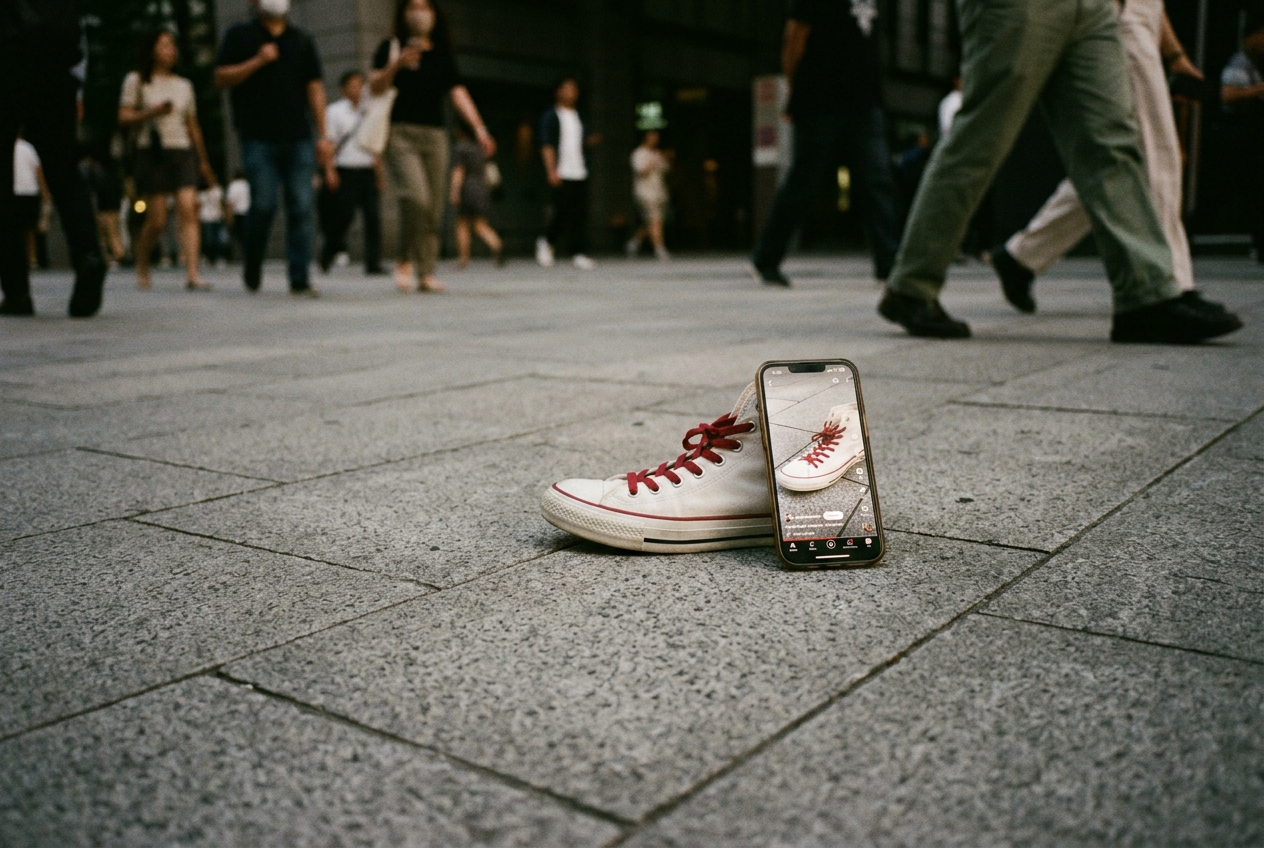
The test clip showed a white canvas sneaker, worn with cuffed dark jeans and planted on a gray paving stone. Its rubber toe cap caught flat daylight. Over several seconds, the laces changed from white to red in a photorealistic synthetic edit. Nothing screamed AI.
That was the point.
The clip was marked through YouTube Studio’s altered-content control, which asks uploaders to disclose realistic media that was meaningfully generated or changed. That action produced a disclosure associated with the YouTube upload. It did not mark the image itself, burn text into the frame or create an obvious warning that followed the sneaker wherever it traveled.
This distinction sounds technical until the recommendation system starts doing its job. YouTube rarely asks viewers to approach a video as a stable object with a complete record attached. It serves a thumbnail on Home, a vertical clip in Shorts, an embedded player in an article or a fragment reposted by another account. Each surface removes context to keep the next viewing action easy.
The disclosure survives inside YouTube’s records. The viewer’s chance of seeing it does not.
The upload form is the strongest part
YouTube’s disclosure system begins with a reasonable premise: the uploader knows whether a realistic scene has been generated or materially altered, so the platform asks that person to declare it. YouTube may also apply labels itself in some circumstances, and its public guidance says disclosure alone should not reduce a video’s audience or eligibility to earn money.
That last point matters. If checking the box automatically punished distribution, creators would have a direct incentive to avoid it. YouTube instead separates the declaration from routine monetization and recommends stronger presentation for sensitive subjects such as elections, conflicts, public health or disasters. The policy recognizes that a synthetic sneaker and a synthetic politician do not carry equal stakes.
Yet the system depends on a cooperative uploader and a platform-controlled interface. The label is metadata, meaning information stored about a video rather than visible material inside its frames. Metadata works well in databases. It becomes fragile in feeds because every surface decides how much of that database to show.
On the Studio side, the red-lace clip had been disclosed. There was no ambiguity. Once it left Studio, clarity became a sequence of taps.
The watch page makes context available, not unavoidable
On the standard watch page, the disclosure appeared with information about how the content was made. Interface wording and placement can vary by device and rollout, but the central behavior remained: the useful context lived around the video, near descriptive material, rather than permanently across the image.
A viewer who opened the surrounding information could find it. A viewer who pressed play, watched the laces turn red and moved on did not have to confront it first. The distinction is between availability and presentation. YouTube can accurately say that a disclosure exists while designing the ordinary viewing path so that it requires no engagement with that disclosure.
This arrangement is defensible for the sneaker. A persistent warning across every harmless synthetic object would turn the player into an airport departure board, and viewers would learn to ignore all of it. The trouble is that YouTube retains the power to decide when a label deserves more prominent treatment, while outsiders cannot inspect a clean rule that guarantees equal treatment across topics, formats and accounts.
The watch page is still the best-case surface because the original title, channel, description and platform metadata remain together. It is also less central than it once was. Many encounters begin in an interface built to answer one question quickly: will this keep you watching?
Shorts turns disclosure into homework
In Shorts, the sneaker occupied the whole screen. The cuffed jeans, canvas upper and red laces had more visual authority than they did on the watch page because the vertical player removed most competing information. The disclosure did not gain similar authority.
Shorts provides routes into a clip’s details, but those routes compete with the easiest gesture on the product: swipe. A viewer must interrupt the feed, open contextual information and inspect it. The person who wants to verify the clip performs extra labor; the person who wants another clip receives it immediately.
That is the recommendation system’s bias even without evidence that YouTube directly downranks disclosed media. Ranking, the automated ordering of videos for each viewer, can remain neutral toward the label while the interface makes the label peripheral. The preview and playback surfaces carry the synthetic image forward. The disclosure waits behind an action that produces no entertainment reward.
This works for YouTube. A large warning could reduce curiosity, complicate thumbnails and slow the transition between clips, all of which would add friction to a product funded by attention and advertising. It may also work for compliant creators, whose videos are not automatically treated as contaminated merely because they used synthetic tools. The cost lands elsewhere.
Viewers must learn where YouTube has hidden the receipt.
Our sneaker remained the same object. Its status became harder to see precisely where its image became easier to consume.
An embed keeps the player and drops the file folder
The embedded version exposed the structural weakness more cleanly. An embed places YouTube’s player inside another page, often without the full watch-page description and its surrounding context. The video ID survives. The ordinary evidence trail may not.
Someone encountering the red-lace clip inside a blog post or forum thread could play it without visiting YouTube’s full page. The host page might explain that the sneaker was synthetic. It might call it real. It might say nothing.
YouTube’s disclosure cannot do much if the embed surface does not present it with comparable prominence.
This is not merely a missing badge. Embeds divide responsibility between the company serving the media and the publisher framing it, while giving neither party a strong incentive to add visual friction. YouTube gets a view and continued distribution. The embedding site gets an easy piece of moving media.
The viewer gets a canvas sneaker whose provenance depends on clicking away from the page that presented it.
A durable disclosure would travel in the player itself, visible without opening a description and available through a consistent control. Better still, provenance data, a record of where media came from and how it changed, would remain attached when compatible services processed the file. YouTube has supported some signals connected to content credentials, but no platform can make provenance durable while treating the visible frame as clean space to protect.
Reposting severs the label
The decisive failure arrives when someone copies the video and uploads it again. The new upload is a new platform object with a new uploader, new metadata and a fresh disclosure decision. The pixels may be nearly identical. The declaration does not transfer merely because the original creator checked a box.
At that point, the white sneaker has become evidence of nothing except its own portability. A cropped copy can lose the channel name. A screen recording can lose technical metadata. A compilation can place the lace change between unrelated clips, turning a disclosed synthetic scene into unattributed feed material that looks native to the reposting account.
YouTube can ask the second uploader to disclose the alteration, and it can apply a label when its systems detect or verify synthetic content. Detection, however, is a moderation backstop rather than a chain of custody. Compression, cropping and repeated editing make automated judgments harder, while the volume of reposted video makes human review expensive. The platform pays for scalable enforcement.
Viewers pay with uncertainty.
This is why the altered-content control should not be mistaken for a watermark. A watermark is visible in the media, though it can be cropped or covered. YouTube’s disclosure is a statement attached to one upload. It survives recommendation only when the recommendation surface chooses to expose it, and it survives redistribution only when the next uploader repeats it or another system reconstructs what happened.
The practical alternative is not a giant scarlet warning on every generated shoelace. YouTube could place a compact, standardized indicator on feed cards and Shorts, carry it inside embedded players, and preserve a visible history when its own remix tools create derivative posts. Reuploads from outside YouTube remain harder, but the platform could distinguish verified provenance from uploader assertion rather than presenting both as one vague category of context.
The synthetic sneaker never changed after export. The container around it did. On the watch page, the disclosure was retrievable; in Shorts, it competed with the swipe; in an embed, it depended on leaving the host page; after reposting, it belonged to an upload that no longer knew the original promise had been made.
That is the mechanism underneath YouTube’s label. The platform records disclosure at the point of supply, then distributes the image through products designed to minimize everything around it.
Questions people ask
Where does YouTube show an altered-content label?
YouTube associates the disclosure with the original upload and can show information about how the video was made around the watch-page description or through other interface treatments. Placement varies by format, device and subject, so the label may require opening details rather than appearing across the video itself.
Does YouTube label AI videos in Shorts?
A creator’s disclosure can remain associated with a Short, but viewers may need to open the Short’s contextual information to find it. The full-screen feed gives the video and swipe gesture priority, which makes a technically available label much less visible during ordinary viewing.
Does the disclosure follow an embedded YouTube video?
The original video ID remains attached to an embed, but the full watch-page context may not appear beside the player. Unless the host page explains the alteration or the player presents a visible indicator, viewers can watch the clip without encountering the disclosure.
What happens when someone reposts a disclosed AI clip?
A downloaded or screen-recorded copy becomes a new upload with new metadata. The original disclosure does not automatically become part of the copied frames, so the reposting account must disclose again or YouTube must identify and label the material through other signals.
One update a day
Today's story, in your inbox
One story each morning — no hype, no filler, no algorithm deciding for you.