
TikTok Shop Search Puts the Sale Ahead of the Review
TikTok Shop search folds paid placements, commission-backed videos and seller ratings into one stream. Here is a repeatable way to separate product evidence from sales machinery.
August 11, 2026 · 8 min read
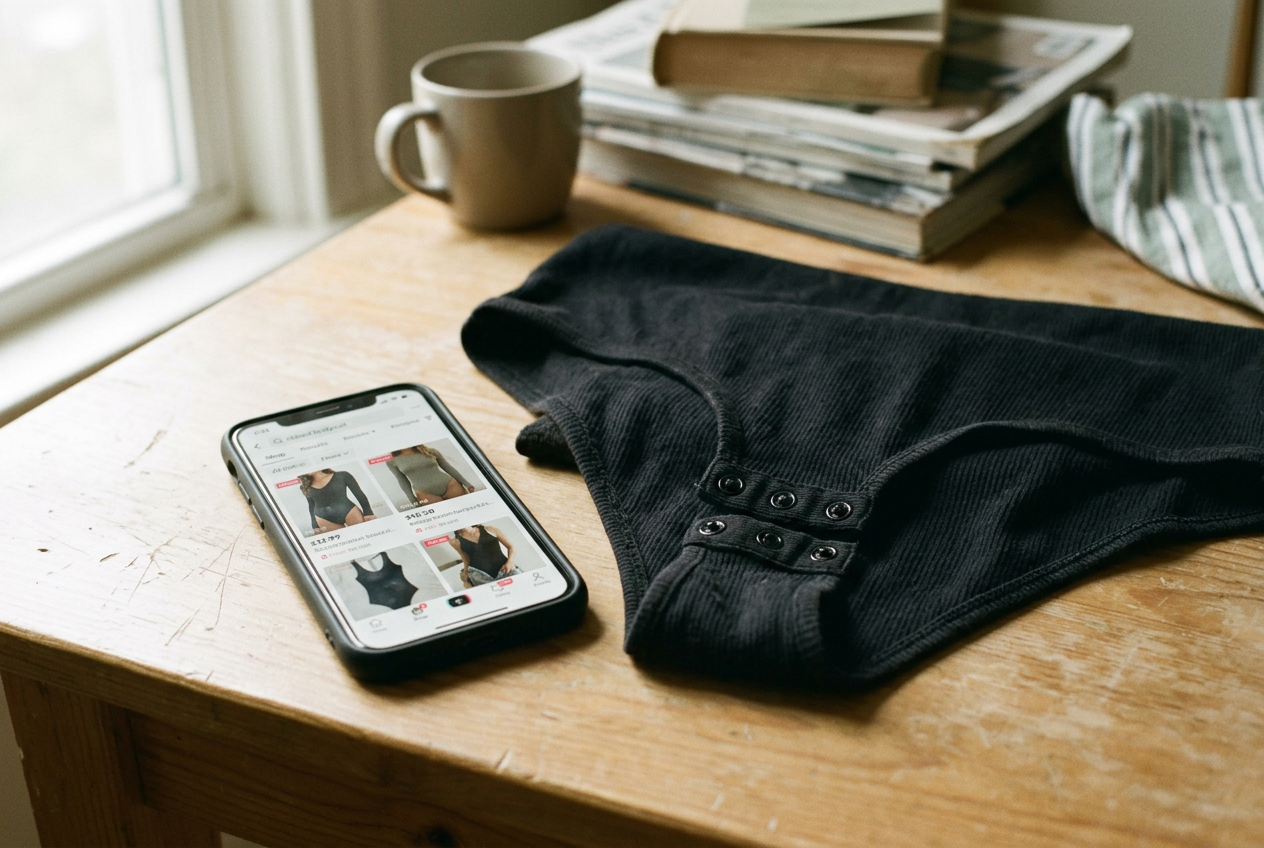
The test case was deliberately ordinary: a black ribbed square-neck bodysuit to wear under high-waisted jeans. The existing one pulled hard at the shoulders after an hour of sitting, while its snap closure pressed into the body rather than lying flat. A replacement needed to answer practical questions about torso length, fabric composition, movement and the closure.
TikTok Shop search produced plenty of confidence. Evidence was harder to find.
That distinction matters because the page looks like a collection of reviews while operating through several commercial systems at once. A sponsored result has paid for placement. An affiliate video can pay its creator when a linked purchase is attributed to them. A seller post moves the seller’s own stock.
Ordinary posts may have no visible sales relationship, although the absence of a label cannot prove independence.
The machinery is clearest when you stop treating the results as one category.
Start with matched searches, not a scroll
A matched search holds most conditions steady while changing one variable. Use the same account, device and session, because personalization can otherwise change alongside the query. Search interfaces vary by account and region, so record the tabs and labels you can see rather than assuming everyone has the same page.
For the bodysuit, I used a plain product phrase first: “black ribbed square neck bodysuit.” The next pass added “review.” The final pass replaced that broad invitation with the actual problem: “black square neck bodysuit long torso.”
The wording shift matters. “Review” asks the platform for a content genre that sellers and affiliates have learned to perform. “Long torso” asks for evidence about fit. The first can reward a fluent sales video whose creator says the garment is flattering; the second gives you a chance of finding someone who shows where the neckline sits, whether the shoulder seams pull and how the snaps behave after the wearer sits down.
For each query, map the first two screenfuls. Record the result’s position, visible label, account type, shop link and whether the post makes a claim you can test from the footage. Do not count enthusiasm as evidence. “So soft” tells you almost nothing unless the creator shows the care label, names the fiber content or compares the fabric with an object already familiar to the viewer.
Repeat the same searches later if you want to test stability. A result that appears once may have caught a temporary ranking signal; a seller or product that keeps returning across small query changes has a stronger claim on the search surface, though still not on product quality.
Follow the payment before the opinion
TikTok does not publish the full weighting behind every search result. That opacity should limit the claim. You cannot look at one screen and reverse-engineer the ranking system.
You can identify the commercial routes built into it.
A sponsored placement enters through advertising spend, commonly through an auction in which advertisers compete for delivery and the platform decides which eligible promotion to show. The exact calculation remains TikTok’s. The useful fact is visible: payment helped the result reach that slot.
Affiliate content runs on a different bargain. An affiliate creator can receive a commission, meaning a share or fixed reward tied to an attributed sale, when someone buys through the attached product link. The video may contain sincere experience. It also has a conversion target.
Those facts coexist, and the second one changes how you should read the first.
TikTok benefits from advertising and commerce activity on its platform. The seller wants the order. The affiliate wants attribution. The shopper supplies the attention, then assumes the risk that a persuasive fit check omitted the one measurement that mattered.
For the black bodysuit, that missing measurement was torso length. Several forms of sales content could show a smooth square neckline while leaving out whether the garment stayed comfortable through sitting, standing and reaching. A clean front-facing shot could not answer the question the old bodysuit had raised.
| Result type | What supports its visibility or payoff | How to read it | |---|---|---| | Sponsored result | Advertiser spending helps secure delivery | Treat every product claim as advertising until independently shown | | Affiliate video | The creator may earn from an attributed purchase | Keep useful demonstrations, discount unsupported praise | | Seller post or product card | The seller benefits directly from the order | Use it for specifications, then verify them elsewhere | | Ordinary post | No visible TikTok Shop tie appears | Potentially useful, but absence of a label is not proof of independence |
Make every review produce evidence
A useful product video should let you write down an observation more precise than “the creator liked it.” For clothing, look for continuous footage of the garment under strain, a readable material label, measurements connected to the wearer’s stated fit and a view of the construction detail most likely to fail.
The bodysuit’s square neckline looked good while nobody moved. The stronger clips were the ones that kept the garment in frame as the wearer raised an arm or sat, because a jump cut between poses can hide the adjustment that followed. If the shoulders were tugged back into place between shots, the final frame was an advertisement for the adjustment, not evidence that the fit held.
Apply the same rule to language. “Double lined” is a construction claim that can be demonstrated by turning an edge or showing the layers. “Snatched” is a desired effect with no stable meaning. “True to size” is weak unless the video gives the garment measurements, the size worn and enough body information to make the comparison useful.
Even then, one body is one data point.
Negative details carry unusual value because they work against the sale. A creator who shows the snap closure twisting, the neckline gaping after movement or the black fabric turning sheer under direct light has supplied evidence that may cost them a conversion. That does not guarantee independence, but it gives the viewer something testable.
Save the useful claim outside the video. Write “closure has two snaps visible in continuous footage,” not “great quality.” The first can be checked against another post or the delivered garment. The second expires as soon as the music stops.
A shop rating belongs to a specific object
The star rating beside a Shop result can refer to a product listing, a seller or another layer of transaction feedback, depending on where it appears in the interface. Tap through and identify what is being rated before letting the number travel farther than its label.
A seller rating can tell you something about order fulfillment or customer experience. It cannot establish that this bodysuit’s shoulder seam will sit correctly. A product rating may combine reviews from buyers who chose different sizes, colors or listing variants, and the most visible comments may focus on shipping rather than wear.
Read the low and middle ratings for repeated, product-specific failures. For the bodysuit, useful complaints would describe a short torso, weak snaps, dye transfer or fabric becoming sheer at the seat. A row of stars without that detail is social proof, meaning a popularity cue that encourages trust because other people appear to have approved. It is not a fit test.
Ordinary posts need checking too
Removing the shop link improves the conditions for independent testimony, but it does not settle the matter. A creator may have received a product, worked with the brand elsewhere or linked it on another platform. TikTok’s visible labels only describe relationships disclosed through the interface in front of you.
Search the product or seller name without opening the Shop tab. Add the failure mode rather than “honest review”: “snap broke,” “see through,” “after washing” or “long torso.” Complaint language often retrieves posts that were not optimized as polished purchase funnels, although disgruntled content can also exaggerate.
Then leave TikTok. Compare the listing’s fiber content and care instructions with the seller’s own site, independent retailer pages where available, and image search results that may reveal the same photos under another seller name. Reused product imagery does not prove dropshipping, but it is a reason to investigate who holds the stock and whether the listing offers any original information.
Give the audit twenty minutes
Spend the first five minutes mapping labels and payment routes. Use the next ten to collect direct evidence about the failure you need to avoid. Reserve the final five for checking the seller, listing images and specifications outside TikTok.
Stop if the product still requires faith. For the black ribbed bodysuit, a video that never showed the snap closure under movement was not worth more scrolling, however convincing the neckline looked in a stationary shot. Search had delivered abundant desire and no answer to the shoulder pull.
Take screenshots of the material claim, size chart and closure before buying, because listings can change and returns consume more time than the original audit. If the delivered garment contradicts those records, keep them with the order information rather than relying on the video remaining available.
Questions people ask
Are all TikTok Shop search results paid ads?
No. The page can include sponsored placements, affiliate videos, seller content and posts without a visible commerce relationship. The categories still sit together inside a shopping-oriented search surface, so identify the label and payment route for each result instead of treating the whole page as either advertising or independent review.
Can an affiliate video still be an honest review?
Yes. Commission does not erase a creator’s experience, but it gives the video a financial interest in conversion. Keep demonstrations you can verify, such as continuous fit footage or a readable care label, while treating broad praise and urgency as sales language rather than product evidence.
Do
TikTok Shop ratings prove that a product is good?
No. First determine whether the rating belongs to the product listing or the seller, then inspect what buyers describe. Ratings can summarize transactions across sizes or variants, while the detail you need may be narrower, such as whether a bodysuit fits a long torso or its snaps stay flat.
How can I find less commercial product posts?
Search the product name outside the Shop surface and add a concrete failure term such as “after washing” or “snap broke.” Then compare claims with external listings and original-looking customer footage. A post without a shop link may be more useful, but it is not automatically independent.
One update a day
Today's story, in your inbox
One story each morning — no hype, no filler, no algorithm deciding for you.