Two Lines on a Fentanyl Strip Do Not Mean the Drug Is Safe
A fentanyl strip reports one target in one prepared sample. Its control line, timing window and cross-reactivity warnings define what the result can support, and what it cannot.
August 11, 2026 · 8 min read
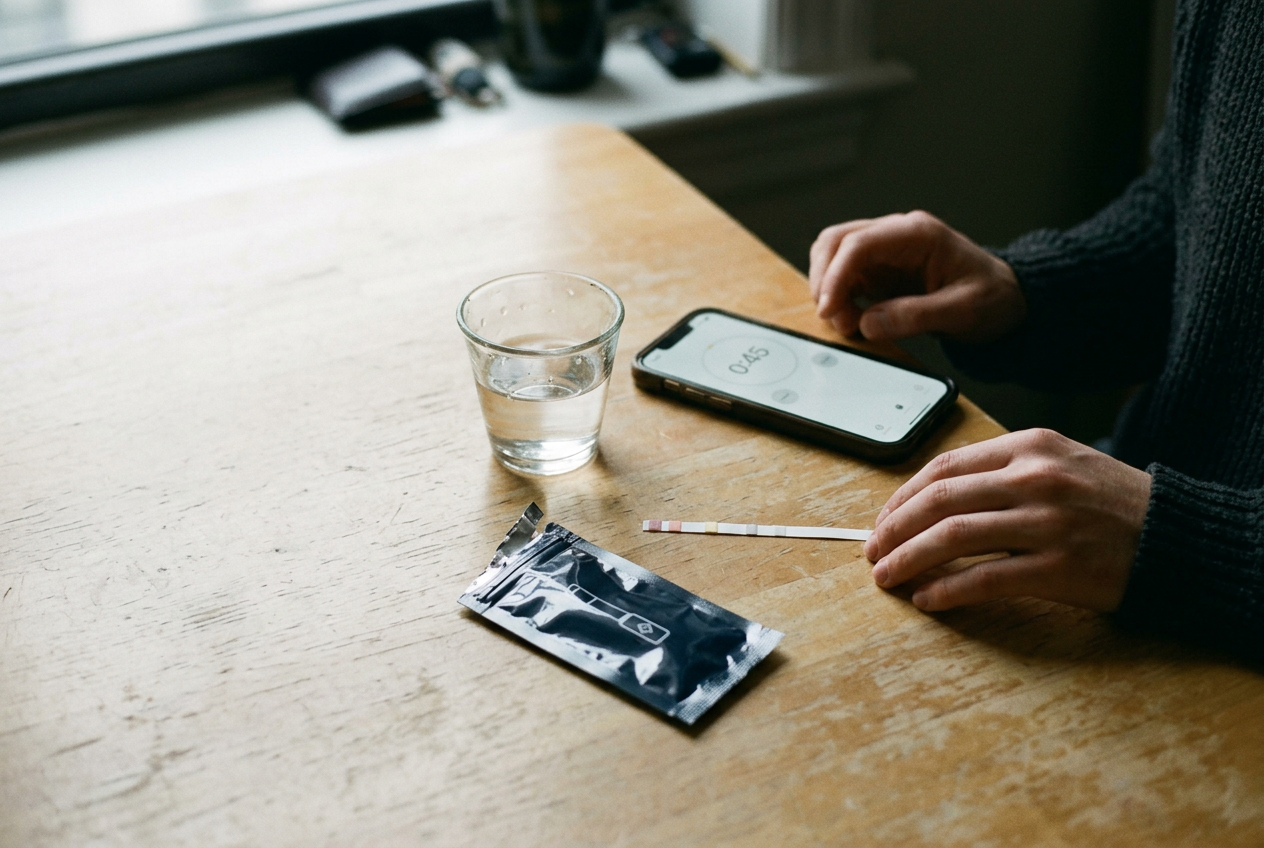
Take one DanceSafe fentanyl test strip from its foil pouch. It is a narrow lateral-flow strip with a wavy end that enters the liquid and a result area where colored lines appear. The object looks almost too basic to misunderstand. Dip, wait, read.
That apparent simplicity is useful in a rushed setting, but it also hides the terms of the result.
The strip can answer only the question built into its chemistry: whether its target was detected above the assay’s threshold in the liquid that reached it. It cannot identify everything in a powder, establish potency, or report on material that never entered the cup. Two lines are not a certificate. They are a limited finding from a prepared sample.
This is reporting based on manufacturer and distributor documentation, not medical advice. Instructions can differ by strip, formulation and packaging, so the current insert supplied with the exact product takes priority over a screenshot, an old social post or somebody’s remembered nightclub tutorial.
Start with the control line
Fentanyl strips commonly use a competitive immunoassay, a test in which fentanyl in the liquid interferes with formation of the test line. That produces the counterintuitive line grammar printed in the instructions: one control line can indicate a positive result, while a control line plus a test line indicates a negative result. A faint test line still counts under the documented interpretation rules.
The control line has one modest job. It shows that enough liquid migrated through the strip and that the test’s internal reagents behaved well enough to produce that line. If the control line does not appear, the test is invalid. A line in the wrong position, including a lone test line without the control, does not become meaningful through optimism.
That control does not verify the person’s dilution, prove that the sampled residue represented the whole bag, or check whether humidity and storage damaged performance in some subtler way. It certainly does not screen for xylazine, nitazenes, benzodiazepines or every fentanyl analog. The little C is quality control for the strip’s run, not quality control for the drug supply.
Return to the DanceSafe strip. Its wavy end and line window impose a sequence: prepare the liquid according to the current substance-specific directions, immerse the correct end for the stated interval, remove it, lay it flat and read it inside the specified window. Skip one of those conditions and the visual result may still look official. Chemistry is unmoved by presentation.
Timing is part of the test
DanceSafe’s published directions for its fentanyl strips tell users to dip the wavy end for 15 seconds, then read the result after the instructed development period, commonly presented as a window of a few minutes. BTNX Rapid Response documentation, seen with many distributed fentanyl strips, specifies its own reading time and warns against interpretation after the stated cutoff. Those directions are not interchangeable just because the strips resemble each other.
Liquid continues to move and the result area continues to develop. Read too early and a faint test line may not yet be visible. Read too late and drying, background color or line changes can create a result the manufacturer never validated. Taking a photograph during the valid window can preserve what appeared then, but a later photo does not extend the assay’s authority.
The practical rule is unglamorous: set a timer from the instructions in the pouch. Do not use the timing from another brand, and do not leave the strip on a bathroom counter until somebody remembers it. A product designed around a narrow reading window cannot support interpretation outside that window, however persuasive the late line looks.
Dilution can bend the answer
Drug checking starts before the strip touches water. The sample must enter a clean container and dissolve in the volume specified for that substance and strip. Testing residue from an empty bag can be useful when that is all that remains, but it answers for the residue dissolved, not every portion previously removed.
Too little water can create cross-reactivity, meaning a non-target substance produces a response that resembles the target response. DanceSafe warns that concentrated samples of substances including methamphetamine, MDMA and diphenhydramine can cause false positives on fentanyl strips, which is why its published dilution guidance changes for some drugs. More powder does not make the test more rigorous. It can push the assay into conditions where another chemical suppresses the test line.
Excessive dilution creates the opposite problem. The target, if present, may fall below the strip’s detection threshold, the concentration at which the assay can reliably flag it. A negative line pattern after arbitrary dilution therefore says less than a negative obtained under the documented ratio. Measuring the sample and water costs time and requires a clean container.
Guessing is faster. It also changes the question.
This is where informal distribution can fail people. A strip may arrive loose, separated from the insert that explains dilution, cross-reactivity and timing, while the recipient gets only the memorable part: one line bad, two lines good. The chemistry is subsidized or handed out; the operating conditions disappear. Institutions can then count strips distributed without knowing whether usable instructions traveled with them.
A negative result has a boundary
Imagine the DanceSafe strip now showing two lines, with the test line pale but visible during the valid reading window. Under the brand’s interpretation guide, that is negative. The correct wording is narrow: fentanyl was not detected above the test’s threshold in that prepared liquid.
It does not follow that the source material contains no fentanyl. Drugs can be unevenly mixed, especially when powders with different particle sizes or densities move through bags and containers. A small scraping can miss a concentrated area. Testing the full amount after dissolving it offers better sample coverage than testing a corner, but it may be impractical when somebody intends to keep the material in dry form, and the strip still cannot report concentration.
Nor does a negative fentanyl result exclude other hazards. Xylazine requires a test designed for xylazine. Nitazenes, a class of potent synthetic opioids, require methods capable of detecting those compounds. A fentanyl strip cannot announce an opioid’s strength, identify an unexpected stimulant, or tell whether two depressants will compound breathing risk.
The absence of its one target is not the presence of safety.
A positive result has limits too. Cross-reactivity may require retesting at the documented dilution, particularly for substances named in the manufacturer or distributor warning. A positive does not quantify how much fentanyl is present, and line darkness is not a dosage meter. The strip is qualitative: it sorts the prepared sample into detected, not detected or invalid under defined conditions.
Keep the precautions the strip cannot replace
A negative strip result should not remove naloxone from the room or turn using alone into a sensible plan. Naloxone can reverse an opioid overdose, though repeat doses and emergency help may be needed. People who use drugs also rely on starting with a small amount, avoiding unplanned drug combinations, taking turns rather than using simultaneously and making sure somebody can recognize slowed or stopped breathing.
Those measures address different failure points. The strip addresses a named target in a sample. Naloxone addresses opioid overdose after it occurs. Social precautions address the delay between losing consciousness and receiving help.
Treating any one layer as total protection defeats the point of layered harm reduction, which assumes that products, supply chains and human decisions all fail.
Keep the used strip long enough to record the result, then follow local disposal guidance. Keep the pouch or photograph its instructions as well. The most valuable artifact is not merely the pair of lines; it is the pair of lines attached to the brand, preparation, timing and substance tested.
The white strip on the table remains useful. It is cheap enough to distribute widely, fast enough to fit into real life and narrow enough to reveal one serious risk that sight, smell and taste cannot reliably identify. Its weakness begins when a program, seller or user asks those two lines to testify about anything else.
Questions people ask
Does a faint second line mean the fentanyl test is negative?
Under the interpretation guides used for common competitive fentanyl strips, any visible test line within the valid reading window counts as negative, even when faint. The control line must also appear. Check the exact brand insert, because a line seen after the cutoff or without a control line is not a valid negative.
Can I test only a small piece of the powder?
You can test a sample according to the strip’s instructions, but the result applies only to the material that reached the liquid. Uneven mixing means a scraping may not represent the rest. Dissolving and testing the full amount improves coverage, though the strip still cannot measure potency or detect every hazardous substance.
Why can methamphetamine or MDMA cause a positive result?
At high concentrations, some non-target drugs can cross-react with the assay and suppress the test line. DanceSafe specifically publishes substance-dependent dilution guidance to reduce this problem. Retesting must follow the current directions for that strip rather than an improvised addition of water.
What should I do after a negative fentanyl test?
Keep the precautions that would matter if the strip missed fentanyl or another opioid were present: have naloxone available, avoid using alone, avoid unplanned combinations and make sure someone can call emergency services. A negative result narrows one uncertainty. It does not settle the contents or safety of the drug.
One update a day
Today's story, in your inbox
One story each morning — no hype, no filler, no algorithm deciding for you.