Your Mobile Concert Ticket Can Report After the Encore
A Ticketmaster SafeTix pass does more than open the gate. It can connect an account, device, purchase and venue scan long after the crowd leaves.
August 15, 2026 · 8 min read
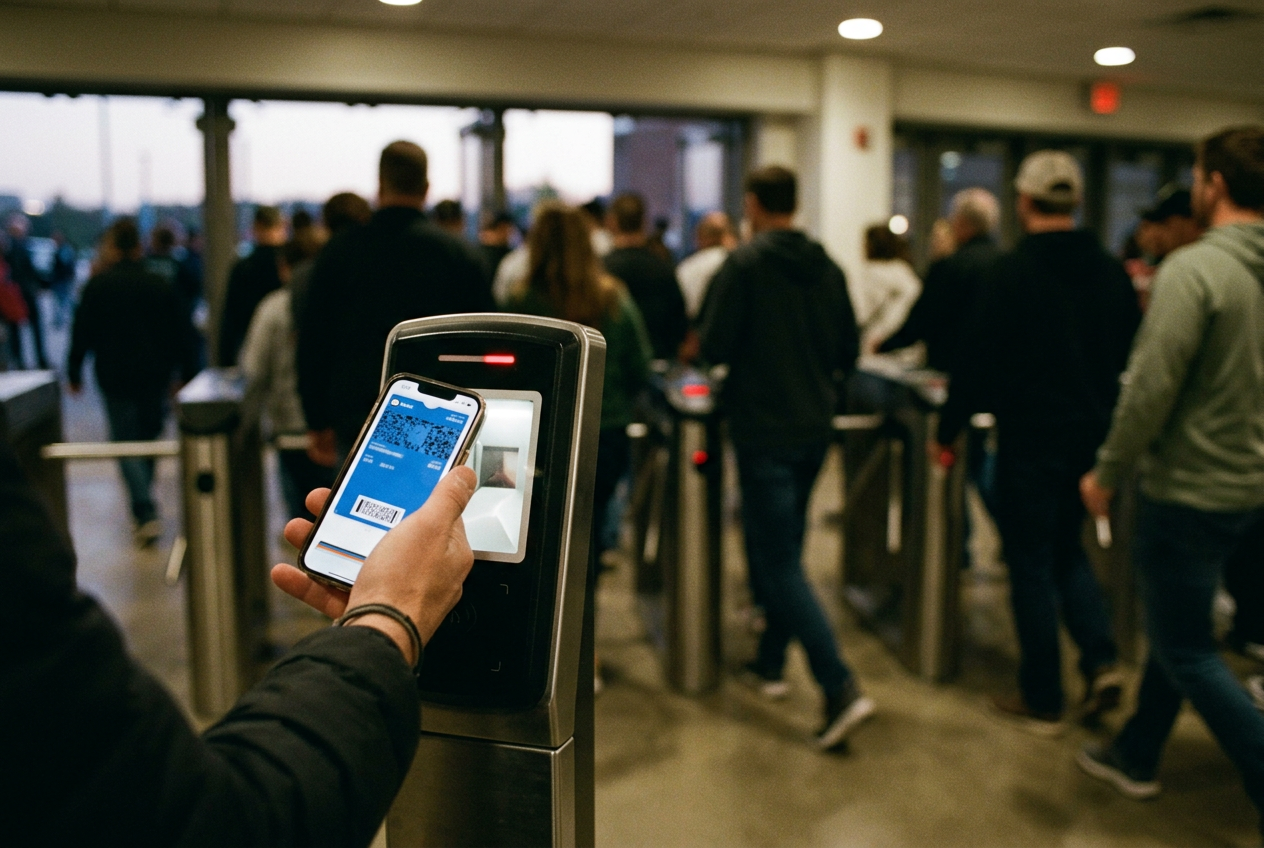
The concrete object is a Ticketmaster SafeTix pass saved to Apple Wallet: blue field, moving barcode, seat assignment, venue name. At the arena gate it appears to perform one job. The scanner accepts it or does not.
That narrow transaction hides the larger system. SafeTix is designed around a token that changes rather than a static barcode that can be copied in a screenshot, and the token resolves against a ticket record held by the platform. By the time it turns green at the gate, the platform may already have an account name, email address, phone number, payment record, transfer history and device information. The scan adds something unusually valuable: evidence that this credential entered this venue at this time.
The ticket has become an identity layer. That does not mean the app records every movement or listens through the microphone. It means ticketing has shifted from possession of a printable object toward authenticated access, where the same account can connect shopping, payment, transfer, admission and later marketing. The system works even when its most invasive permissions are refused.
The barcode is an account credential
A paper ticket could be sold, handed over or lost without the issuer learning much about the person who eventually used it. Mobile ticketing makes that ambiguity harder to preserve.
Ticketmaster describes SafeTix as a security measure. Its changing barcode is meant to reduce duplication and screenshot fraud, while account-based transfer lets the platform revoke one credential and issue another to the recipient. Those controls solve real access problems. They also require the ticketing company to know which credential is valid, which account controls it and whether the scanner has admitted it.
The blue SafeTix tile therefore carries two meanings. To you, it is Section 112, Row G. To the access-control system, it is a live reference to a database record.
Transfer sharpens the point. A forwarded PDF can travel as an attachment. An account-based mobile transfer generally asks the recipient to accept the ticket through an email address or phone-linked flow, often creating or signing into an account before the pass appears. The platform can then connect sender, recipient, event and acceptance status.
A security feature has produced a relationship graph, although the relationship may be no deeper than one friend finding a spare seat.
Ticketmaster’s US privacy disclosures describe collection around account details, purchases, interactions, device information and event-related activity. The wording is broad because Ticketmaster operates inside Live Nation Entertainment’s larger business and works with venues, promoters, teams, artists and service providers. A privacy policy describes what a company reserves the right to do, not proof that every category was collected from every person. Still, it marks the legal perimeter the company has drawn for itself.
Permissions are only one intake
Phone permissions matter, but they are the visible switches in a system with less visible inputs.
If a ticketing app requests location, the operating system can allow precise or approximate coordinates, sometimes only while the app is in use. Location can support nearby-event recommendations, venue guidance, fraud controls or marketing attribution. Contacts may make ticket transfer easier. Camera access can support scanning and account features.
Notifications create a channel for schedule changes, offers and reminders, while a push token, the identifier used to route a notification to one app installation, can persist until it changes or is revoked.
These permissions are conditional. Refuse location and the app does not gain a secret exemption from iOS or Android. Choose limited photo access and the app receives only the selected items. Modern phones also restrict background activity, particularly when an app has not been used recently.
But the SafeTix pass still knows plenty without them. The service receives information you type, transaction details generated by the purchase, IP address and device or browser signals needed to deliver the service. It can record that an account opened a ticket, initiated a transfer or presented a valid token. None of that requires access to contacts, photos or GPS because it happens inside the company’s own service.
This distinction is where permission advice often becomes too comforting. Turning off location limits location collection. It does not make an authenticated ticket anonymous.
Apple’s App Store privacy labels and Google Play’s Data safety forms provide another layer of brand disclosure. Ticketing-app listings have identified categories such as contact information, purchases, identifiers, usage data, location and diagnostics, although the exact declarations can vary by operating system, region and app version. Developers submit these labels themselves. They are useful maps, not independent audits.
The trackers sit beside the ticket
An embedded tracker is outside code, usually supplied through a software development kit, that helps an app measure use, diagnose failures or support advertising. A ticketing company does not need to build every analytics or marketing tool from scratch. It can add a vendor’s code and send events when screens load, buttons are tapped or campaigns produce purchases, subject to the app’s configuration and the phone’s controls.
Ticketmaster’s privacy materials discuss cookies, pixels and related technologies across its digital services, along with analytics and advertising uses. A pixel is a small request that reports an interaction to a server. In an app, similar reporting can occur through an SDK rather than a literal image.
The important division is between cross-company tracking and first-party measurement. Apple’s App Tracking Transparency prompt governs certain attempts to connect app data with activity from other companies for advertising or data-broker purposes. Refusing that prompt can cut off an important identifier and restrict covered tracking. It does not stop Ticketmaster from measuring activity inside its own app, associating that activity with a signed-in account or retaining a transaction needed to operate the ticket.
The account is the more durable identifier anyway. Advertising IDs can be reset, restricted or unavailable. An email address used to buy and accept tickets travels across devices because the user supplies it again. Account linkage lets the service recognize the customer after a phone upgrade, a browser change or a denied tracking request.
The cleanest surveillance system is not always the one with the cleverest sensor. Sometimes it is the login form.
The gate creates the strongest record
At entry, the barcode or contactless credential is checked against access-control infrastructure. Ticketmaster markets Presence as a venue platform for managing digital admission and understanding entry activity. The operational purpose is straightforward: validate the ticket, reject copies, track capacity and help staff resolve problems.
The scan also converts intention into attendance. A purchase says somebody acquired a seat. A transfer says an account received it. A successful gate event says the credential arrived.
That difference matters to promoters and marketers because attendance is stronger than browsing or purchase alone. It can help distinguish the person who bought four tickets from the accounts that accepted the other three, although what a specific venue or organizer receives depends on its contracts, system configuration and privacy role. Ticketmaster’s policies contemplate disclosures among affiliates, event partners and service providers. They do not publish every event-level data flow in a form a ticket holder can inspect from the gate.
There is money in reducing fraud and speeding admission. There is also money in knowing which account attends which category of event, responds to which campaign and returns to which venue. The same record can support customer service, security, audience segmentation and promotion. Those purposes are not interchangeable, but the database does not need to forget one use before another begins.
Terms such as “sale” and “sharing” add more confusion. Under some US state privacy laws, sharing data for targeted advertising can qualify even when nobody buys a neat spreadsheet of ticket holders. A company’s opt-out link may therefore cover advertising transfers that do not resemble an ordinary cash sale. The legal label follows the statute, not the user’s likely reading of the word.
The pass can outlive the performance
Saving the blue SafeTix tile to Apple Wallet may reduce the need to reopen the Ticketmaster app at the gate. It does not turn the pass into paper.
Apple’s PassKit documentation allows a pass issuer to register a pass for updates. The issuer can use a push channel to tell the wallet that updated pass data is available, which is how a time, gate or event detail can change without printing a new ticket. This registration is not continuous GPS access. Apple also instructs issuers not to treat the device library identifier used for pass updates as a general device-tracking identifier.
After the show, several records can remain even if the visible pass expires: the order, account, transfer chain, support history and admission result. Opening a follow-up email or returning to the app can produce fresh interaction data. Marketing suppression, fraud prevention, tax, accounting and legal obligations may also mean that an account-deletion request does not erase every record immediately.
The practical controls are fragmented because the collection is fragmented. Phone settings govern permissions and certain tracking. The app controls notification preferences. The company’s privacy page may offer advertising opt-outs or state-law requests.
Using the mobile website instead of installing an app can remove app permissions and SDK access, but browser cookies and account records remain. A wallet pass can spare an app opening, yet the credential still resolves to the ticketing system.
Paper pickup or a box-office alternative may exist, though mobile-only rules, identity checks and queues can make it costly in time or unavailable. That friction is part of the design. The privacy-preserving option is weakest when the gate treats a charged phone and a platform account as the normal form of a ticket.
Once the doors close, removing the expired SafeTix pass clears the blue tile from your wallet. It does not clear the scanner’s result.
Questions people ask
Can a concert ticket track my location after the show?
The ticket itself is not a continuous GPS beacon. A ticketing app can receive location when you grant the relevant permission and the operating system allows access, while an account can still retain purchases, transfers and admission records without location permission. A Wallet pass may receive issuer updates, which is different from reporting continuous coordinates.
Does denying app tracking stop Ticketmaster from collecting data?
It can restrict covered cross-company advertising tracking, particularly on iOS, but it does not block first-party records created inside the service. Ticketmaster can still associate purchases, app actions, transfers and ticket scans with a signed-in account when those records are needed or permitted under its policies.
Is
Apple Wallet more private than the ticketing app?
It can reduce exposure because you may avoid opening the full app at the venue and need not grant the app extra permissions. The pass still contains an issuer-controlled credential, can register for updates and remains connected to the ticketing backend when it is validated.
What remains after I delete an expired mobile ticket?
Removing the pass deletes the copy displayed in your wallet, not the platform’s underlying business records. The ticketing company, venue or event partner may retain the order, transfer history and admission result under its policies, contracts and legal obligations, subject to applicable privacy rights.
One update a day
Today's story, in your inbox
One story each morning — no hype, no filler, no algorithm deciding for you.