YouTube Auto-Dubbing Makes the Creator Sound More Certain
YouTube’s automatic voices can carry one video across languages. They also turn pauses, emphasis and uncertainty into decisions made by platform infrastructure.
August 24, 2026 · 8 min read
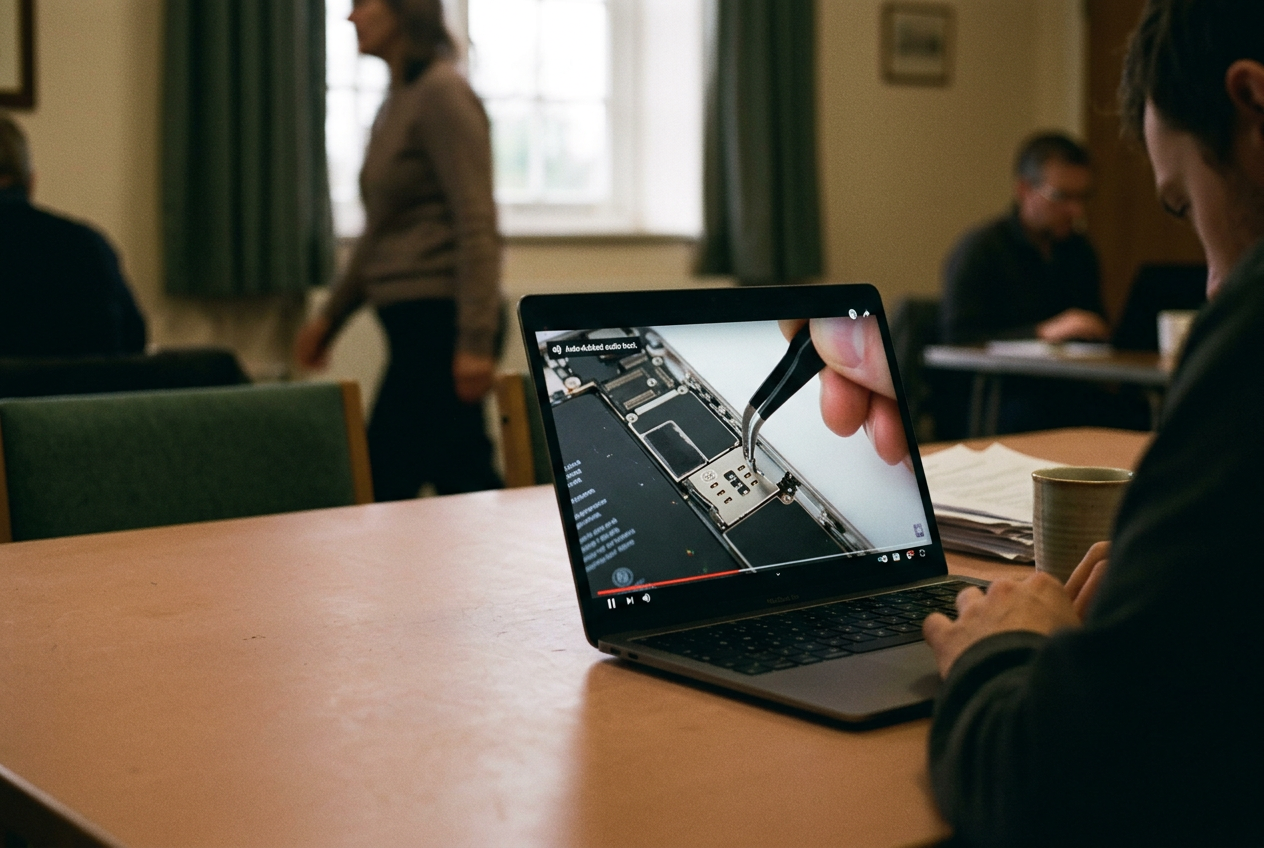
The revealing moment in the repair video was a screw beside the camera bracket.
In the original English track, the creator slowed down before touching it. His voice dropped, there was a short pause, and the warning sounded provisional: this part had resisted him before, but he was deciding how much force to use now. Switch the same video to its automatically generated Spanish track and the sequence still made literal sense. The synthetic speaker finished the thought earlier, covered part of the pause and delivered the warning at one steady level.
Nothing was mistranslated badly enough to produce a comic screenshot. That is the more useful finding. YouTube auto-dubbing works well enough to move attention away from obvious error and toward a quieter intervention: the platform is now interpreting the person, not merely carrying the person’s words.
I compared the original and automatically dubbed tracks on eligible instructional and commentary videos by switching audio languages inside the same YouTube player, replaying short passages around cuts, names, hesitations and changes in volume. This was a hands-on evaluation, not a linguistic benchmark. The camera-bracket screw became the anchor because the information survived while the speaker’s relationship to it changed.
A dub is a chain of guesses
Automatic dubbing starts with speech recognition, software that turns recorded speech into text. That transcript is translated, passed to a text-to-speech system that generates a new voice, then fitted back against the video’s running time. Each stage can preserve the broad proposition while shaving away evidence about how the proposition was formed.
A pause may mean the creator is reaching for a tool, waiting for a visual reveal, reconsidering a claim or giving the viewer time to register risk. The system sees available duration. A lowered voice might signal caution, embarrassment or a joke aimed at regular viewers. The generated voice has to select an intelligible delivery from evidence that does not travel neatly through a transcript.
This is why timing matters beyond lip sync. A tutorial is edited around hands, cuts and consequences. In the repair video, the original warning ends close to the moment the screwdriver meets the camera-bracket screw. The dubbed warning ends sooner, leaving the synthetic voice briefly calm and complete while the creator’s hands are still negotiating the difficult part.
The viewer receives the same instruction with a different confidence level.
That difference is easy to dismiss as polish. It is interpretation.
Human dubbing has always involved interpretation too. Translators choose words, actors choose emphasis and directors decide which mismatch matters. The difference here is institutional. YouTube can apply similar choices across a large catalog, distribute them through the existing player and make the result available without building a separate production around each language.
The judgment becomes repeatable infrastructure, while responsibility stays diffuse.
Fluency hides the edit
The roughest automatic dubs announce themselves. Names break apart. Acronyms become words. A sentence overruns a cut and continues while the speaker on screen has stopped moving.
Those failures are visible, and creators can catch them if they have the language knowledge and time to review each track.
The stronger dubs deserve more scrutiny because fluency encourages trust. In the videos I checked, ordinary explanatory passages were often easy to follow. Problems clustered around proper names, product terms, clipped interjections and phrases whose meaning depended on how they were said. The system could retain a name yet shift its stress, or preserve a technical term while making it sound like part of the surrounding sentence rather than an object the creator had deliberately singled out.
Names expose the limits quickly. A transcript can treat an unfamiliar person, model number or channel name as a probable sequence of common sounds. Translation may leave the term untouched, but the generated voice still needs to pronounce it, and that pronunciation becomes the version repeated to viewers who may never hear the original. A creator can correct some errors through YouTube’s controls, where available, but correction is labor.
It also requires knowing that an error exists in a language the creator may not speak.
Tone is harder to audit than a misspelled name. The original speaker in the repair video did not sound neutral around the camera-bracket screw. He sounded wary. The dub communicated danger through vocabulary, yet its delivery was smoother than the action on screen.
No dashboard can flag that as plainly as it can flag a broken transcript, because the sentence remains usable.
Platforms tend to optimize what they can detect. Legibility wins.
Disclosure exists at the edge of attention
YouTube does disclose automatic dubbing. In the tested player, the audio-track controls identified generated language tracks as auto-dubbed, and the video interface offered a route back to the original. That is better than presenting the voice as untouched.
The disclosure still lives in settings, exactly where many viewers have no reason to look. If YouTube selects a track according to language preferences or viewing context, the first voice a person hears may be synthetic. The label explains the production method only after the system has already made the listening decision.
This matters because the screen keeps supplying the creator’s face, gestures and edits. The generated speech attaches itself to that body. Viewers are not watching a freestanding translation with a visible performer; they are watching a familiar person apparently speak in a voice whose pacing and emotional resolution were produced elsewhere. The original creator authorized or tolerated the feature at channel level, but authorization does not make each vocal choice theirs.
The label also frames the issue as provenance: this track was made automatically. It says less about authorship. A more meaningful disclosure would remain visible when an auto-dubbed track is active, especially at the start of playback, and would make returning to the original as easy as switching captions. YouTube already knows which track it served.
Making that fact conspicuous would cost screen space, not a technical breakthrough.
Reach without another upload
For creators, the appeal is direct. Conventional dubbing requires translation, recording, review, file management and coordination across languages. Separate channels or reuploaded versions can divide comments, analytics and subscriber attention. An additional audio track keeps the translated audience on the same video, where views and advertising can accumulate around one asset.
YouTube benefits from the same consolidation. A video that becomes understandable to more viewers has more opportunities to hold attention and serve ads, while the platform avoids relying on every creator to fund a multilingual production operation. Recommendation systems, software that ranks which videos appear to each viewer, gain more material that can plausibly cross a language boundary. Auto-dubbing does not guarantee distribution, but it removes one reason a recommended video would be unusable after the click.
The bargain is reach in exchange for delegated performance. YouTube pays the computational cost of generating tracks. Creators absorb the review burden, the reputational risk and the awkward fact that quality control expands with every supported language. A large channel may have staff or multilingual viewers who report problems.
A smaller creator can either trust the output or spend time checking work that was published to extend the platform’s inventory as much as their own audience.
That imbalance explains why the feature works even when it is imperfect. The dub does not need to reproduce the person fully. It needs to make the video understandable enough that a viewer does not leave.
The person becomes a setting
The camera-bracket screw stayed in the same place through every track. The creator did not.
In English, his pause belonged to the performance and to the practical risk unfolding under his hands. In the generated track, that hesitation became spare time to be compressed or filled. The platform preserved the tutorial’s utility while regularizing the person who made it, producing a speaker who was cleaner, steadier and less contingent than the one recorded in the room.
Creators have always been reshaped by platform systems. Thumbnails reward certain expressions. Retention graphs turn introductions into liabilities. Search favors familiar phrasing.
Auto-dubbing moves that pressure inside the voice itself, after filming, with no need for the creator to change how they speak. Interpretation is performed downstream and delivered as playback.
The alternative is not to reject dubbing. Creators should be able to reach people outside their first language without building a small localization company. The reasonable demand is narrower: prominent track disclosure, stronger controls over publication, editable pronunciation for names and a review system that distinguishes an unchecked generated track from one approved by someone competent in that language.
Until then, the small gray auto-dubbed label carries more weight than its placement suggests. It marks the point where YouTube stopped transporting a performance and began supplying part of it.
Questions people ask
How does YouTube auto-dubbing work?
YouTube transcribes a video’s speech, translates the resulting text, generates speech in another language and fits that audio to the existing timeline. The chain can preserve the main information while changing pauses, pronunciation and emphasis, particularly when the original delivery depends on jokes, uncertainty or action happening on screen.
Can creators review or turn off automatic dubs?
Eligible creators may receive controls for managing automatic dubbing, including reviewing tracks or preventing publication, although available options can vary by channel and rollout. Meaningful review takes time and language knowledge. A creator who cannot understand a generated track must rely on another person, viewer reports or the platform that produced it.
Does
YouTube clearly label auto-dubbed voices?
The player can identify an automatically generated track in its audio settings, and viewers can switch back to the original language. That disclosure is easy to miss because it sits outside the main viewing frame. A persistent indicator would better reflect that the voice attached to the creator’s face was generated by YouTube.
Who benefits financially from auto-dubbing?
Creators can reach additional viewers without commissioning a separate dubbed upload, keeping attention and potential ad revenue on one video. YouTube gains more watchable inventory across language boundaries and more chances to retain viewers. The platform covers generation, while creators carry much of the checking, correction and reputational cost.
One update a day
Today's story, in your inbox
One story each morning — no hype, no filler, no algorithm deciding for you.