A License Plate Alert Becomes Police Evidence Fast
An automated plate match starts as a machine-generated lead. A few routine choices can turn it into a traffic stop, a warrant affidavit and evidence the defense must fight to obtain.
August 11, 2026 · 8 min read
In Commonwealth v. McCarthy, a Massachusetts drug investigation absorbed a set of 30 records showing David McCarthy’s vehicle crossing the two road bridges connecting Cape Cod to the mainland. Each read was small and mundane: a plate number, an image, a location and a time generated when a camera photographed passing traffic.
Those 30 reads matter because they show the system’s practical power. An automated license plate reader, or ALPR, does not need to produce a cinematic tracking map to influence a prosecution. It needs to produce a record that an officer can summarize in an investigative report, place beside other allegations and carry into a warrant application. Once that happens, the plate read stops looking like a machine’s probabilistic observation and starts looking like police knowledge.
That conversion is the mechanism. The camera supplies the lead. Police paperwork gives it authority.
The alert is a comparison, not a finding
An ALPR camera photographs vehicles and uses optical character recognition, software that converts an image of text into searchable characters, to estimate the plate number. The system stores some combination of the plate string, photographs, time, location and camera identifier. It may also record confidence scores or alternate readings, although what an officer sees depends on the product and agency settings.
A live system compares the estimated number against a hot list, a database of plates associated with stolen vehicles, warrants, registration problems or other law-enforcement interests. A match produces an alert. That alert does not establish who is driving, whether the database entry remains current or whether the software read the plate correctly.
Public ALPR policies commonly tell officers to verify a hit before acting. Verification can mean looking at the plate with human eyes, checking the alert against a current government database and confirming that the make or model matches the wanted vehicle. Those steps matter. Similar characters can be confused, plates can be transferred, database entries can lag and a registered owner may be nowhere near the car.
The binding force varies. A department policy usually governs employees, but violating it does not automatically make evidence inadmissible. A state statute can impose enforceable collection or access rules. A state supreme court’s interpretation binds courts below it within that state.
Vendor training material is not law, however official it looks in a procurement file.
In State v. Donis, the New Jersey Supreme Court examined stops triggered by mobile plate readers and allowed comparison against narrowly defined law-enforcement databases, while requiring officers to confirm an alert before making a stop. That ruling binds New Jersey courts under the state constitution. It does not create a national rule, and it does not turn every confirmed hit into proof of a crime.
A stop gives the machine a human narrator
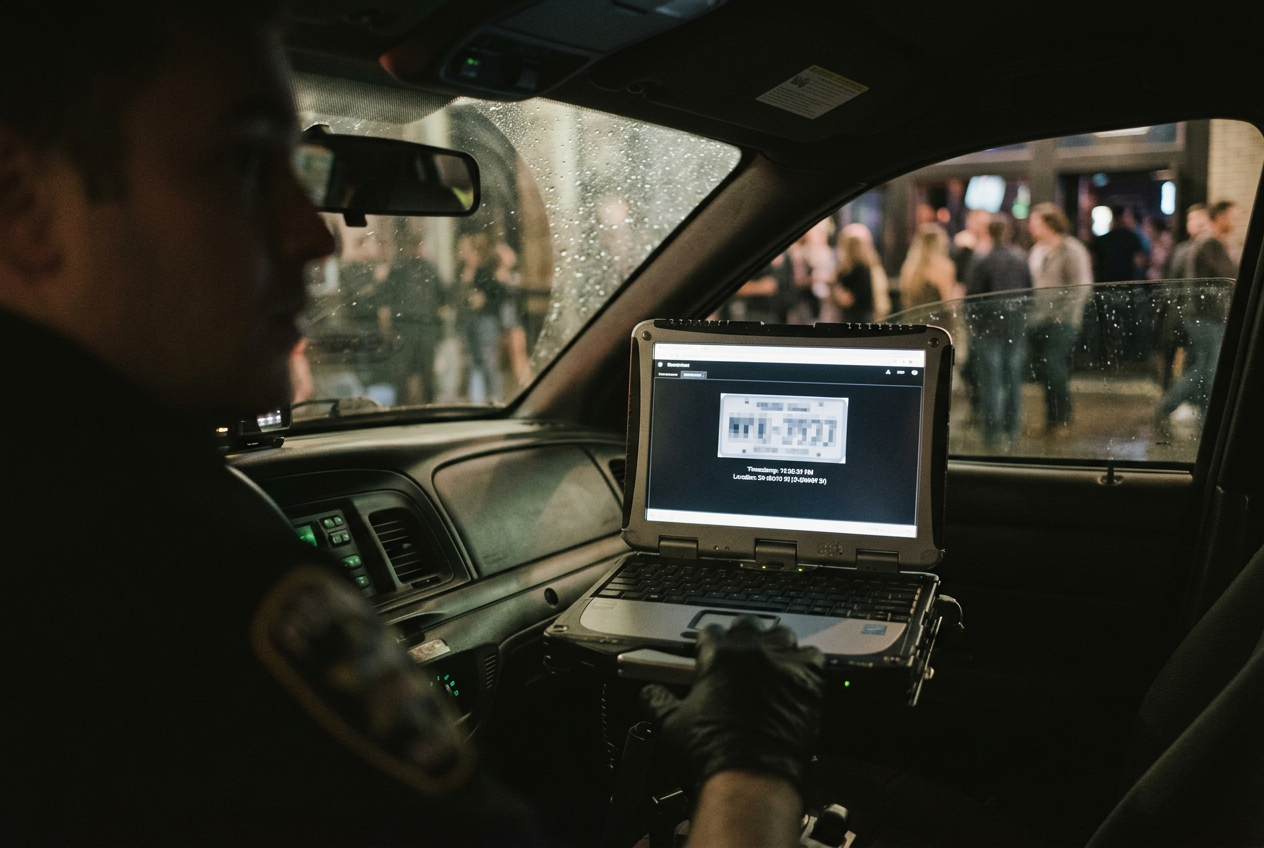
A plate alert reaches a criminal case most cleanly through an officer’s report. The officer records where the alert appeared, what database produced it, how the plate was checked and what happened next. If the officer sees the plate and confirms a current stolen-vehicle entry, the stop may rest on that confirmed information rather than on the camera output alone.
The distinction gets blurred fast. Reports often compress a chain of software and database operations into a sentence saying that an ALPR identified a wanted vehicle. That phrasing drops the uncertainty from the plate-reading software, the source and age of the hot-list entry, and the officer’s verification work. It also gives the machine an active verb.
The ALPR “identified” the car. Case closed, at least grammatically.
A stop can then generate evidence with a life separate from the original alert. An officer may see contraband, receive a statement, discover an outstanding warrant or develop grounds for a search. Prosecutors can argue that those later observations support the arrest even if the ALPR data carried errors. Defense lawyers may respond that the stop lacked reasonable suspicion, meaning specific facts indicating that crime or another lawful basis for detention existed when police activated their lights.
Courts usually examine the information officers had at that moment. The agency’s after-the-fact confidence in its vendor does not repair a hit that was never confirmed. Nor does finding evidence later retroactively justify the stop.
The 30 bridge reads in McCarthy entered at another point. Investigators searched historical data rather than waiting for a live alert, using the records to reconstruct travel over several months. The Massachusetts Supreme Judicial Court ruled that this limited collection did not violate the state constitution on the facts before it, while warning that a denser ALPR network could reveal enough movement to become a constitutional search. That warning is important, but it is not a nationwide ban on warrantless plate tracking.
The warrant affidavit launders the interface
When police seek a search warrant, an officer submits an affidavit laying out facts meant to establish probable cause, a fair probability that evidence of a crime will be found in the place to be searched. Judges generally read the affidavit, not the vendor interface, raw image set or confidence-score history behind it.
An ALPR record can enter as one corroborating fact. The affidavit may say a suspect’s vehicle traveled through a location, appeared near an address or followed a pattern consistent with the investigation. Alongside surveillance, informant information and records from other databases, a weak plate read can look stronger because it sits inside a larger narrative.
This is where McCarthy’s 30 bridge crossings do their institutional work. A row of camera records becomes evidence of travel; the officer selects the relevant dates and describes their significance; the warrant judge receives the description in a sworn document. The software’s limits remain offstage unless the affidavit includes them or the judge asks.
Police cannot knowingly or recklessly put material falsehoods in a warrant affidavit. Under Franks v. Delaware, a defendant can sometimes obtain a hearing to challenge such statements or omissions, but the threshold is demanding: the defense needs a substantial preliminary showing, often before it has received every technical record needed to understand the ALPR hit. The paperwork arrives with a presumption of regularity.
The underlying system arrives later, if at all.
That asymmetry works for vendors and agencies. Cities and counties buy cameras, data access and network subscriptions through local budgets, grants or shared contracts. A subscription can let one department search reads collected by other participating agencies, turning scattered cameras into a regional archive without requiring a single government to build the whole thing. The public pays for collection.
Defendants then spend time and legal resources trying to reconstruct what the purchased system did in their case.
Discovery is where the clean story can come apart
Criminal discovery is the exchange of case information between prosecution and defense under court rules, statutes and constitutional duties. An ALPR-related production may include the alert, photographs, database return, officer report and material used in a warrant application. It may also need to include evidence favorable to the accused under Brady v. Maryland, including information that materially undermines the reliability of the government’s account.
The difficult records sit one layer deeper: audit logs showing who searched the system, alternate plate candidates, confidence information, retention history, hot-list updates, user notes and records of how an alert was confirmed. Prosecutors may not have gathered those materials because police did not place them in the ordinary case file. Agencies may say the vendor controls them. Vendors may point back to contract terms or retention settings.
None of that makes the information categorically undiscoverable. It does make obtaining it slower. A defense lawyer may need a targeted request, a subpoena or a court order, while explaining why technical records matter to a stop that the police report presents as routine. Discovery rules differ by jurisdiction, and courts do not agree on how far the prosecution must search across police systems or third-party platforms.
At trial, the government still must connect the record to the case. Authentication means showing that an item is what its proponent claims it is. A witness might explain the camera system, identify the record or describe how the agency stores and retrieves reads. Hearsay objections can arise when a party offers an out-of-court statement for its truth, though machine-generated data and attached human database entries may receive different treatment depending on the jurisdiction and purpose.
The plate image remains the useful anchor. If it is clear, properly timed and tied to a documented camera, it may support the officer’s account. If the image does not match the reported characters, the camera location is uncertain or the hot-list record was stale, the same image can expose what the report compressed.
ALPR evidence gains force by becoming boring. A proprietary system generates a line of data; an officer turns that line into a sentence; another officer repeats the sentence in an affidavit; the prosecutor receives the affidavit as part of the file. By the time the defense asks for the 30 underlying reads, the summary has already traveled farther than the records supporting it.
Questions people ask
Can police stop a car based only on an ALPR alert?
The answer depends on the jurisdiction and the alert’s basis. Many public policies require officers to visually check the plate and confirm the hot-list entry before stopping the vehicle. A confirmed stolen-car hit can support a stop, while an unchecked or visibly incorrect read is much harder to defend.
Do police need a warrant to search historical plate-reader data?
There is no single nationwide rule covering every ALPR search. Courts consider the number of records, tracking period, camera coverage and applicable state constitutional protections. McCarthy allowed a limited historical search in Massachusetts but warned that a broader network could expose enough movement to require stronger constitutional protection.
Must prosecutors disclose the raw ALPR records?
Potentially relevant images, alerts and reports generally belong in discovery, especially when they support the stop or warrant. Audit logs, confidence data and vendor-held records can require specific requests or litigation because they may not appear in the prosecutor’s standard file. The exact obligation depends on local rules and who controls the data.
Is an
ALPR match proof that a person was driving?
No. A plate read links a camera observation to a vehicle registration number, subject to reading and database errors. It does not identify the driver by itself. Police need other evidence to connect a particular person to the vehicle at the recorded time.
One update a day
Today's story, in your inbox
One story each morning — no hype, no filler, no algorithm deciding for you.