A New Jersey Capacity Sign Decides What the Club Can Book
The number beside the exit is more than a safety limit. It sets the ticket ceiling, bar target, bathroom pressure and practical size of every artist who enters the room.
September 5, 2026 · 8 min read
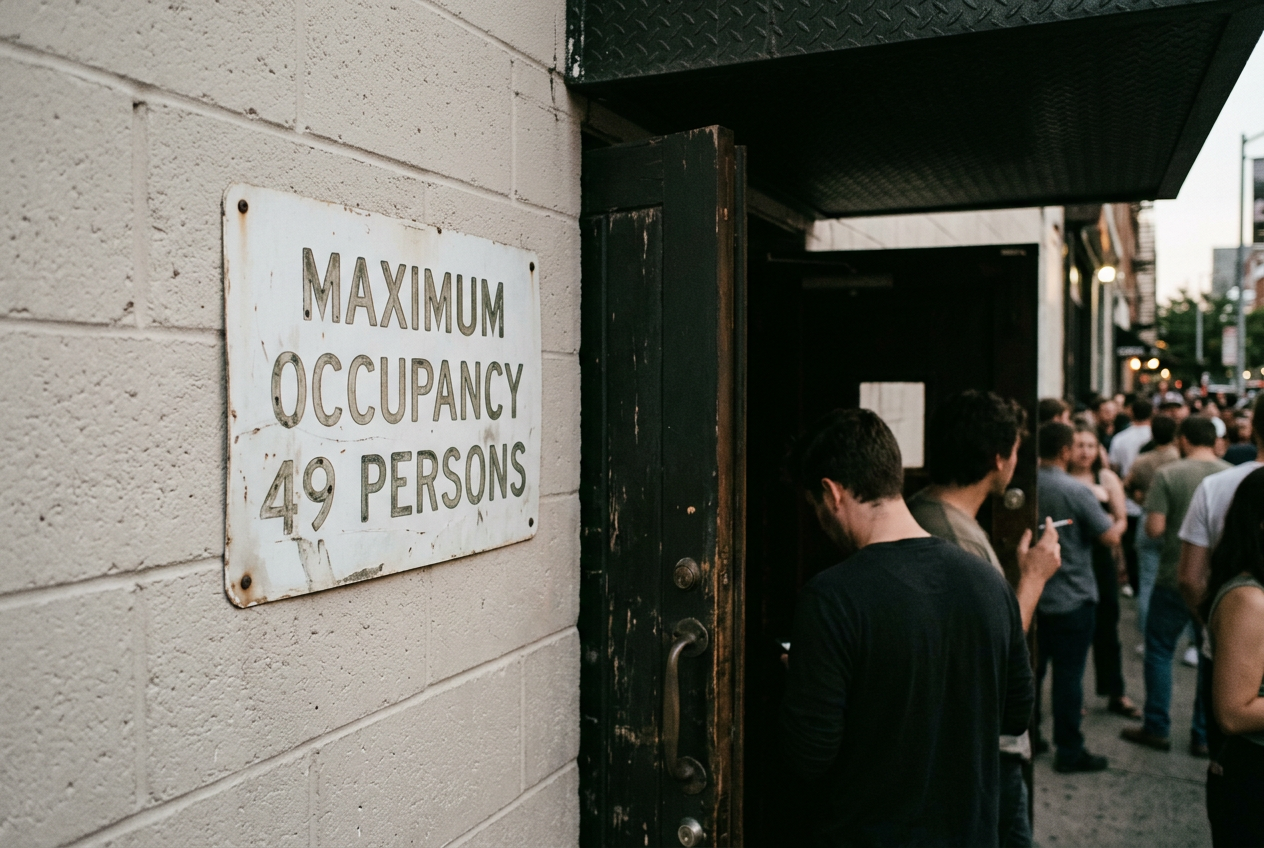
Take a hypothetical New Jersey room with a white metal placard screwed into the cinder block beside its entrance: MAXIMUM OCCUPANCY 49 PERSONS. The number is small enough to feel intimate and large enough to create a line outside. It also looks official in the least glamorous way possible, like something delivered with a boiler inspection.
Forty-nine is useful here because it makes the subtraction visible, not because every venue has that limit. The bartender counts. So do the door worker, sound engineer, performers, photographer, promoter and friends who have somehow become essential to the evening. Depending on the approved use and layout, the placard may cover everyone inside, not merely the people who bought tickets.
A capacity crowd and a full ticket allocation are different quantities.
The sign presents itself as a safety ceiling. For the operator, it is also the largest possible sales funnel. Every plan for the night begins there and works backward.
The sign is the revenue ceiling
New Jersey regulates buildings through statewide construction and fire codes administered by public officials, with provisions drawn partly from nationally used model codes. The occupant load, meaning the number of people a space is designed or approved to hold, reflects what the room is used for, its floor area, its exits and other life-safety conditions. A room with fixed seats is treated differently from open standing floor. Moving the folding chairs into a closet does not authorize the owner to print more tickets.
The means of egress, the continuous route people use to reach safety, matters because a crowd must be able to leave under bad conditions rather than ideal ones. Exit count, door arrangement and travel distance can limit a room before its raw square footage does. Fire protection systems and an approved certificate of occupancy, the document establishing a building’s lawful use, sit elsewhere in the same machinery. The number on the wall is the compressed result.
Then nightlife does its own calculation. Start with the posted limit. Remove workers, artists, complimentary entries and guest-list obligations. What remains is the paid inventory, although even that inventory may be held back to prevent an oversell or accommodate production needs.
Multiply those admissions by the ticket price and the venue has its gross ticket potential before ticketing charges, taxes, artist compensation, labor, insurance, sound, security and the other expenses that arrive whether the room feels magical or resembles a damp basement with a speaker in it.
This is why a sold-out show can still lose money. Sellout describes demand against a legal ceiling. It says nothing about whether the ceiling is high enough to support the bill.
The room inside the number
The 49-person placard makes ticket pricing look like a cultural choice when it is often a constrained arithmetic problem. If the artist’s guarantee, which is the minimum fee promised for the performance, rises while legal capacity stays fixed, the promoter can charge more, reduce other costs, negotiate a door split or decline the show. A door split pays the artist an agreed share of ticket receipts, usually after specified deductions, and transfers more attendance risk onto the performer.
There are softer evasions. Book a local opener expected to bring friends. Cut the guest list. Run two performances.
Ask the artist to accept less because the room is good for the scene, a sentence that tends to become less persuasive around rent day. None changes what the wall permits at one time.
A second show can increase total admissions, but it also asks artists and workers to repeat the labor while the venue resets the room, clears the first audience and risks selling two partly full houses instead of one full one. The plan works best for acts with enough demand, flexible production and an audience willing to arrive at an inconvenient hour. A touring band carrying gear, supporting crew and a tightly routed schedule may find the experiment less charming.
Capacity therefore selects for certain kinds of performance before taste enters the conversation. Small packages, low production requirements and artists willing to gamble on the door fit more easily. An act whose fee has graduated beyond the room’s maximum ticket gross cannot be booked through enthusiasm alone. The venue needs higher prices, bar subsidy, outside funding or a performer accepting below-market pay.
The bar is asked to rescue the ticket
Independent rooms often depend on drinks because ticket revenue may pass substantially to the artist or promoter while the venue keeps more of the bar sale. That makes the occupancy sign a bar forecast too. Each person admitted represents only so many possible trips to the counter during a set, and an all-ages audience, a short program or a bill that keeps people pinned near the stage changes the expected spend.
The bar target then leaks into the room. Show times drift later so people stay longer. A cheap ticket can function as customer acquisition for alcohol. The operator favors nights whose crowd is thought likely to drink, while genres with younger audiences or lower bar spending have to prove themselves through ticket volume that a 49-person room cannot manufacture.
This does not mean every venue runs a crude drinks-per-head spreadsheet after closing. It means the underlying incentive remains even when nobody opens a spreadsheet. If ticket income cannot cover the artist and production, the bar is expected to close the gap; when it does not, the supposedly successful packed night becomes evidence against booking a similar show again.
The people paying are not abstract. The audience sees a higher ticket price or a stronger push toward drinks. Artists see smaller guarantees. Staff see leaner shifts.
Promoters carry the loss when the evening lands below the narrow line between full enough and legally too full.
Bathrooms collect the pressure
The same approved occupancy that produces ticket inventory also puts bodies into the bathroom queue. Plumbing codes use fixture requirements tied to occupancy and use when buildings are designed, altered or reviewed, although what a particular existing building must provide depends on its approvals and history. The legal details vary. The human result is easier to observe.
At the 49-person room, one slow toilet can reorganize the night. People miss part of a set, abandon a drink order to keep their place or leave between artists rather than face the line again. Staff must monitor a corridor that was not intended as a holding area. Anyone who needs more time, privacy or an accessible route pays a greater share of the inconvenience.
Bathroom capacity is not interchangeable with fire capacity. A room does not become safe merely because the restroom queue is tolerable, and adding a toilet does not automatically permit more occupants. Yet the systems meet in the customer’s body: the code admits a defined crowd, the bar tries to sell to that crowd, and the building asks everyone to process the evening through facilities whose limits become obvious only after the ticket money is gone.
The placard stays dry beside the door. The line does the explaining.
Capacity curates the scene
A legal limit looks neutral because it does not name genres. Its economic effects are selective. The room can support an experimental bill with modest fees, a DJ night requiring limited stage production or a local lineup whose members absorb promotional labor. It struggles with a touring act whose audience is larger than the room but smaller than the next available venue, especially when that larger venue costs much more to rent and staff.
That gap matters. Artists do not move through a smooth ladder of increasingly spacious rooms. They encounter missing rungs, territorial booking arrangements, venue closures and buildings whose lawful uses were settled long before the current scene arrived. Once an act outgrows the 49-person sign, it may skip the neighborhood, take a worse deal in a larger room or play somewhere improvised where safety and accessibility are less secure.
Operators feel the same squeeze from the other side. Raising the legal capacity may require professional plans, construction work, different exits, upgraded systems, more plumbing or a formal change in the building’s approved use. The exact requirements depend on the property. The expense often improves an asset owned by somebody else, which is a poor incentive for a tenant surviving on short leases and volatile nights.
So the venue keeps the sign. Prices edge upward. Bills get stacked with more acts expected to bring their own small constituencies, which can turn a show into several overlapping guest lists with amplifiers. The underground remains alive, but it spends an odd amount of energy negotiating with one piece of white metal.
The number belongs to safety
Overcrowding is not a clever revenue strategy. It narrows exit access, complicates evacuation and shifts risk onto patrons and workers who did not agree to become spare building capacity. Treating enforcement as an enemy of culture misses why occupancy rules exist, particularly in nightlife, where low light, loud sound, unfamiliar layouts and alcohol can make an emergency harder to read.
The real conflict is that a public-safety number also decides private economic viability without providing the money required to improve the building. The fire official does not set the artist’s fee, the landlord’s terms or the audience’s drink budget. Still, all of them gather beneath the posted limit.
At the end of the night, the door worker can count only the people who cross the threshold. The landlord’s square footage, the promoter’s optimism and the artist’s draw do not create a fiftieth legal place in front of the stage.
Questions people ask
Does a venue’s capacity include staff and performers?
Often, the relevant occupant load concerns everyone in the approved space, not only paid attendees, though the treatment of separate areas depends on the building and its approvals. A venue therefore cannot safely assume that every number on the placard is a sellable ticket; workers, artists and guests consume physical and legal room too.
Why do tiny venues charge so much for tickets?
A small room has very little inventory across which to spread the artist fee, production costs, labor, insurance and rent. When those costs rise but capacity does not, the promoter must raise the ticket price, rely more heavily on bar income, negotiate a cheaper deal or decide the show cannot work there.
Can a venue increase capacity by removing seats?
Not on its own. Layout affects occupant-load calculations, but exits, approved use, fire protection and other building conditions still control what the room may lawfully hold. A changed setup may require official review rather than a quick furniture shuffle before doors.
Why does legal capacity affect which artists get booked?
Every artist arrives with an economic footprint: fee, crew, equipment, expected audience and production needs. If the room’s maximum possible ticket income cannot support that footprint, the booking requires higher prices, bar subsidy, outside funding or a discount from the artist. The 49-person sign remains beside the clicker.
One update a day
Today's story, in your inbox
One story each morning — no hype, no filler, no algorithm deciding for you.