
A Secret Warehouse Party Still Leaves a Ticketing Trail
The address stays hidden until the last minute. Everything else, from the invite link to the refund request, passes through systems built to identify buyers and give platforms control.
August 23, 2026 · 7 min read
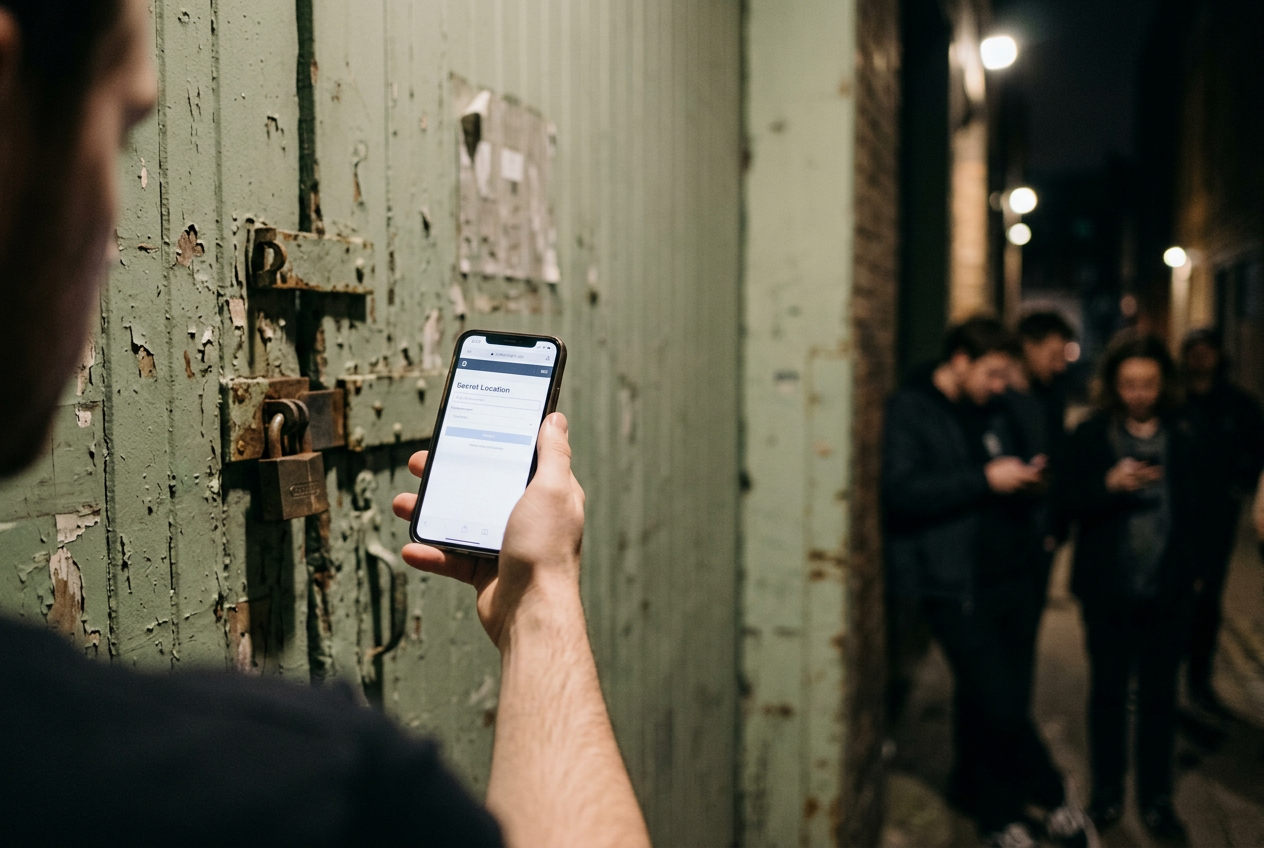
An archived Resident Advisor listing for UNTER, the long-running queer techno party in New York, contains the essential contradiction in two words: “Secret Location.” The venue field withholds the warehouse address, while the page around it performs the usual work of online commerce. There is an event description. There are ticket categories.
There is an account login, a payment flow and, once purchased, a digital ticket tied to a buyer.
That “Secret Location” line is more than scene-setting. It shows how underground nightlife has separated secrecy into parts. The room can remain undisclosed while the event, transaction and audience become legible to companies whose business depends on making them legible.
UNTER did not invent this arrangement. Parties across club culture use public listings with private location drops, semi-private ticket links passed through group chats, or approval systems that place a thin membrane between discovery and purchase. The room feels secret. The transaction is ordinary.
Secrecy now starts after discovery
A warehouse party once relied more heavily on flyers, phone trees, record shops, trusted promoters and cash at the door. Those systems leaked too, and nostalgia tends to remove the tedious parts: uncertain turnout, counterfeit directions, door congestion and the promoter discovering at 2 a.m. that enthusiasm does not pay the sound rental.
Advance ticketing solves a real problem. Promoters face costs before anyone dances. Artists need deposits. Sound, lighting, security, toilets, insurance where available, transport and harm-reduction supplies require money or a promise backed by credible sales.
Presales turn a possible crowd into working capital and tell the organizer whether the room will be dangerously full, embarrassingly empty or somewhere useful between.
The invite link helps regulate that demand, but it does not make the event private. An unlisted link, meaning a page omitted from ordinary search and platform browsing, still works for anyone who receives it. It can move from a trusted chat to a larger Discord server in seconds. Screenshots travel.
Promoters may cancel ticket orders or screen names at the door, yet every extra approval step costs labor and slows sales.
Resident Advisor occupies a particularly useful position here because it is both cultural guide and ticket seller. A listing can reach people already sorted by city and musical interest, while the platform handles checkout and digital admission. That audience is valuable precisely because it exceeds the promoter’s immediate circle. It also weakens the original boundary.
The system fills the room by making the party findable enough.
Return to the UNTER listing. “Secret Location” conceals the final turn in the journey. The page still reveals that an event exists, roughly where it will happen, when people should be available and which crowd might attend. For many parties, that is enough information for neighbors, landlords, opportunistic resellers or authorities to begin paying attention.
The ticket is a bundle of records
A digital ticket is usually presented as a QR code, a square barcode scanned at entry. Operationally, it sits at the end of several linked records: the purchaser’s account, payment authorization, order time, ticket type, communications and scan status. Depending on the platform and organizer settings, the promoter may receive an attendee list containing names and contact details, while the platform and payment companies retain their own transaction records under their policies and legal obligations.
This does not mean a city agency is watching every techno purchase. It means the infrastructure creates material that cash at the door would never produce, and some of that material can be requested through legal process, disclosed under platform rules or exposed through an account compromise. A secret address offers no protection to the buyer list already sitting elsewhere.
Centralization also identifies the seller. Ticket platforms and payment processors need an accountable party because card payments can be disputed, refunded or investigated. They may verify identity, banking details and business information before releasing funds. The organizer can use a collective name on the flyer; the payout still has to arrive somewhere.
That requirement shifts risk unevenly. Queer parties, migrant-run events and Black underground scenes often value controlled location sharing for reasons beyond mystique, including harassment, hostile policing and the physical safety of guests. A centralized service can reduce chaos at the door while collecting the very records that make a community easier to map. The promoter accepts that exposure because refusing it can mean relying on cash flow, manual spreadsheets and a smaller pool of buyers.
The clean interface hides the bargain. You get a QR code. The platform gets a transaction it can classify.
The location drop is a timed leak
Sending the address on the day of the party reduces the period during which it can circulate. It does not guarantee secrecy. The location drop must reach hundreds or thousands of people quickly, which usually means email, SMS, an app notification or an account page. Each method creates another dependency at the most fragile point in the night.
Spam filters can catch the message. Phone numbers may be mistyped. Ticket buyers forward the email to friends arriving separately. Support requests spike while the promoter is dealing with production.
If the platform suspends the event or an email provider restricts the account, the organizer may lose the fastest route to people who have already paid.
A late address also transfers uncertainty to the audience. Buyers commit money before they know the travel time, accessibility of the building or surrounding transport options. That burden lands hardest on disabled guests, people traveling alone and workers with fixed schedules. Secrecy protects the room, but it can make attendance depend on having spare time, flexible transport and tolerance for a plan changing after midnight.
The UNTER page’s “Secret Location” field therefore sells two things at once: admission and deferred information. The delay can be necessary. It can also become branding, allowing a professionally ticketed event to retain the social charge of something passed hand to hand.
Refund rules decide who carries the failure
The arrangement becomes clearest when the party moves or gets canceled. Eventbrite lets organizers publish their own refund policies. DICE uses features including ticket transfer and, for eligible sold-out events, a waiting list through which a returned ticket may find another buyer. Resident Advisor offers resale or transfer tools in certain circumstances.
Across these systems, eligibility depends on platform rules, event settings and whether the organizer has formally canceled or postponed the event.
Those distinctions matter when a warehouse falls through hours before doors. A promoter may try to relocate rather than cancel because money has already gone to production and artists. A buyer who cannot reach the replacement site may see a material change; the platform may still wait for the organizer’s decision before processing refunds. Booking fees can receive different treatment from ticket face value under published terms.
Then comes the chargeback, a cardholder’s request for their bank to reverse a disputed payment. Too many disputes can lead to delayed payouts, reserves or account restrictions, depending on the provider and its assessment of risk. The platform protects itself first because it sits between the card network and an event that may have disappeared overnight. The promoter can lose access to incoming money exactly when refunds, replacement equipment or a new room require cash.
This is where centralized tools gain practical authority over underground culture. They do not need to ban a genre. They can remove a listing under their terms, pause payments while reviewing risk, reject an event that appears unlawful or unsafe, or close an account after disputes. Each action may be defensible in isolation.
Together they give a handful of commercial systems the ability to interrupt a scene without understanding why the event withholds its address.
Going offline has a price
Promoters can reduce the trail. They can sell fewer advance tickets, accept cash, maintain their own mailing lists and reveal locations through smaller trusted networks. Each choice exchanges platform exposure for another cost: more administrative work, less predictable income, slower communication and a door operation carrying more money.
Self-hosted ticketing still needs payments unless the event runs on cash or cryptocurrency, and both introduce their own access and security problems. A cooperative platform could set policies around community safety and data retention, but it would still need technical maintenance, support staff, fraud handling and enough events to survive. Independence requires infrastructure. Somebody pays for it.
The useful distinction is not between authentic underground parties and compromised online ones. The mechanism is harsher. Expensive, precarious rooms force organizers to know attendance before opening, while digital presales provide that knowledge by centralizing identity, communication and money. The address remains the one detail they can hold back.
On the old UNTER listing, “Secret Location” still sits inside the ticket platform’s orderly frame. The warehouse is absent. The commercial record is ready.
Questions people ask
Can a secret warehouse party be traced through ticket sales?
Ticket sales can create records held by the organizer, ticket platform, payment processor and buyer’s bank. Those records do not automatically reveal the warehouse address, but they can identify the event, purchasers, payout destination and communications, and some may be disclosed through legal process or a security breach.
Why do underground parties use Resident Advisor, DICE or Eventbrite?
Advance ticketing gives promoters money before doors open, helps estimate attendance and reduces cash handling and door delays. Large platforms also bring discovery, customer support and scanning tools. The tradeoff is dependence on platform policies, payment reviews and databases that sit outside the scene’s control.
Does a last-minute location drop keep a party secret?
It shortens the time available for the address to spread, which can reduce unwanted attention. It cannot stop buyers from forwarding the message, and it makes the organizer dependent on email, text or app delivery at the moment when a failed account or blocked message is hardest to fix.
Who pays when a warehouse party is canceled?
The answer depends on the organizer’s refund policy, the platform’s terms and what money has already been spent. Buyers may receive the ticket price while losing some fees, and organizers can face refund demands or payment disputes after paying artists and suppliers. Platforms can delay payouts or restrict accounts while they assess the event.
One update a day
Today's story, in your inbox
One story each morning — no hype, no filler, no algorithm deciding for you.