Your Smart Intercom Can Put Every Guest in a Landlord Log
A ButterflyMX guest link looks like a temporary key. Behind it sits an access system that can connect tenants, visitors, door events and property management.
August 23, 2026 · 8 min read
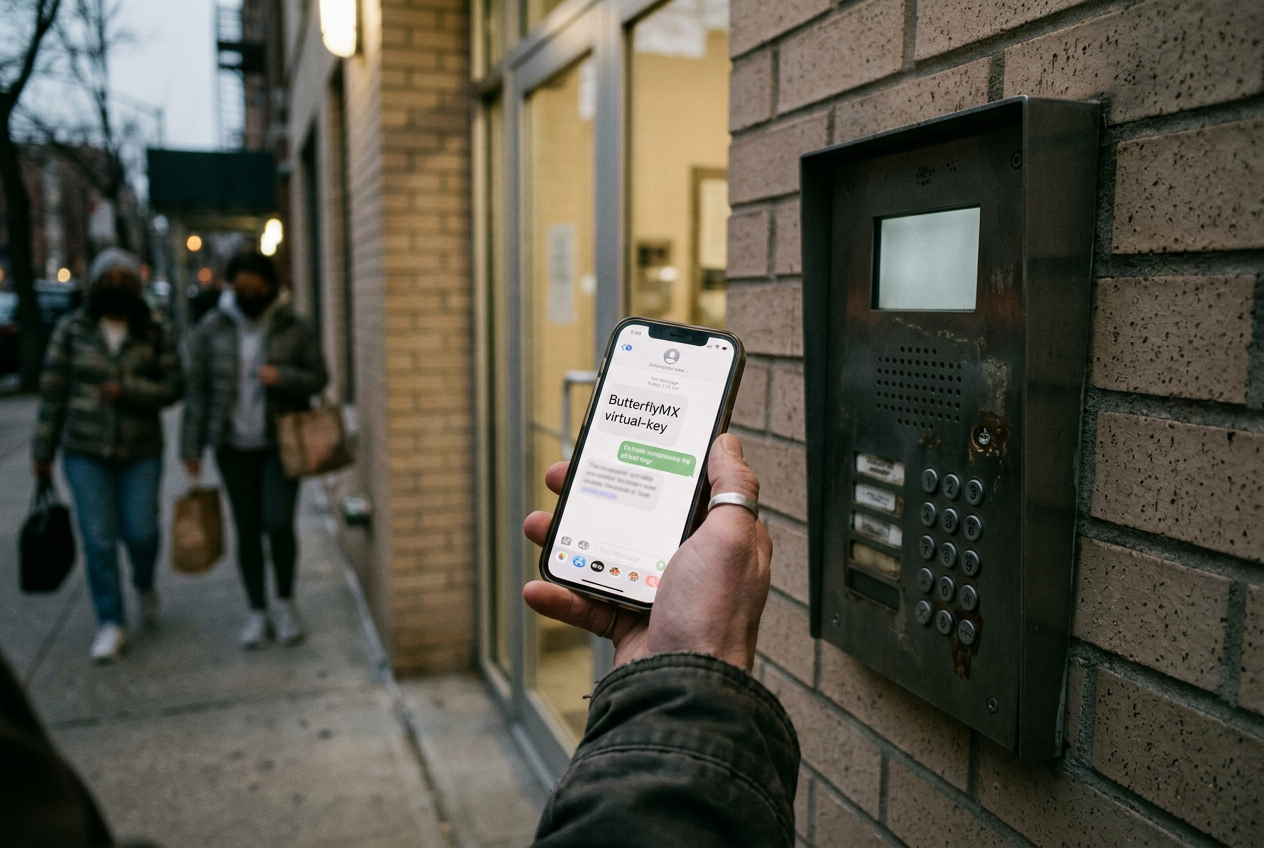
A ButterflyMX virtual key sitting in a guest’s text thread does not look like surveillance infrastructure. It looks like a favor. Tap the link, approach the building, open the door. No wait by the intercom.
No missed call because your host left a phone on silent.
The link is also a record waiting to happen. To generate it, a resident account must exist inside a property database. The system may know which unit issued the credential, when it became valid, when it was used and which entrance received the command. Depending on the building’s hardware and configuration, an entry event can also carry an image from the intercom camera.
The old buzzer revealed that somebody pressed apartment 4B. The app-based door can preserve who authorized the visit and when the authorization worked. That distinction is the business model.
The door became an identity system
A conventional intercom is mostly a circuit. A visitor selects an apartment, a resident answers, and somebody presses a button that releases the lock. Unless a separate camera or security desk records the encounter, the system does not need a persistent account for either person.
Smart entry changes the unit of access. ButterflyMX, Latch and similar property-technology vendors sell systems in which the property creates resident profiles and assigns permissions. A mobile credential, meaning a digital token on a phone that can authorize an unlock, replaces or supplements the key, fob and buzzer. Residents can then issue time-limited credentials to guests, contractors or cleaners.
ButterflyMX’s public materials promote virtual keys alongside centralized property administration and access history. Its documentation tells managers how to manage residents and review door activity, while its privacy materials describe the collection of account, device and service-use information. The exact fields available to a manager depend on the product, contract and permissions selected by the building. The important point is less glamorous: logging is a normal system function, not an accidental exhaust pipe.
An audit trail is a chronological record of system events. In access control, it can answer which credential requested which door at what time and whether the request succeeded. That is useful when a lock fails or a package disappears. It is also a compact map of domestic association when one resident repeatedly sends credentials to the same visitor, home-care worker, organizer or partner.
The map is partial. It does not show where someone went after leaving the lobby. It does not need to. Presence at a residential address, tied to a unit and timestamp, can already disclose more than a landlord needs to collect rent or repair a boiler.
The guest link is the receipt
Return to that ButterflyMX link. A resident can send it because management first enrolled the resident, connected the account to a unit and allowed that account to create guest access. The visitor may avoid downloading an app, but the building has not become anonymous. The credential still carries its relationship to the issuing account.
That relationship is what makes the feature convenient. Management can revoke access without changing a lock. Residents can admit somebody without being home. Staff can investigate a failed release without standing in the lobby and guessing.
The same architecture makes visits searchable after the person has left, because a database must distinguish an active credential from an expired one and associate the unlock request with the correct property.
A paper guest book made its surveillance function obvious. It sat at a desk and demanded a name. The virtual key hides the ledger behind the successful opening of a door, at the exact moment when neither resident nor visitor has much reason to interrupt the transaction and inspect a privacy policy.
Visitors also occupy an awkward contractual position. The tenant may have accepted app terms, perhaps through clickwrap, the screen that requires a user to press an acceptance button before continuing. The property owner has a separate commercial agreement with the vendor. A guest receiving a link has neither the leverage of the buyer nor the continuing account relationship of the resident, yet the guest’s arrival can still enter the buyer’s system.
Consent arrives after the housing decision
Privacy policies tend to describe categories of information, service providers, security practices and legal disclosures. They rarely answer the question that matters at 11:40 p.m. with groceries in both hands: whether the tenant can refuse the app and still enter the apartment on equal terms.
Housing makes ordinary platform consent unusually thin. Declining a social app costs access to that app. Declining a building’s designated entry system may cost time at the door, access to guest features or the ability to receive a delivery. If management has removed the working buzzer or treats physical credentials as an exception, acceptance becomes part of occupying the home even when the lease never uses the phrase movement data.
The commercial customer is usually the owner or manager. The resident is an end user administered by that customer. This division matters because the customer commonly controls enrollment and offboarding, while the vendor operates the software and stores data under the service arrangement. When a tenancy ends, management can disable the credential immediately.
Whether every associated log, visitor link, image and backup disappears on the same schedule is a separate question governed by product settings, contracts and applicable law.
New York City’s Tenant Data Privacy Act shows that lawmakers can recognize this imbalance. The law applies rules to smart-access buildings, including consent, privacy policies, data safeguards and restrictions on how owners use or sell access data. It also treats biometric information as especially sensitive. Those protections are local, however, and they do not change the national sales pitch: install a managed doorway first, then route residents through its terms.
A face makes the credential harder to replace
Some building systems go further than a phone. Swiftlane markets facial recognition alongside mobile access and video intercom features. Facial recognition converts measurements from an image into a biometric template, a mathematical representation used to compare a person’s face with an enrolled reference.
The template is attractive to access vendors because a resident cannot forget it upstairs. That permanence is the problem. A password can be changed after a breach. A face cannot.
Camera angle, lighting and algorithmic performance can also affect a match, turning an error into a denied entrance rather than a bad photo suggestion.
Public reporting on Atlantic Plaza Towers in Brooklyn made the stakes visible when tenants fought a proposed facial-recognition entry system. Their objection was not technophobia. A landlord controls the place where refusal has consequences, and facial enrollment would have placed a durable bodily identifier inside that relationship.
Laws such as Illinois’s Biometric Information Privacy Act impose consent and retention obligations in covered circumstances, while other jurisdictions provide much less. The unevenness helps vendors sell one product into buildings governed by radically different rules. Hardware may be standardized. Tenant power is not.
The buyer gets the dashboard
Property technology companies sell owners a reduction in friction. Remote credential management can reduce key replacement, simplify turnover, route deliveries and let staff handle doors across multiple properties. The vendor gets paid for hardware, software or continuing service. The owner gets an administrative layer over the entrance.
Residents receive convenience, but they do not usually choose the vendor, negotiate the retention period or design staff permissions. Nor do they necessarily get a dashboard showing which property employee searched their unit, opened an image or exported a report. A system can maintain role-based access, which limits each staff account to approved functions, without giving tenants visibility into how those roles were assigned.
This is where the word private matters. Government surveillance attracts constitutional rules, records requests and public debate, however incomplete those restraints may be. A landlord’s access log sits inside a private commercial system. Police may later seek records through legal process, but management does not need to be police to use a log during a dispute, investigate an unauthorized occupant or scrutinize visits that it considers suspicious.
The architecture works because every participant is offered a narrow convenience. The guest avoids waiting. The tenant avoids a key handoff. The manager avoids rekeying.
The vendor turns those solved inconveniences into a recurring service relationship whose durable asset is control over the credential layer.
A less extractive door is possible
A smart entrance does not have to become an unlimited domestic ledger. Buildings can keep working physical keys or fobs available without a penalty, preserve a direct buzzer option for visitors and collect only the event data needed to operate the lock. Short retention should be the default. Biometric enrollment should never be the price of entering one’s home.
Residents also need plain notice that names the fields being recorded, who inside management can view them and when the vendor deletes backups. An access system should log staff access to tenant records and expose that history to the affected resident. Guest credentials can expire without preserving a long-term association graph. Door security does not require a permanent social archive.
The ButterflyMX virtual key in the text thread would still work under those conditions. It would open the entrance, expire on schedule and leave behind no more than the building needs to confirm that the lock functioned. Convenience is real. Indefinite observation is a product choice.
Questions people ask
Can my landlord see every time I enter the building?
Possibly, depending on the system, configuration and staff permissions. App unlocks, mobile credentials and fobs commonly create access events tied to an account. Ask for the building’s privacy policy, retention schedule and a description of the fields visible in the management dashboard rather than assuming the intercom behaves like an old buzzer.
Does every smart intercom use facial recognition?
No. Many systems rely on apps, links, PINs or fobs, while products such as Swiftlane also offer facial recognition. A camera at an intercom does not by itself prove biometric matching is active. The relevant questions are whether the system creates a face template, where it stores that template and whether another credential works equally well.
Can a visitor use a smart intercom without being logged?
A visitor may avoid creating an app account, but a virtual key can still produce an event connected to the resident who issued it. A traditional buzzer or staffed entrance may create fewer identity-linked records, although cameras and separate security systems can still record the visit. The building should disclose which route creates which data.
What fallback should a tenant have?
A working physical key, fob or direct buzzer keeps entry from depending entirely on a charged phone, an active account and the vendor’s servers. The fallback should not carry an extra fee or require repeated staff approval. Before an outage, test the physical credential and ask management in writing whether it will remain active.
One update a day
Today's story, in your inbox
One story each morning — no hype, no filler, no algorithm deciding for you.